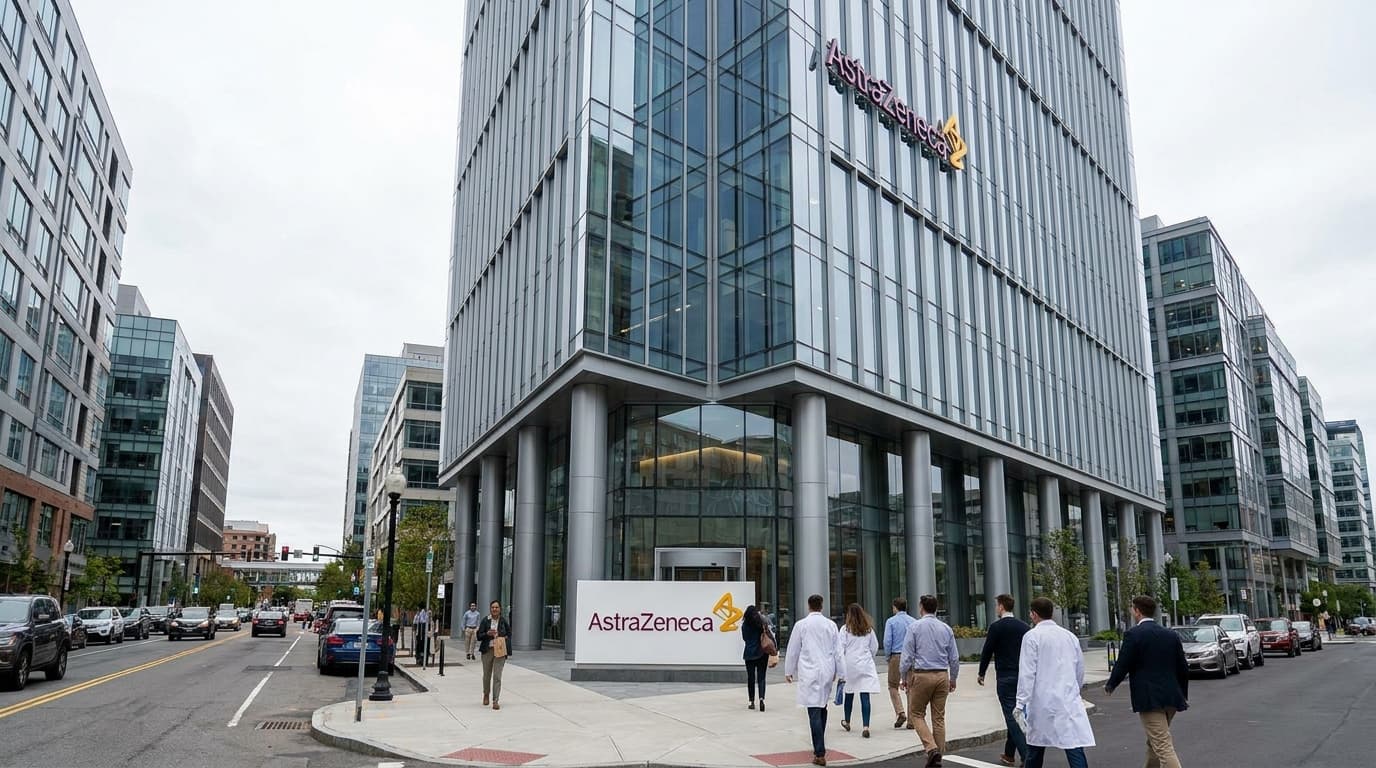
AstraZeneca opened a new 570,000-square-foot R&D center in Kendall Square on Monday, adding a major Cambridge site that the company says will house nearly 2,000 researchers and scientists.
The 18-story building includes 10 floors of interconnecting laboratories and office space. AstraZeneca has said the setup is intended to support "seamless science" through technologies that integrate robotics, continuous automation and agentic AI, while research teams there work on drugs for chronic obstructive pulmonary disease, obesity and metabolic disease, breast cancer and rare diseases.
The Site And Strategy
The opening extends AstraZeneca's existing footprint in the Boston area, where the company already has an earlier Kendall Square outpost and another site in Boston's Seaport neighborhood. This new center is part of AstraZeneca's $1 billion commitment to Massachusetts, alongside a plan to increase its workforce in the state by over 50% "in the coming years."
Executives framed the new building less as a standalone facility than as a way to embed more deeply in the local concentration of hospitals, academic institutions and biopharma companies. Sharon Barr, AstraZeneca's head of biopharmaceuticals R&D, said being in that ecosystem would let the company work alongside scientific and research talent in the area. The building sits next to the Broad Institute of MIT and Harvard and near Thermo Fisher Scientific's gene therapy manufacturing site.
That positioning matters because large drugmakers are still concentrating research capacity in places where talent recruitment, external collaborations and platform access can happen in close proximity. In that sense, the center is an operating choice as much as a real-estate one.
Research Focus
At the ribbon-cutting ceremony, cancer drew the most discussion. CEO Pascal Soriot said, "The day when we can cure many cancers is not far—even metastatic cancers," and highlighted cell therapies and T cell engagers as promising areas.
AstraZeneca said the building will also support work in biologics and cell therapy. The inclusion of automation and agentic AI fits the industry's broader push to improve research efficiency and decision-making inside large R&D networks, rather than treat AI as a separate program.
Soriot also emphasized the building's environmental design: it is all-electric, runs on renewable energy and uses a water recycling system to reduce waste. Massachusetts Governor Maura Healey linked the opening to the state's 2024 Mass Leads Act, a $4 billion economic development move intended to help keep the region competitive for investments like AstraZeneca's.