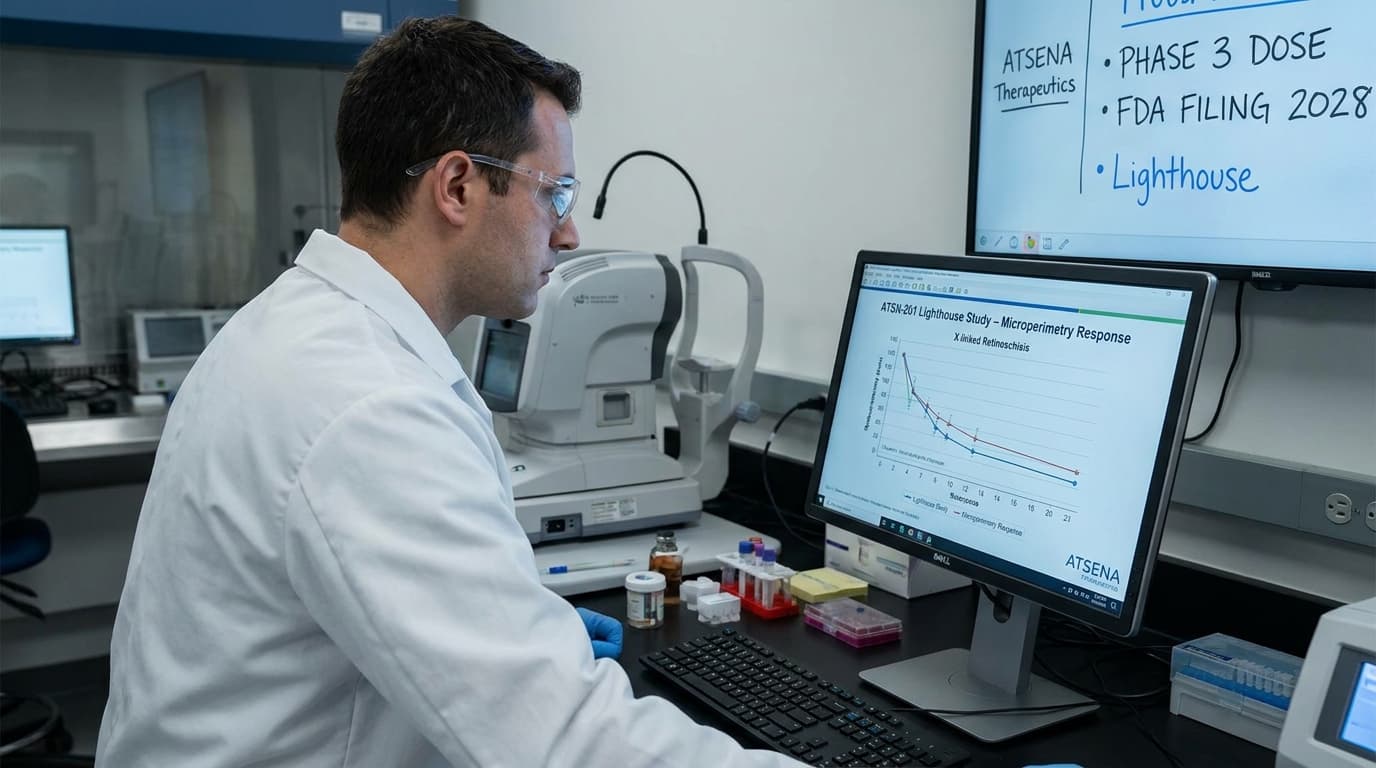
Atsena Therapeutics has posted an early efficacy signal for its X-linked retinoschisis gene therapy ATSN-201, giving the company a more concrete basis for the phase 3 portion of its Lighthouse study and a stated path toward an FDA filing by the end of 2028.
The update comes from the first two parts of the phase 1/2/3 trial, which enrolled 18 treated patients and three untreated controls. For a rare eye disease that the source says lacks approved, disease-specific treatments, the practical question is no longer whether ATSN-201 can produce isolated signs of activity, but whether the effect looks consistent enough at the selected dose to support a registrational push.
The data
Across the first two parts of Lighthouse, Atsena administered different doses and volumes of ATSN-201 into one eye in 18 patients with X-linked retinoschisis. Another three patients formed an untreated control arm.
Half of the 18 treated patients met the microperimetry response criteria. That matters because microperimetry, which measures retinal sensitivity, is the primary endpoint in the phase 3 part of the trial. One of the 18 patients also had a microperimetry response in the untreated eye.
At the dose Atsena selected for phase 3, six of nine patients responded on microperimetry, while none of the three control patients did. The company said it chose the lowest dose for phase 3 because it showed a consistent efficacy profile and a more favorable tolerability profile than higher doses.
The visual acuity findings add support, though they are not presented as the primary registrational measure. Eight of the nine patients who received the phase 3 dose started with baseline visual acuity worse than 20/40, which the source describes as the threshold commonly required for driving eligibility in the U.S. At the latest assessments, three patients had visual acuity of 20/40 or better, another three had improved visual acuity, and two were unchanged.
In the full 18-patient dataset, 12 people met the optical coherence tomography response criteria and nine were visual acuity responders. Among patients who received the phase 3 dose, five were optical coherence tomography responders.
Why the dose choice matters
Atsena's decision to carry forward the lowest dose is a useful signal in a gene therapy field that has often had to trade activity against tolerability. Here, the company is arguing it did not need to push exposure higher to preserve efficacy. If that holds in the next stage, it could strengthen the package not just clinically but also from a review standpoint, because the chosen dose is already tied to both response and tolerability in the company's own dataset.
What comes next
Atsena said it expects to complete enrollment in the third part of Lighthouse in the first quarter of next year. That timeline puts the company on track to report data in the first half of 2028 and file for FDA approval by the end of that year.
The commercial backdrop is straightforward even from a limited dataset: X-linked retinoschisis affects about 30,000 men in North America and Europe, and multiple groups have studied possible therapies without producing a treatment. For Atsena, that means the next phase is less about proving interest in the target and more about showing that the early efficacy pattern can survive the larger, approval-oriented part of the study.