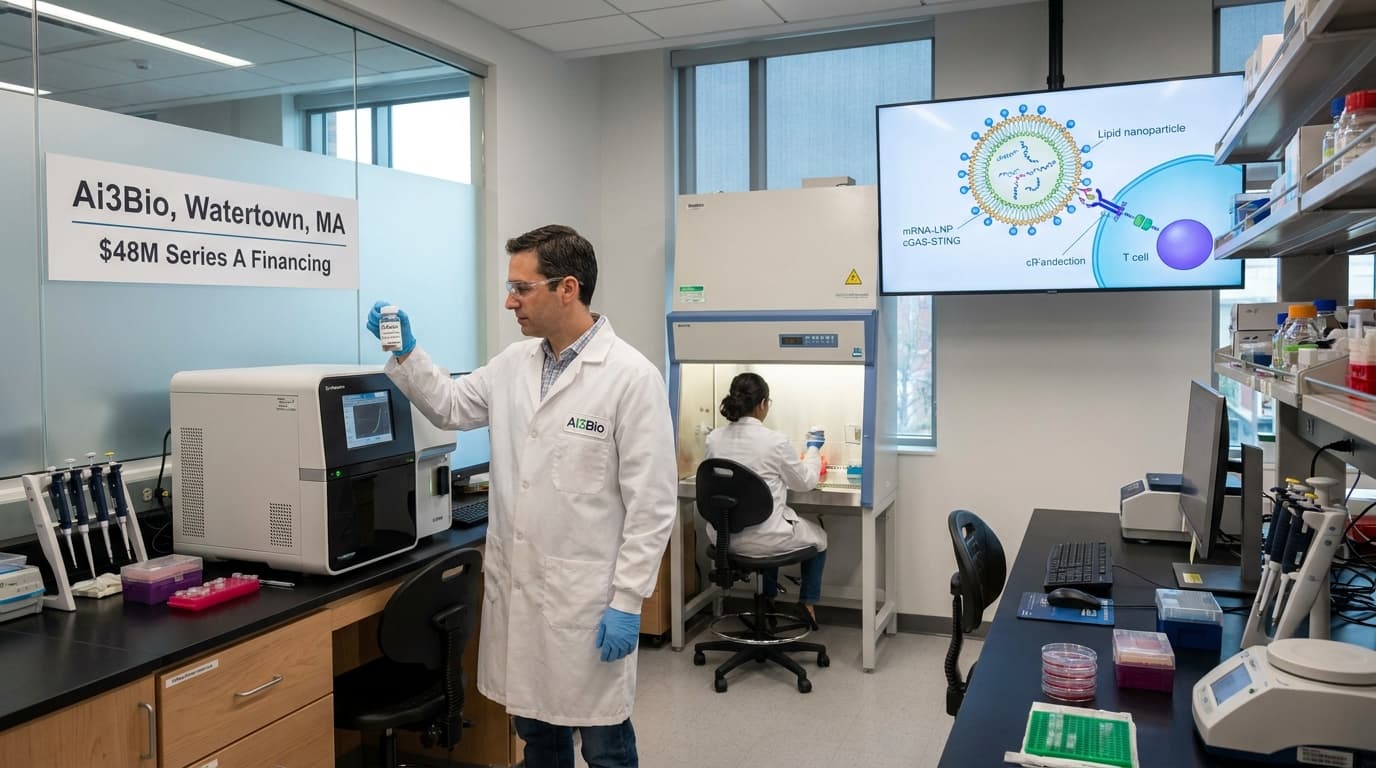
Ai3Bio has come out of stealth with $48 million in financing and a strategy that tries to narrow the meaning of immune reset. Rather than reprogramming one immune-cell population to attack another, the company is developing a therapy intended to make pathogenic cells self-destruct through a built-in cellular pathway.
The Watertown, Massachusetts-based startup said the funding will support a pipeline that could begin its first tests in humans next year. In a field where many companies are pursuing ways to eliminate disease-driving immune cells and let the immune system rebuild, ai3Bio is arguing that more selective depletion could matter as much as depletion itself.
The Science
Ai3Bio’s first target is Th17 cells, a helper T-cell subtype that helps fight infections but, when overactive, contributes to autoimmune disease. Existing medicines already address IL-17, the signaling protein secreted by Th17 cells. The source names Novartis’s Cosentyx, Eli Lilly’s Taltz and UCB’s Bimzelx as blockbuster-selling IL-17 inhibitors approved in several immunological indications.
Ai3Bio’s argument is that those monoclonal antibodies block the signaling protein but do not stop the cells from continuing to produce it, which is why treatment must be chronic. CEO Steven Altschuler said the company’s approach could stop IL-17 at its source.
The therapy consists of a lipid nanoparticle delivering messenger RNA instructions that trigger cell death. A targeting antibody designed to bind CD161, a protein overexpressed on pathogenic Th17 cells, is meant to guide the therapy to those cells. Once there, the mRNA activates cGAS-STING, an immunological pathway that has drawn drug-hunting interest for nearly 20 years but, according to the source, still has no FDA-approved drugs targeting it.
Scientific co-founder Jonathan Kagan described the mechanism as delivering instructions for a cell to kill itself rather than “delivering a grenade into the cell.” That distinction is central to ai3Bio’s positioning: a therapy that is cytotoxic to the intended cell population without relying on broad immune ablation.
Why The Approach Stands Out
Ai3Bio says precision is the main differentiator. Kagan said the strategy is not intended to eliminate pre-existing memory T cells specific for threats such as cytomegalovirus or flu, preserving immune defenses that broader immune reset strategies can compromise. That is a notable commercial and clinical claim in a category where efficacy must be balanced against the cost of wiping out useful immunity.
The startup also argues it may have a safety advantage over immune reset approaches based on cell therapy. The source points to companies such as Cabaletta Bio and Kyverna Therapeutics, which are pursuing autoimmune diseases with CAR T-cell therapies made by ex vivo engineering of a patient’s T cells. It also notes that Johnson & Johnson entered a partnership over the summer on a Sail Biomedicines candidate that reprograms T cells in vivo to target pathogenic B cells, while AbbVie, Bristol Myers Squibb, Gilead Sciences and Eli Lilly have also struck deals for in vivo cell therapies.
Kagan said one known complication of cell therapies is cytokine release syndrome, which can follow the breaking open of disease-driving cells and release of cellular contents. He said ai3Bio’s approach is naturally immunosuppressive and does not come with that risk. The company is also highlighting logistical simplicity: Altschuler said its drug can be administered in a single step, without the preconditioning regimen often used ahead of cell therapy and without wiping out the immune system’s existing memory of past protections.
The Platform Behind It
Ai3Bio was formed by combining two startups, Corner Therapeutics and Novasenta. Corner contributed experience with lipid nanoparticles, along with research indicating that targeting the STING pathway in T cells would lead to cell death. Novasenta, launched by UPMC in 2021, brought an AI technology platform for identifying druggable targets; ai3Bio says that platform led to the CD161-targeting antibody now being used to pursue Th17 cells.
That makes ai3Bio notable not only as an immunology company but as an example of AI being used upstream in target and antibody selection rather than as the headline product. The nearer-term test is whether that combination of AI-enabled target finding and a complex delivery construct can produce selective depletion in humans, because the company’s precision thesis depends on doing more than hitting IL-17 biology indirectly.