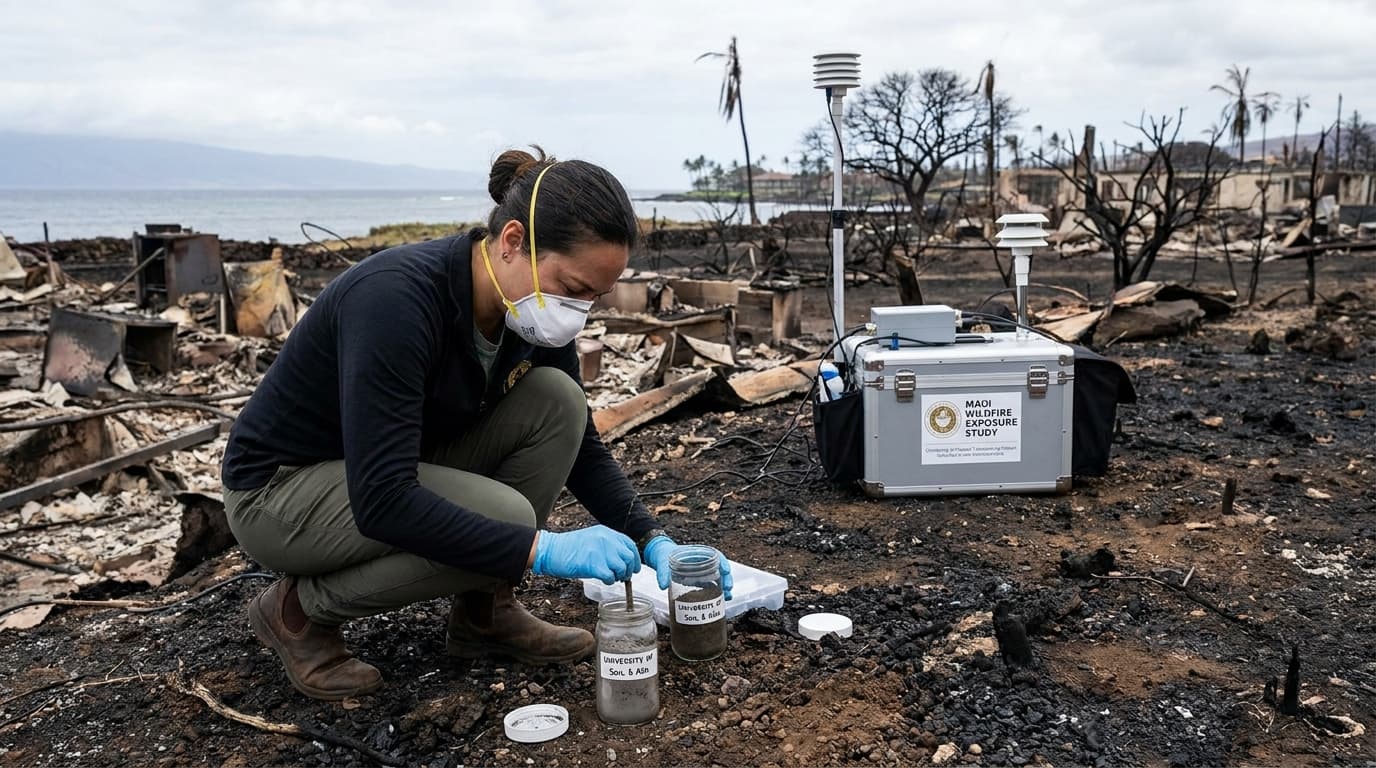
A new Maui wildfire study points to a longer health tail than standard smoke-exposure models capture. Researchers with the Maui Wildfire Exposure Study found substantially elevated concentrations of metals in 1,400 adults up to a year and a half after the 2023 fires, linking higher metal burdens to abnormal lung function in nearby residents.
The work, published in the Proceedings of the National Academy of Sciences, shifts the focus from the immediate burn period to what remains in soot, ash, debris and dirt after the flames are out. That matters because the Maui fires destroyed the town of Lāhainā, killed more than 100 people, and burned through buildings, vehicles, electronics and other materials that can leave a different chemical signature than vegetation fires alone.
The Findings
University of Hawai‘i researchers reported elevated levels of metals including arsenic, cadmium, copper and antimony in participants’ urine samples. Among the comparisons to U.S. biomonitoring data, antimony was nearly 40 times higher in Maui participants, manganese was 3.8 times higher, barium 2.3 times higher and arsenic 2.2 times higher.
The study found that having more metals in the body was more likely to result in abnormal lung function during standard breathing tests, including lower breathing capacity and difficulty moving air in and out of the lungs. The geographic pattern of those effects also matched the distribution of smoke and ash, with residents nearest to Lāhainā, and Wailuku and Kahului, experiencing a different impact than those near Kula.
Alika Maunakea, co-principal investigator of MauiWES and a professor at the University of Hawai‘i, Mānoa, said the aftermath of the Lāhainā disaster created a more complicated mixture of chemical exposures than is typically studied after fires of this magnitude. In practical terms, that means post-fire public health surveillance may need to treat contaminated residue and re-exposure as part of the event, not as a separate cleanup issue.
What The Study Can And Cannot Say
The researchers said the study cannot determine exactly how much of the impact came directly from the wildfires versus chronic or other exposures, including Hawai‘i’s geology, diet, historic agricultural and industrial activity, and environmental sources. They do not have comparable data from before August 2023.
That limitation narrows the claim but does not remove the signal. The combination of elevated metals, lung-function findings and their geographic alignment with smoke and ash supports the case for persistent post-disaster exposure risk, even if the exact contribution from the fires cannot be isolated with precision.
Why It Matters
The strategic implication is broader than Maui. Ruben Juarez, co-principal investigator of MauiWES and a professor of health economics at the university, said climate-related disasters can alter environments in ways that continue after the immediate emergency is over. He added that floods, hurricanes, fires and other disasters can disturb soil, debris, buildings and legacy contaminants, creating new exposure pathways.
For health systems and recovery planners, the study argues for longer-term air-quality and exposure monitoring rather than treating risk as ending when visible danger disappears. Kekoa Taparra of the University of California, Los Angeles, who was not involved in the research, said the findings expand understanding of the fires’ health burden over an extended period. As fires become larger, faster-moving and more frequent in some regions, the commercial and policy challenge is not only emergency response but sustained environmental health surveillance afterward.