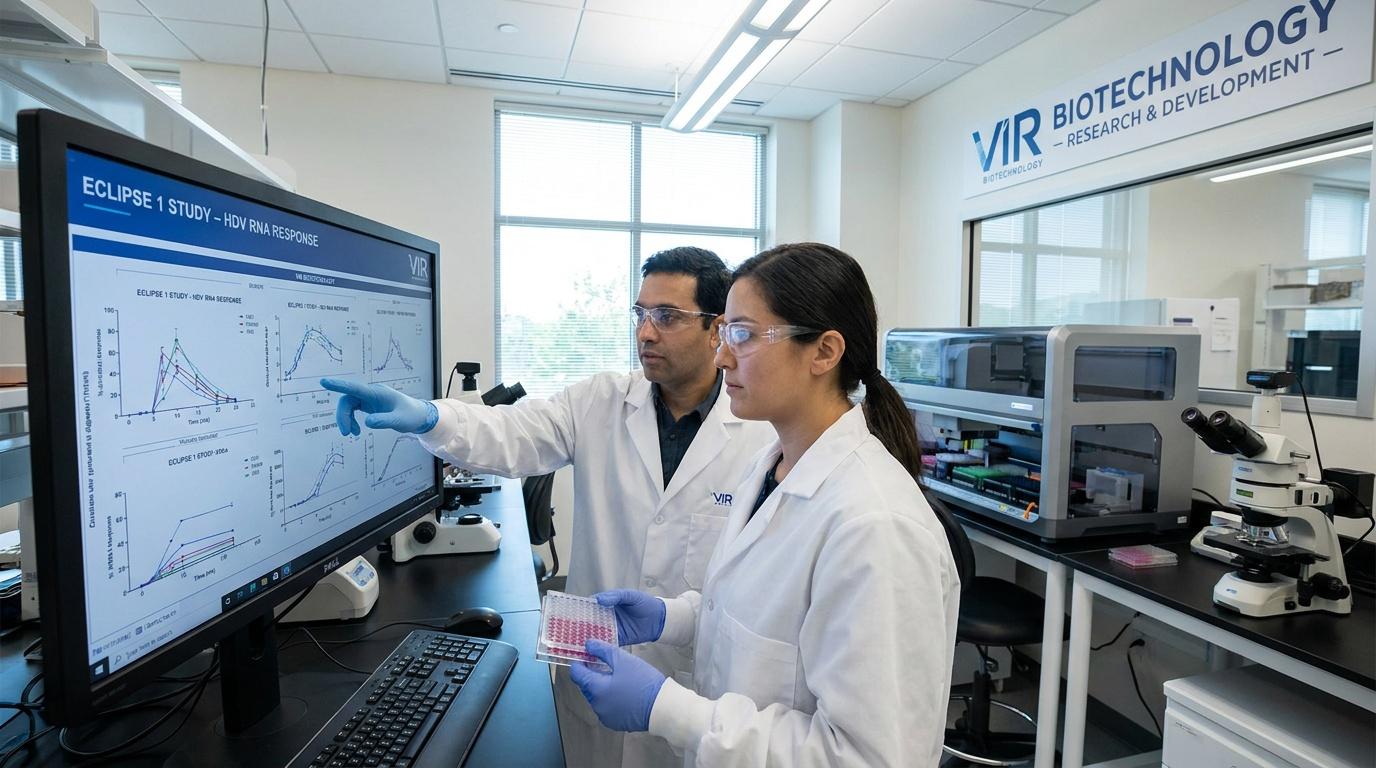
Vir Biotechnology said its phase 3 Eclipse 1 study in chronic hepatitis delta hit the primary endpoint, putting the company on track to assemble the first component of a planned U.S. filing next year and a broader approval package for mid-2027.
The result positions Vir more directly against Gilead, which won FDA approval for Hepcludex in chronic hepatitis delta in May, and Mirum Pharmaceuticals, which reported a phase 3 win for brelovitug in September. For Vir, the signal is not just that the trial worked, but that its combination now has late-stage data strong enough to support a claim of commercial relevance in what remains a nascent market.
The Data
Vir evaluated monthly subcutaneous elebsiran and tobevibart in 124 adults with chronic hepatitis delta. About two-thirds of patients started treatment immediately, while one-third began at Week 12.
At Week 48, 44% of patients in the immediate-treatment arm had undetectable hepatitis delta virus RNA and normal ALT levels, meeting the study’s primary endpoint. No patients in the delayed-treatment arm met the primary endpoint at Week 12.
Vir also highlighted secondary endpoint results from the immediate-treatment group at Week 48: 79% had undetectable virus levels, 53% had normal ALT levels, and all patients had either undetectable virus or at least a 2-log10 reduction in levels. In the delayed-treatment group at Week 12, the only response reported was a 5% ALT normalization rate.
Vir separately shared phase 2 findings showing that all 28 patients who completed 96 weeks of combination therapy had undetectable virus. In an exploratory analysis, 10 patients who stopped treatment continued to have undetectable virus levels after 12 to 48 weeks of follow-up. Vir said that analysis suggests curative potential.
The Competitive Picture
Cross-trial comparisons remain difficult because the studies were not run the same way. Fierce Biotech cited Leerink analysts saying Mirum’s enrollment of patients with severe disease is “a key point of differentiation.” Even with that caveat, Vir’s readout compares favorably on viral suppression to the benchmark data cited for Hepcludex.
After 48 weeks on Hepcludex, 20% of patients had undetectable HDV RNA and 56% had normal ALT levels, according to the source report. That does not establish superiority, but it does suggest Vir may have a candidate capable of competing on efficacy if later studies and regulatory review hold up.
Investors reacted quickly: Vir shares rose 17% to $14.25 in premarket trading Monday from a Friday closing price of $21.21.
Vir is still running two other phase 3 trials, including one comparing the combination directly with Gilead’s Hepcludex. Data from those studies are expected in the first quarter of next year, and Vir plans to use all three phase 3 trials to seek U.S. approval in mid-2027.