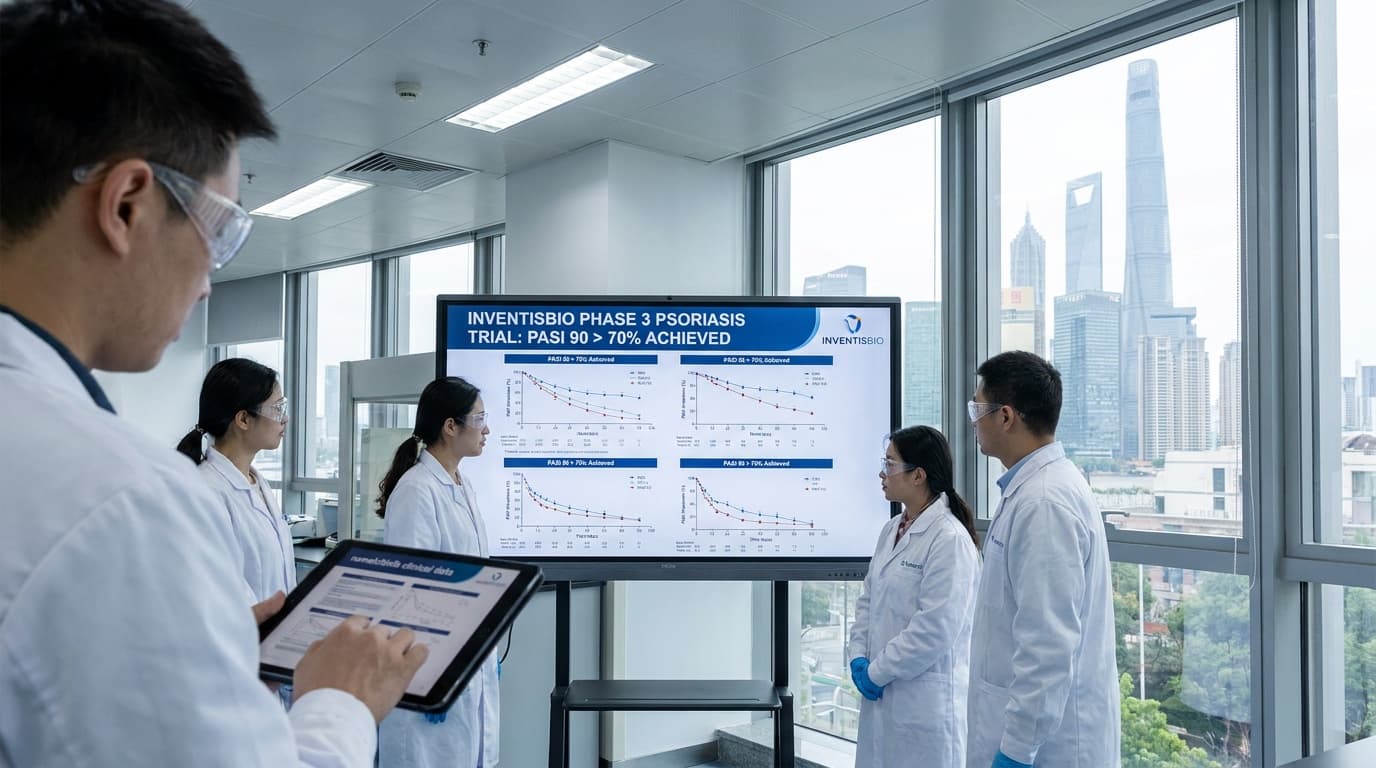
InventisBio reported a phase 3 win for nomelcitinib in psoriasis, saying more than 70% of patients in each of two treatment arms achieved at least a 90% improvement on the Psoriasis Area Severity Index at Week 16. The Shanghai-based biotech said the TYK2 inhibitor significantly outperformed placebo on the trial’s primary endpoint, although it has not yet shared the placebo rate.
The topline matters because oral psoriasis competition in TYK2 is now defined by increasingly narrow efficacy gaps. On the numbers disclosed so far, nomelcitinib appears competitive with other late-stage entrants, while the absence of new safety signals supports InventisBio’s effort to build the drug across multiple inflammatory indications.
The data
InventisBio randomized 391 people in China to receive one of two nomelcitinib regimens or placebo. At Week 16, more than 70% of patients in the two treatment arms reached PASI 90, a result the company said was in line with phase 2.
The company also reported success on a key secondary endpoint measuring the proportion of patients with clear or almost clear skin at Week 16. More than 80% of people receiving nomelcitinib met that response criterion, again significantly outperforming placebo.
InventisBio said no new safety signals emerged in the study.
Cross-trial comparisons are unreliable, particularly between Chinese trials and global studies, but the efficacy figure compares favorably with phase 3 PASI 90 rates disclosed for other oral competitors. Takeda reported Week 16 PASI 90 rates of 61.3% and 51.9% for zasocitinib, while Alumis reported 59.9% and 53.1% for envudeucitinib. Johnson & Johnson and Protagonist Therapeutics’ oral IL-23 receptor antagonist Icotyde posted PASI 90 rates of 50% to 55% in the adult trials that supported its FDA approval.
What it means for the TYK2 race
The strategic signal is that InventisBio is moving from being a regional developer with broad TYK2 ambitions to a company with phase 3 data that can be discussed alongside better-known competitors. That does not settle relative drug quality, because placebo results, full safety detail and direct comparisons are still missing, but it does give the company a clinically relevant proof point in a class that has already attracted large deal values.
InventisBio has global rights to nomelcitinib. Its Chinese R&D program also includes phase 2 trials in ulcerative colitis, psoriatic arthritis, systemic lupus erythematosus and vitiligo, reflecting the wider therapeutic scope investors have assigned to TYK2 inhibition.
The next differentiator may come from direct benchmarking rather than cross-trial reading. InventisBio started another phase 3 trial in China in January to compare nomelcitinib with Bristol Myers Squibb’s TYK2 inhibitor Sotyktu, a benchmark that Johnson & Johnson and Takeda have already beaten. The company is also running a phase 2 psoriasis trial in the U.S.