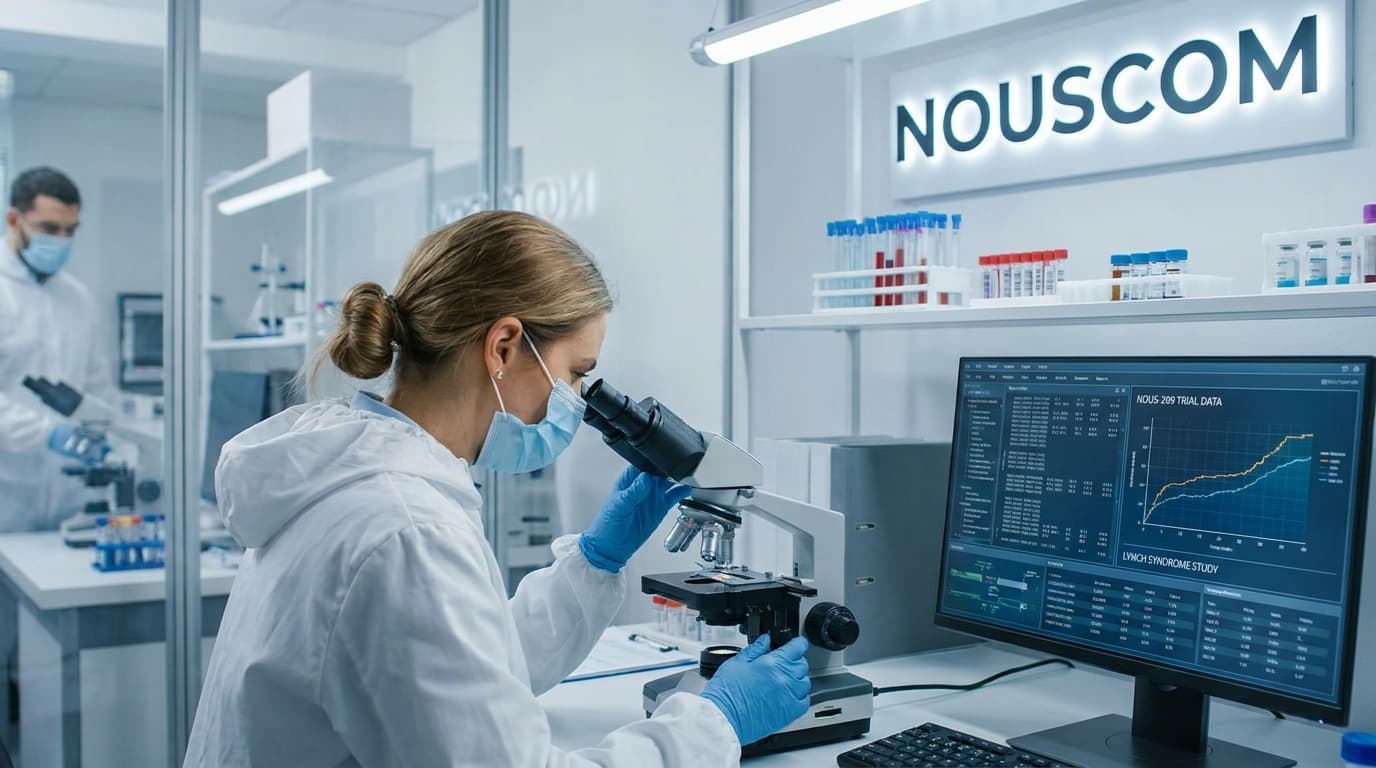
Nouscom has raised 120 million euros ($135 million) in a series D round to advance NOUS-209 into a global, registration-enabling clinical trial for cancer interception in Lynch syndrome carriers.
The financing centers on an off-the-shelf cancer immunotherapy designed for tumors with mismatch repair deficiency and microsatellite instability. Nouscom said NOUS-209 uses two viral vectors to deliver 209 shared frameshift peptide neoantigens, with the goal of training the immune system to recognize and attack cancerous and precancerous cells before tumors develop.
The data
Nouscom paired the financing with early evidence from a phase 1b/2 trial in Lynch syndrome. According to the company, all evaluable Lynch syndrome carriers who received the vaccine were free from advanced adenomas and colorectal cancer.
The biotech said it has one-year data on 43 patients and two-year data on 17 participants. Comparing those results with the expected cancer incidence in Lynch syndrome carriers, Nouscom said the study produced an encouraging signal of durable clinical activity. The trial also generated evidence of broad, potent and durable anti-neoantigen T-cell responses, and annual retreatment enhanced those responses.
Lynch syndrome is one of the most prevalent hereditary cancer syndromes, with a 50% to 80% lifetime risk of colorectal cancer, a 40% to 60% risk of endometrial cancer and increased risk of other tumor types. It is estimated to affect nearly a million people in the U.S., while remaining underdiagnosed and facing limited preventive options.
Why The Raise Matters
An investor syndicate co-led by M Ventures and Revelation Partners backed the round, with new investors Angelini Industries, the European Investment Bank and Neva SGR joining existing backers including 5AM Ventures and Andera Partners.
The strategic point is less the size of the round than what it is funding: a prevention-oriented cancer vaccine program moving toward registration. That stands apart from the better-known personalized vaccine efforts from Merck & Co. and Moderna, which tailor vaccines to each patient's tumor. Nouscom is instead betting that shared neoantigens recurrently found in Lynch syndrome patients can support an off-the-shelf product, a model that could be more scalable if late-stage data hold up.
Nouscom has a personalized program in its pipeline, but the company said the off-the-shelf candidate has been a priority throughout its decade-long history, including a 42 million euro financing round in 2017 that was earmarked to take NOUS-209 into the clinic.