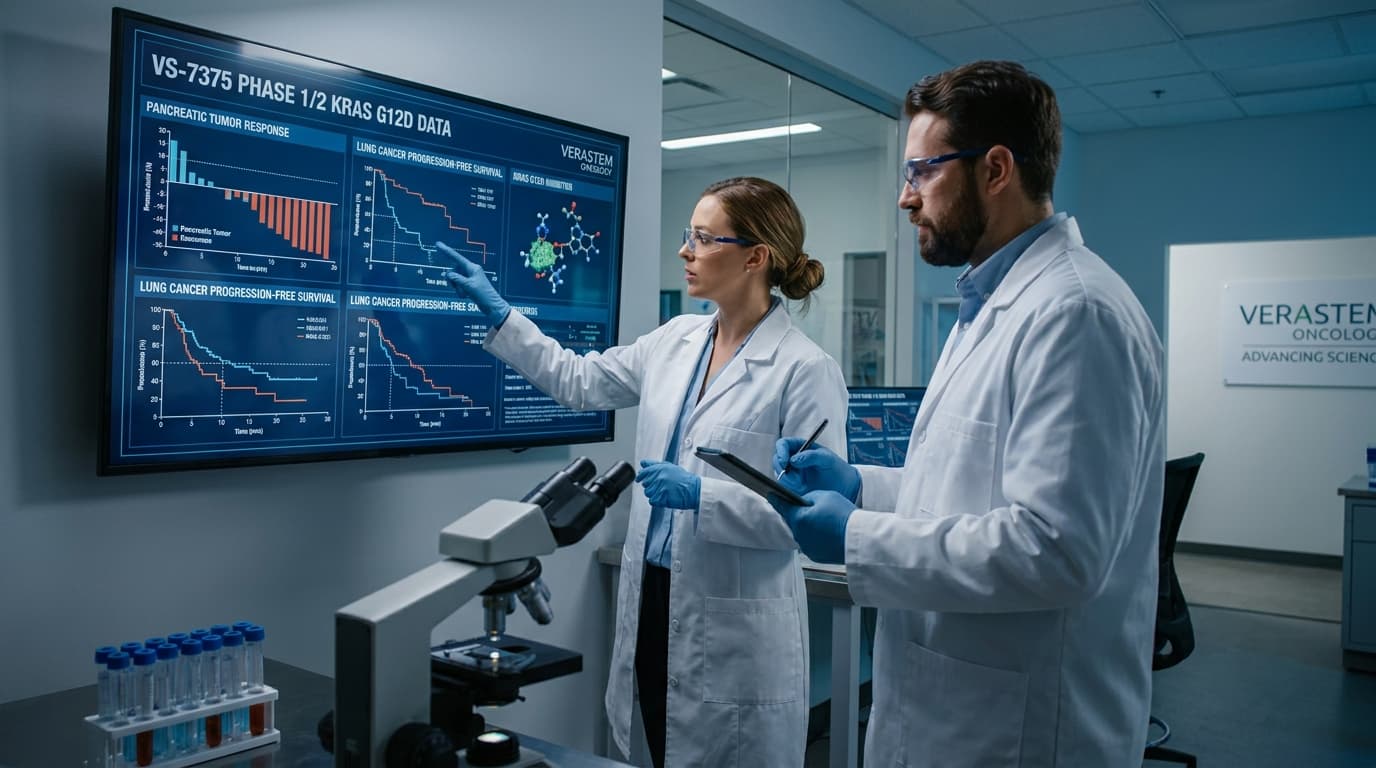
Verastem Oncology has put fresh weight behind its summer decision to refocus R&D on VS-7375, releasing early phase 1/2 data that the company says justify a rapid move into phase 3. The drug is being tested in more than 200 patients with advanced KRAS G12D-mutated solid tumors, with the headline readout centered on metastatic pancreatic ductal adenocarcinoma and non-small cell lung cancer.
The strategic importance for Verastem is straightforward: after its approved ovarian cancer combo regimen Avmapki and Fakzynja underwhelmed in a pancreatic cancer study, the company needed evidence that its KRAS program could become more than a pipeline reset. These data do not settle that question, but they do give Verastem a basis to pursue a registrational path in a tumor type where recent KRAS progress has already started to change competitive expectations.
The data
In 22 evaluable patients with metastatic pancreatic ductal adenocarcinoma who received a 900 mg daily dose of VS-7375, Verastem reported a 67% progression-free survival rate at six months and an 80% overall survival rate. Sixteen of those patients remained on treatment at the six-month mark.
The company also broke out response data in pancreatic cancer by line of therapy. Half of the eight pancreatic ductal adenocarcinoma patients treated in the second-line setting experienced a response. Across the broader group of 22 patients who received the drug in the second-line setting or later, 41% saw a response, including two complete responses.
In non-small cell lung cancer, Verastem reported that among 23 patients treated with a 600 mg daily dose of VS-7375, the confirmed objective response rate was 43% at 4.4 months, with a six-month progression-free survival rate of 72%.
VS-7375 is described by the company as an oral selective KRAS G12D inhibitor designed to engage the target in both its active, or ON, and inactive, or OFF, states. The G12D mutation represents 26% of all KRAS mutations, which the source describes as making it the most prevalent KRAS mutation in human cancers.
The competitive picture
The comparison investors are most likely to make is with Revolution Medicines' Rasonque, which won FDA approval in August for metastatic pancreatic cancer. Fierce Biotech reported that Rasonque previously showed a 36% confirmed objective response rate in the second-line setting and 21% in the third-line setting and beyond.
That does not make VS-7375 a winner on cross-trial math alone. The Verastem dataset is still early, cohort sizes are small, and management's own language was notably ambitious: CEO Dan Paterson said the company had "set a new benchmark in PDAC," while Chief Scientific Officer Jonathan Pachter said "we have a true blockbuster." The more durable signal is narrower. Verastem now has enough early activity in a hard-to-treat KRAS-defined population to argue that its program belongs in the same strategic conversation as the first approved agents in this class.
Manuel Hidalgo Medina of New York University said on the investor call that VS-7375 and RAS inhibitors more broadly are changing how pancreatic ductal adenocarcinoma is being managed and treated. For smaller oncology companies, that shift matters because it can create partnering leverage before definitive data arrive.
What comes next
Verastem said it will move VS-7375 into a phase 3 trial as a monotherapy and in combination with anti-EGFR therapy or chemotherapy, with the aim of launching the study by the end of the year. Paterson also said the company is likely to pursue some form of partnering, arguing that an ideal deal would make "the pie bigger."
That next step is the real test of whether this update is an investable inflection point or simply a strong early look. For now, the company has turned a pipeline refocus into a potentially registrational story, but it still needs larger and later-stage evidence to show the current efficacy signals hold up under a more demanding trial design.