Merck & Co. has released fuller data from the Brunello trial of remigromig in diabetic macular edema, and the added detail has intensified concerns about the drug’s competitive profile. While Merck had already said last month that its trispecific asset was noninferior to ranibizumab on the primary endpoint, the numbers now in view point to a tougher commercial path.
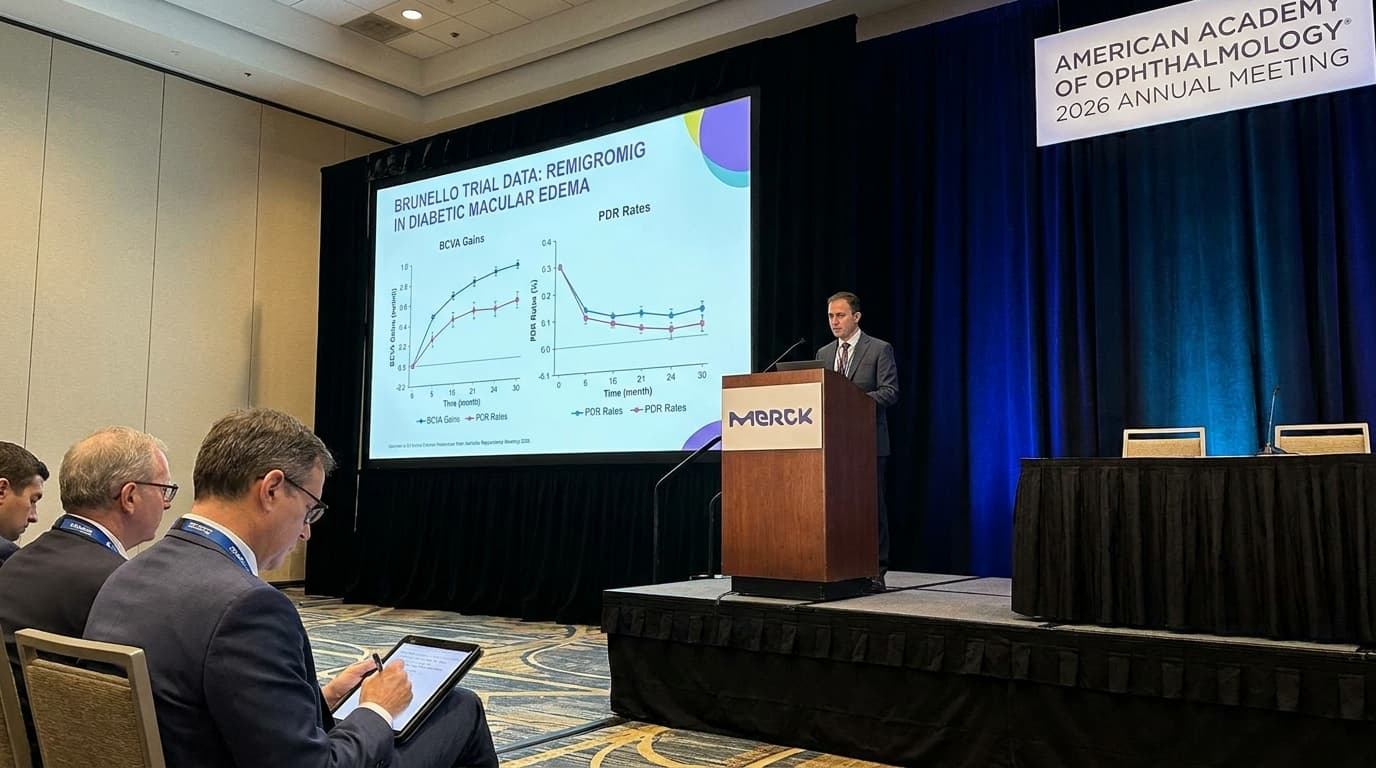
The issue is not whether remigromig produced activity, but whether it did enough to justify adoption in a market with established anti-VEGF therapies. Based on the Brunello results presented at the American Academy of Ophthalmology 2026 Annual Meeting, BMO Capital Markets analysts said they see “limited competitive potential” for the program.
The Data
The new disclosure put specific figures around the safety concerns that had surfaced in Merck’s topline release. Proliferative diabetic retinopathy affected 6.7% of participants taking remigromig 0.5 mg and 6.1% of participants taking remigromig 0.8 mg, compared with 0.9% for patients on Lucentis.
Treatment discontinuations due to adverse events also ran higher in the remigromig groups. Merck reported discontinuation rates of 4.9% for the 0.5 mg dose and 4.5% for the 0.8 mg dose, versus 0.9% in the Lucentis arm.
Efficacy did not offset those imbalances. After one year of treatment, mean gains on the BCVA eye test were 9.1 letters for remigromig 0.5 mg and 8.7 letters for remigromig 0.8 mg, compared with 11.8 letters for Lucentis. Merck also said no secondary endpoints showed remigromig was superior to ranibizumab.
Merck is performing additional analyses to further characterize the findings. The company said PDR rates may reflect natural disease progression in diabetic macular edema patients because remigromig focuses on repair and maintenance of the blood-retinal barrier rather than directly suppressing new vessel growth, and added that the PDR cases were generally manageable.
The Commercial Picture
The data matter because Merck paid $1.3 billion upfront in 2024 to buy the asset and the rest of Eyebiotech. Brunello now sets a high bar for any later dataset to materially improve remigromig’s positioning.
BMO Capital Markets analysts said the current profile appears to show weaker numerical efficacy and a less favorable safety profile than ranibizumab, and warned the imbalances could limit physician enthusiasm given the availability of established anti-VEGF therapies with proven efficacy and safety profiles. That is a sharper test than the primary endpoint alone, because noninferiority can preserve a development program without creating a clear reason to switch treatment.
Merck has taken a more positive view, with Merck Research Laboratories president Dean Li saying remigromig is the first new mechanism of action in more than 20 years to match anti-VEGF therapy in a pivotal diabetic macular edema study. Merck has also argued that 30% to 40% of diabetic macular edema patients are failed by existing VEGF drugs, framing unmet need as the opening for a differentiated mechanism.
Another phase 2b/3 trial in diabetic macular edema is ongoing, and Year 2 personalized treatment intervals could provide additional context. For now, though, the signal from Brunello is that novelty alone may not be enough if physicians see a less favorable risk-benefit trade-off than the one already available.