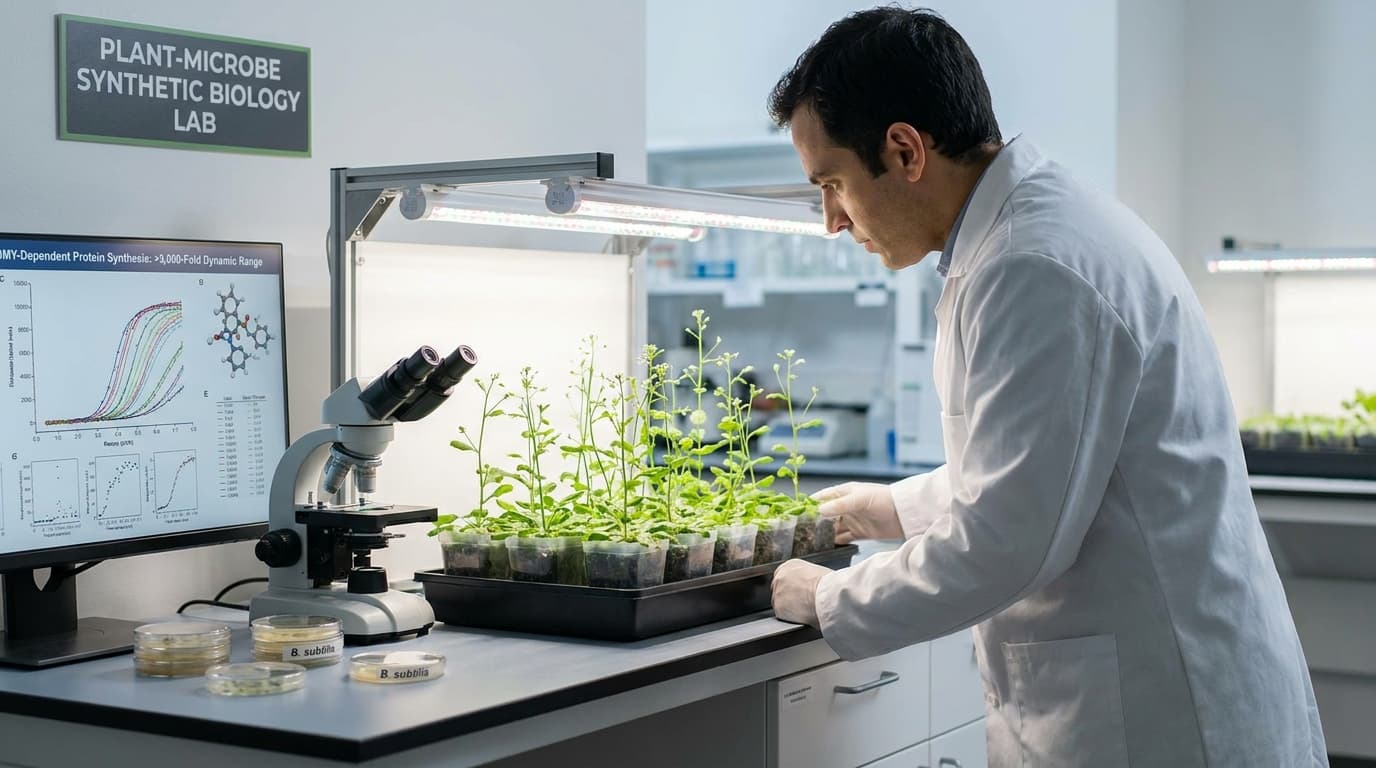
A Nature Biotechnology study describes a way to make bacterial activity depend on a signal produced by the plant host itself. Using O-methyl-L-tyrosine, or OMY, as a model compound, the researchers engineered the soil bacterium Bacillus subtilis so that target protein synthesis occurs only when the noncanonical amino acid is available.
They then engineered Arabidopsis, tomato and poplar to biosynthesize OMY, showing that plant-derived OMY could stimulate gene expression in both model and wild soil bacteria. The central claim is not simply that microbes can be engineered to respond to plants, but that noncanonical amino acids may offer a more orthogonal control layer than signals with existing natural roles in interkingdom communication.
The data
The bacterial system relies on genetic code expansion. The researchers introduced an orthogonal aminoacyl-tRNA synthetase and tRNA pair into B. subtilis. When OMY is present, that machinery suppresses in-frame amber stop codons in target transcripts, allowing translation of the encoded protein.
In the model soil bacterium, the team reported OMY-dependent protein synthesis with a greater than 3,000-fold dynamic range. They also said the approach was generalizable across multiple target proteins and could function in a wild bacterial isolate with minimal optimization.
On the plant side, the authors selected OMY because it has not been detected in agricultural soils and its known biosynthetic origins are limited to marine Streptomyces species and the rice blast fungus Magnaporthe oryzae. They also noted that OMY can be synthesized from L-tyrosine in a single enzymatic step by MfnG, an O-methyltransferase from Streptomyces drozdowiczii, which made heterologous production more tractable.
The study showed that inducible and tissue-specific expression of this single biosynthetic enzyme by the plant enabled on-demand control over microbial activity. In cocultivation experiments, plant-derived OMY was sufficient to direct bacterial protein synthesis.
Why the signal matters
The practical problem the paper addresses is well defined. Beneficial microbes can promote crop growth, but in field settings they can also spread beyond target plants, diluting the intended competitive advantage and creating unintended ecological effects. Previous engineered signaling systems have used rhizopines, opines, sucrose and quorum-sensing molecules, but the authors argue that these molecules’ natural biological roles may limit how orthogonal they can be in synthetic systems.
Their alternative is to build communication around a molecule outside the canonical translational repertoire. Plants naturally produce an estimated 250 to 300 noncanonical amino acids, and the paper frames that chemical diversity as a largely untapped control interface for plant-microorganism partnerships.
The commercial implication is that precision agriculture tools will likely need controllability as much as efficacy. A growth-promoting microbe that cannot be restricted to the intended host or condition carries a deployment problem, not just a biology problem. This study offers an early design for making microbial function conditional on a host-defined cue.
Constraints on translation
The authors explicitly note that agricultural use would require OMY production not to compromise plant fitness. They reported that OMY shows reduced phytotoxicity relative to plant-produced noncanonical amino acids that act as allelopathic compounds, including meta-tyrosine and L-canavanine.
According to the study, OMY was about 50-fold to 200-fold less potent than those known allelopathic noncanonical amino acids and was not misincorporated into native plant proteins like other allelopathic noncanonical amino acids. They further reported that conditional and tissue-specific OMY production reduced growth impacts while preserving effective bacterial signaling.
That leaves the work as a platform result rather than a field-ready product. Still, it advances a useful principle for ag-biotech engineering: if microbial benefits are to be deployed with precision, the control signal may need to be designed for exclusivity from the start, not borrowed from pathways plants and microbes already use for other purposes.