AbbVie’s next-generation Crohn’s disease combination candidate, ABBV-466, beat both of its component monotherapies in a phase 2 trial, giving the company a fresh efficacy signal beyond Skyrizi even as Skyrizi remains one of its biggest products.
The strategic point is not that Skyrizi has failed. AbbVie reported $10 billion in Skyrizi sales over the first half of the year. Instead, the company is trying to build on a mechanism it sees as incomplete, citing evidence of α4β7-driven inflammation despite IL-23 inhibition and testing whether adding the α4β7 inhibitor trosunilimab can improve outcomes.
The data
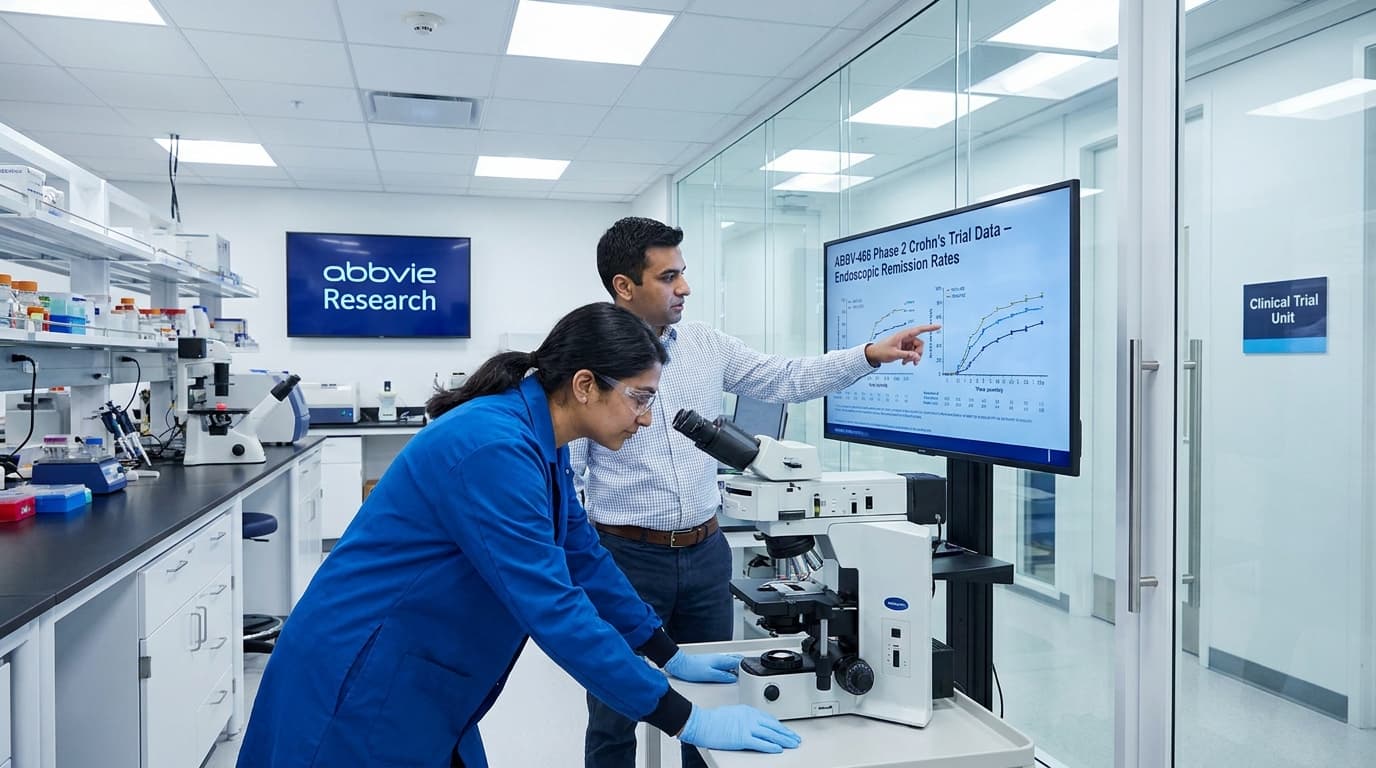
AbbVie randomized 300 people with moderate-to-severe Crohn’s disease to receive Skyrizi, trosunilimab or the combination. At Week 12, 30.2% of patients on ABBV-466 met the primary endpoint of endoscopic remission, versus 21.3% on Skyrizi and 18.0% on trosunilimab.
The company also compared the ABBV-466 figure with prior phase 3 Skyrizi studies in Crohn’s disease, where endoscopic remission rates were 24% and 19%, respectively. But the source also notes that cross-trial comparisons are complicated by differences in patient populations.
Those differences matter. In the Skyrizi-trosunilimab trial, 75% of patients had failed at least one advanced therapy and 25% were biologic-naïve. In the earlier Skyrizi phase 3 program, the study with the 24% remission rate included some biologic-naïve patients, while the 18% rate in that same program applied to patients with prior biological failure alone. The study with the 19% remission rate included only patients with prior biological failure.
Prior treatment exposure also differed. In the Skyrizi-trosunilimab study, 9.3% of patients with prior biological failure had previously received an IL-23 therapy such as Skyrizi, and 12% had tried a JAK inhibitor. AbbVie’s Rinvoq, described in the source as the first FDA-approved JAK inhibitor for moderate-to-severe Crohn’s, came to market after the company completed the Skyrizi monotherapy trials.
AbbVie said the phase 2 data suggest advantages for a dual-targeting approach in today’s more heavily pretreated populations. The company linked ABBV-466 to colonic epithelial repair and barrier restoration at Week 12. By Week 24, AbbVie reported tissue remodeling and metabolic changes in ABBV-466 patients that were generally not observed in either monotherapy arm.
Safety and next steps
Rates of serious adverse events were similar across all three cohorts. The most common adverse events in the ABBV-466 and trosunilimab groups were Crohn’s disease and nausea. In the Skyrizi monotherapy arm, the most common adverse events were Crohn’s disease and joint pain.
AbbVie began a larger phase 2 study of the combination in July. That 2,000-patient trial contains two sub-studies, one assessing ABBV-466 in patients with moderate-to-severe Crohn’s disease or ulcerative colitis.
Chief Scientific Officer Roopal Thakkar said on an earnings call in July that AbbVie does not intend to wait until the end of that study to make development decisions. He said the company plans to take interim snapshots and could begin planning a move into phase 3 if, for example, a higher dose of trosunilimab supports higher efficacy. That gives the current readout more than proof-of-concept value: it is an early test of whether AbbVie can turn Skyrizi from a strong standalone product into the base of a broader combination franchise.