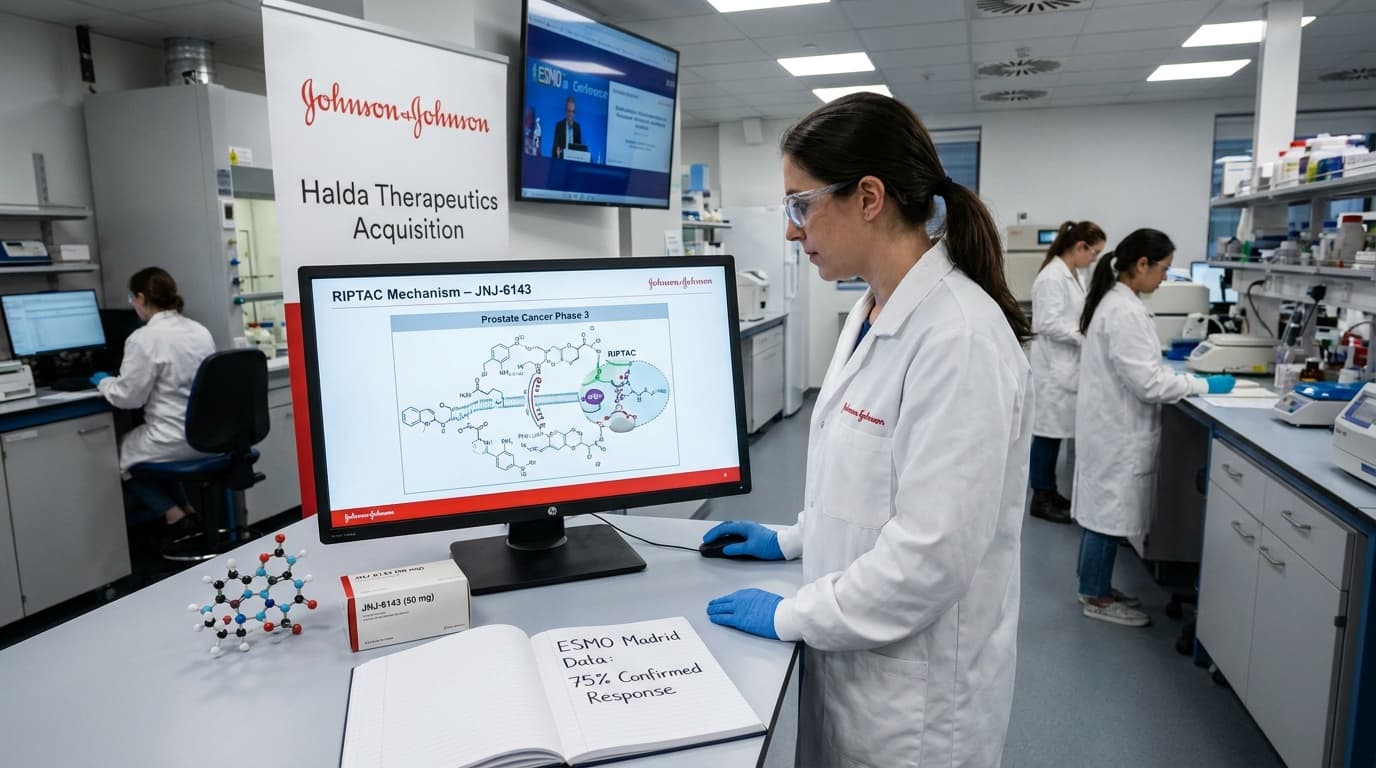
A year after Johnson & Johnson paid over $3 billion for Halda Therapeutics, the company has delivered its first updated clinical readout from the acquired RIPTAC platform and is presenting it as proof that the mechanism may have room in a prostate cancer market J&J already knows well. At ESMO in Madrid, the company said 75% of patients in an ongoing study of JNJ-6143 had experienced a confirmed complete or partial response.
The significance of the update is broader than the response rate alone. J&J bought Halda for a platform designed to use bifunctional small molecules to bind a tumor-specific protein and a protein essential to cell survival, with the goal of killing cancer cells through what the company describes as a “hold and kill” mechanism. In prostate cancer, where resistance to androgen receptor pathway treatments is a persistent problem, J&J is arguing that this mechanism could sidestep some of the usual bypass routes.
The Data
The findings presented at ESMO covered patients with metastatic castration-resistant prostate cancer, an advanced form of prostate cancer that continues to progress despite treatments targeting the androgen receptor pathway. J&J noted that median overall survival for these patients typically ranges from around 13.5 to 31.6 months depending on the site of metastasis.
JNJ-6143 targets androgen receptor and bromodomain 4, or BRD4, and is given as a once-daily oral drug. In the updated dataset, 75% of patients had a confirmed complete or partial response. Looking specifically at the 38 patients who received the 50 mg dose, 77% achieved a confirmed reduction in prostate-specific antigen levels of at least 50%, and 48% had a reduction of 90% or more.
That builds on the earlier phase 1 signal Halda had reported before the acquisition. In that dataset, 59% of 22 patients who completed at least two cycles at various doses achieved a greater than 50% reduction in prostate-specific antigen.
Safety was part of J&J’s case for advancing quickly. The company said 19% of patients experienced nausea, 16% experienced fatigue and 13% had elevated triglyceride levels. All of those were Grade 1 or 2, with one Grade 3 event and one patient discontinuing treatment because of a side effect.
Why The Readout Matters For J&J
J&J is already established in prostate cancer through Zytiga and Erleada, so the company is not entering the field as an outsider. Yusri Elsayed, M.D., Ph.D., global oncology therapeutic area head at Johnson & Johnson Innovation, told Fierce there had been a feeling at one point that little more could be done in the space because the existing drugs are strong. He said the RIPTAC data changed that view by serving as “proof of concept” for a mechanism that could kill the cell regardless of mutations or other resistance mechanisms.
That framing is the key signal in the update. J&J is not just saying JNJ-6143 looks active; it is saying the platform may support a new treatment architecture in cancers where hormonal pathway resistance narrows options over time. Elsayed also pointed to responses in patients with measurable disease or metastases in the liver or lymph node, saying these are patients who usually do not show responses with Zytiga or Erleada.
What Comes Next
J&J has already started a phase 2 trial of JNJ-6143 at 50 mg daily in around 100 patients with metastatic androgen pathway modulation-resistant prostate cancer. A phase 3 trial is set to begin next week.
The company is also moving beyond a single asset. Earlier this year, J&J took another RIPTAC with the same concept as JNJ-6143 into the clinic. Elsayed said there are probably 20 other programs moving quickly in discovery, with some expected to enter the clinic in different tumor types as they progress.
For now, the data remain early, and J&J itself said survival translation will need later-stage studies. But by moving JNJ-6143 into phase 3 while expanding the broader RIPTAC pipeline, the company is treating this as an operating platform rather than a one-off oncology bet.