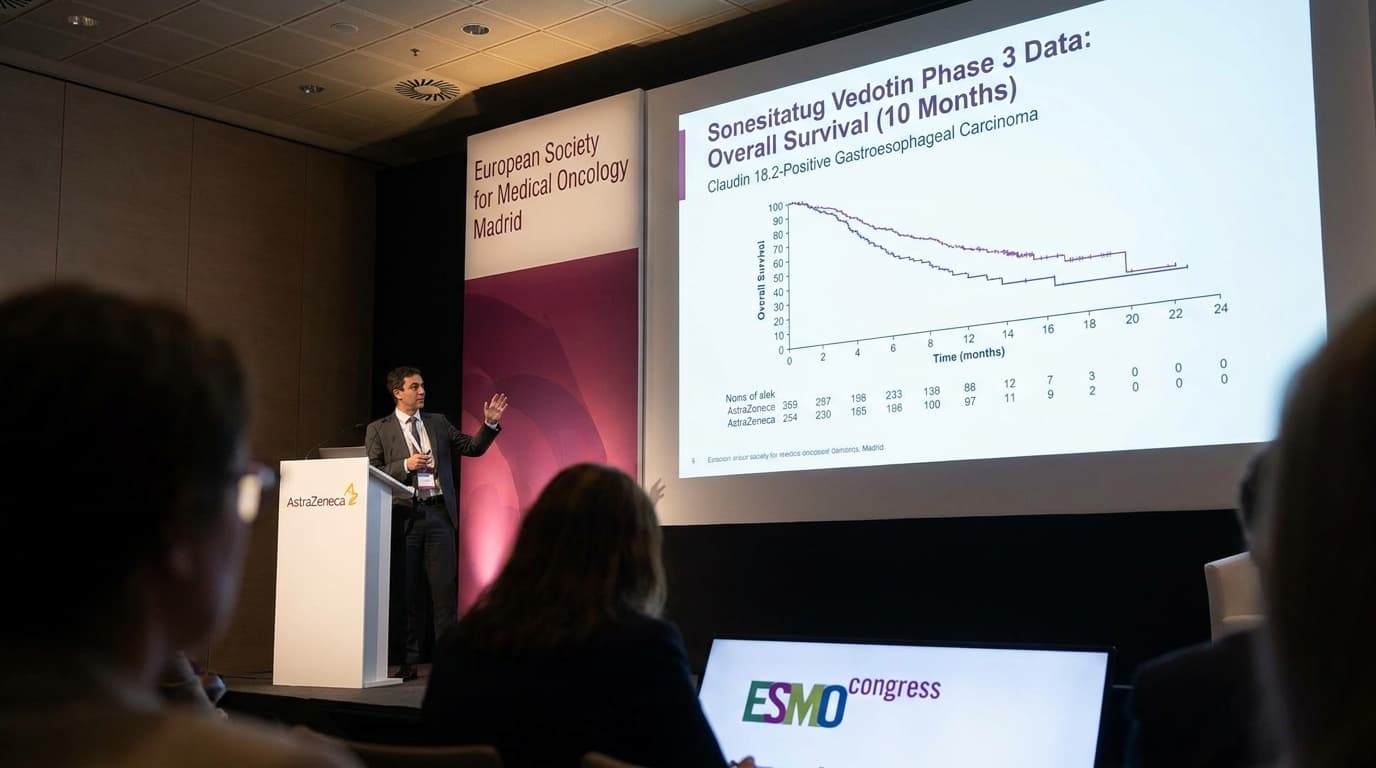
AstraZeneca is arguing that a mixed phase 3 readout for sonesitatug vedotin, or sone-ve, still gives it a regulatory path in Claudin 18.2-positive gastroesophageal carcinoma. The company had already said in July that the study met one of its dual primary endpoints, overall survival, while missing progression-free survival as assessed by blinded independent central review.
At the European Society for Medical Oncology Congress in Madrid, AstraZeneca executives said the detailed dataset remains robust enough to take to regulators. The strategic point is straightforward: the company is asking regulators to put more weight on survival than on a narrowly missed PFS endpoint in a tumor type where it says progression can be difficult to measure.
The Data
AstraZeneca evaluated sone-ve in 594 patients with second-line or later advanced or metastatic Claudin 18.2-positive gastroesophageal carcinoma. In the third-line or later setting, median overall survival was 10 months for patients receiving sone-ve versus five months for patients receiving an investigator's choice of therapy. In the intent-to-treat population, median overall survival was 10.6 months and 6.4 months, respectively.
The weaker point in the dataset was progression-free survival by blinded independent central review. Median PFS was 4.2 months for patients receiving sone-ve versus 3.8 months for the control group. Susan Galbraith, AstraZeneca's head of oncology hematology R&D, said gastric cancer can be harder to assess on PFS because of diffuse peritoneal spread, which can leave central reviewers without the broader clinical context available to investigators.
AstraZeneca instead highlighted investigator-assessed PFS, which showed a median of 4.4 months for the sone-ve group versus three months for the control group. Galbraith also pointed to an enhanced response rate, although the source did not provide a response figure.
Competitive Position
AstraZeneca's case rests on whether regulators view the overall survival gain as sufficient to offset the missed PFS endpoint. Galbraith said overall survival is the key endpoint from a regulatory perspective and compared the magnitude of benefit to what was seen with Enhertu in the DESTINY-Breast04 dataset.
The company is making that argument as competition builds in Claudin 18.2-targeted ADCs. Takeda also brought phase 3 data to ESMO for arcotatug tavatecan, another Claudin 18.2-targeted ADC. AstraZeneca said its study is the first global phase 3 trial for a Claudin 18.2-targeted ADC, while Takeda's data came from China and Japan. Galbraith also noted a product-level distinction: arcotatug tavatecan uses a topoisomerase I inhibitor-based payload, while sone-ve uses a vedotin payload.
Sone-ve is already being studied in other phase 3 trials in the first-line setting. For now, the commercial and regulatory signal is that AstraZeneca believes a survival-led filing argument is still viable, but it may need to win that case while a rival asset is advancing with its own late-stage dataset.