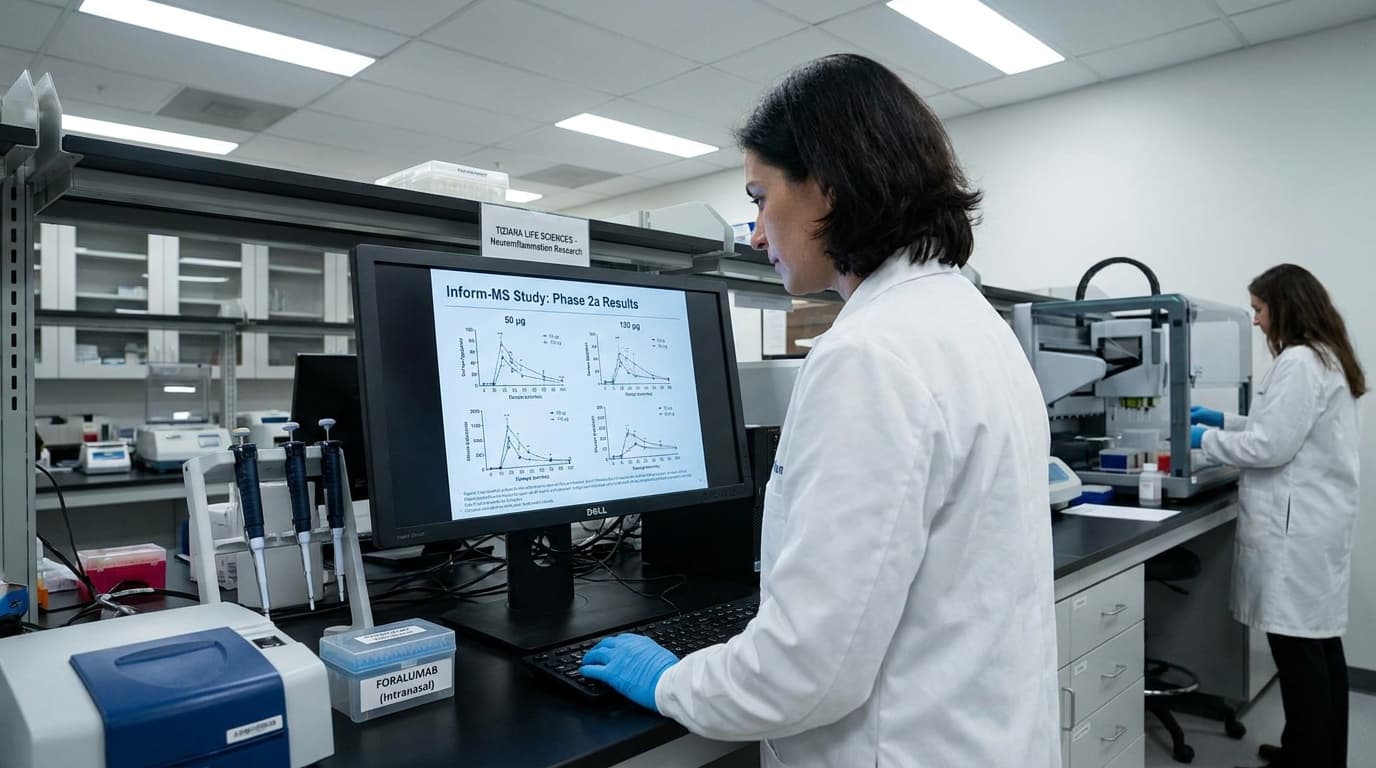
Tiziana Life Sciences reported a mixed but directionally useful phase 2a result for intranasal foralumab in non-active secondary progressive multiple sclerosis, or na-SPMS. The company said the Inform-MS study met its dual primary endpoints overall, with safety achieved across the trial and a statistically significant neuroinflammation benefit versus placebo in the 50 μg cohort, while the 100 μg cohort missed that efficacy goal.
That matters because na-SPMS remains a part of multiple sclerosis with progressive disability and fatigue but no FDA-approved therapies specifically indicated for the condition, according to the company’s description in the study announcement. It also matters because the readout suggests foralumab may have biological activity, but not in a simple more-dose-more-effect pattern.
The data
Inform-MS enrolled 48 patients with na-SPMS and tested 12 weeks of intranasal foralumab at 50 μg or 100 μg against placebo. Fierce Biotech reported that participants received the doses over 12 weeks, while BioSpace described the regimen as three-week cycles.
On the neuroinflammation primary endpoint, PET scans of evaluable patients showed a 0.0231 reduction in white-matter/global-brain SUV ratio for the 50 μg cohort compared with placebo, according to Fierce Biotech. Tiziana described that difference as statistically significant. BioSpace separately said the lower dose was tied to a statistically significant reduction in microglial activation at 12 weeks compared with placebo, assessed using PET imaging to measure a mitochondrial protein biomarker, but added that Tiziana did not provide specific data behind the results.
The higher dose did not replicate that result. Fierce Biotech said the 100 μg dose failed to demonstrate a statistically significant difference in SUVR during PET scans, and BioSpace similarly reported no significant difference for the 11 patients receiving 100 μg.
Safety was the cleaner part of the package. All 48 participants completed treatment, and no serious adverse events linked to foralumab were reported. Fierce Biotech said 76.7% of patients across both foralumab doses experienced treatment-emergent adverse events, compared with 83.3% of the placebo cohort. The most common treatment-emergent adverse events were headache, fall, nasal congestion and rhinorrhea or runny nose.
Secondary endpoints were mixed. Fierce Biotech reported a 6.17-point decrease in Modified Fatigue Impact Scale scores in the 50 μg cohort and a 7.18-point drop in the 100 μg group, while the placebo group saw no significant change, allowing Tiziana to characterize fatigue as a statistically significant improvement for the drug. Another secondary endpoint using the Expanded Disability Status Scale did not show a benefit.
The scientific signal is encouraging, but the dose split is the real story. For a mid-stage program, showing activity at one dose and not at a higher one can still justify advancement, yet it usually shifts the next development question from whether the drug is doing anything to why the response curve looks this way and which regimen is worth carrying forward.
The road here
Foralumab is Tiziana’s lead candidate and part of a broader narrowing of the company around that asset. Fierce Biotech noted that Tiziana announced plans at the end of last year to spin out its interleukin-6 receptor candidate into a separate company, while BioSpace said the other publicly listed asset is the anti-IL-6 receptor monoclonal antibody TZLS-501 and that there has been no update on the planned spinout since it was announced in December 2025.
The company is also running or supporting additional work with foralumab in Alzheimer’s disease, amyotrophic lateral sclerosis, multiple system atrophy and an open-label extension or expanded access setting in na-SPMS. That wider program means the Inform-MS result is not just a single readout; it is one of the first controlled signs that intranasal foralumab may be producing measurable biological effects in a progressive neuroinflammatory disease.
What to watch
Tiziana said it plans to present detailed findings at an upcoming scientific conference and meet with the FDA to discuss a potential path forward for further clinical development in na-SPMS. The next value inflection is likely less about broad efficacy claims than about whether the company can use this dataset to define a registrational strategy around the lower dose and explain the lack of separation at 100 μg.
Investors reacted negatively in the near term, with BioSpace reporting that Tiziana’s stock fell 17% to 67 cents per share as of Monday’s market open. That response fits the ambiguity of the data package: the trial produced a clinical-development foothold in an area of unmet need, but not the kind of clean dose-response story that tends to simplify financing and partnering discussions.