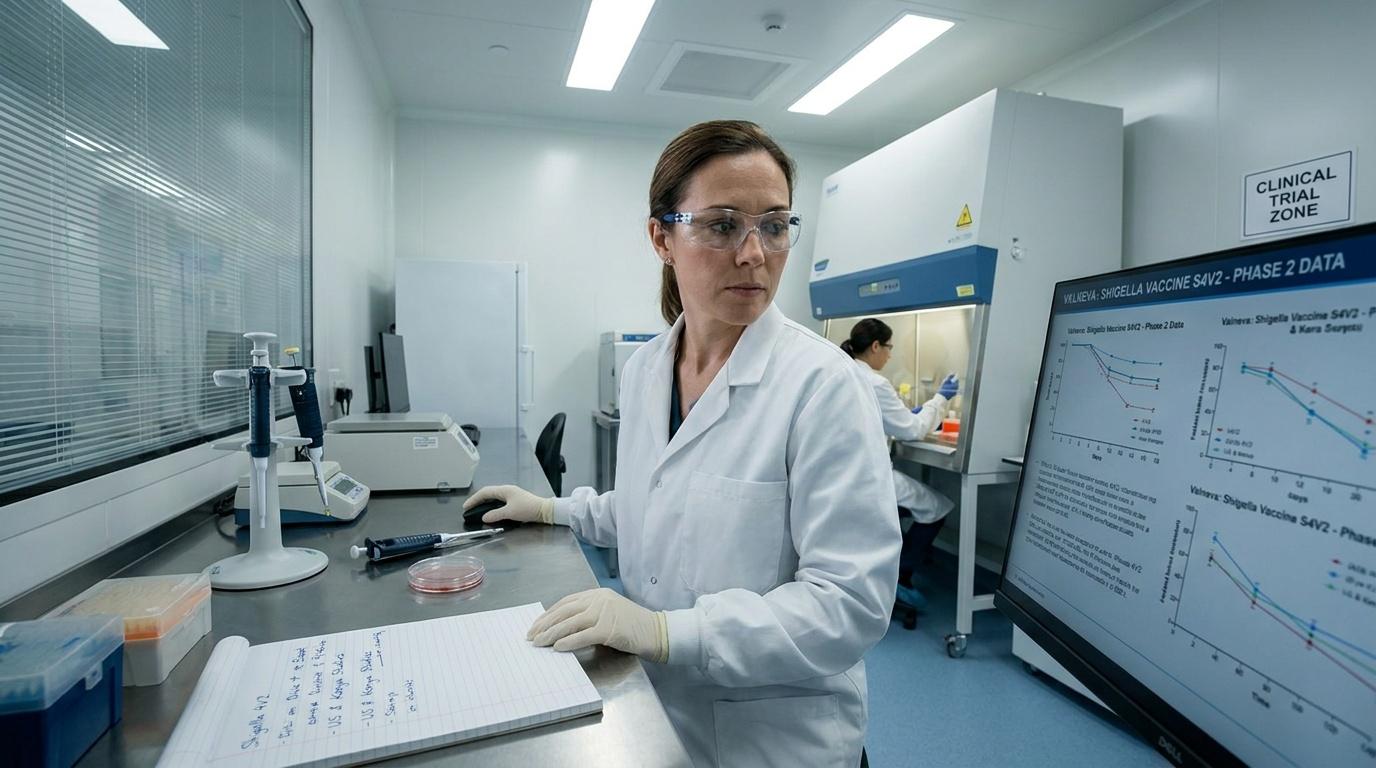
Valneva said its Shigella vaccine candidate Shigella4V2 reduced cases of shigellosis in a U.S. phase 2 controlled human infection model study, meeting the trial’s primary endpoint and giving the company an efficacy result in a vaccine category that still has no approved products.
The announcement is directionally positive, but it is also incomplete. Valneva did not provide detailed efficacy data from the challenge study and said it is still conducting additional analysis of efficacy and immunogenicity. That leaves the program with a clinically useful signal, but not yet a fully defined registrational route or product profile.
The Data
The U.S. study, sponsored by LimmaTech, enrolled 120 healthy adults ages 18 to 50 years. Participants received two doses of S4V2 or placebo one month apart, and around a month after the second dose they were challenged with the Shigella sonnei 53G strain.
Valneva said the results showed a statistically significant reduction in cases of shigellosis among participants who received S4V2 versus placebo, which met the primary endpoint. The company did not disclose the underlying efficacy numbers in the announcement.
Valneva released those results alongside another phase 2 study in Kenya that tested two dose levels of S4V2 against a meningococcal vaccine in 110 infants aged nine months. According to the company, that trial showed a favorable safety and tolerability profile across both dose levels, with adverse events tending to be mild to moderate and occurring at similar rates across the control groups.
The Kenya study also generated what Valneva described as encouraging evidence of immunogenicity and antibody persistence, while also showing that further evaluation is needed on dose selection and vaccination scheduling to optimize the breadth and robustness of the immune response.
The Road Here
Valneva licensed rights to the tetravalent bioconjugate vaccine from LimmaTech in 2024 for 10 million euros ($10.7 million) upfront. The asset had previously been part of GlycoVaxyn before that company’s 2015 acquisition by GSK. GSK handed the candidate back in 2023, citing plans to prioritize its own vaccine for the bacteria, and Valneva picked it up the following year.
The company now describes S4V2 as the world’s most clinically advanced tetravalent bioconjugate vaccine candidate against shigellosis. That matters because shigellosis remains the second leading cause of fatal diarrheal disease worldwide, yet the field still lacks an approved vaccine.
For Valneva, the strategic question is whether these two phase 2 studies are enough to justify a larger and more expensive development push at a time when the company has been managing broader business pressure. Earlier this year, it laid off 15% of its workforce as travel vaccine uptake fell. Rather than committing immediately to the next trial, Valneva said it is evaluating the complete datasets to determine the most appropriate path forward for the potential first-in-class candidate.