Zura Bio has discontinued development of tibulizumab in hidradenitis suppurativa after the antibody missed its phase 2 primary endpoint in the Tibushield trial. The setback wiped out much of the company’s market value at the open, with the stock falling 72% to $1.12 from a Friday close of $4.09.
The decision narrows tibulizumab’s path but does not end the program. Zura said it will continue studying the antibody, which inhibits IL-17A and BAFF, in systemic sclerosis and polymyalgia rheumatica. Those trials are scheduled to report results in the first half of 2027 and late 2028, respectively.
The Data
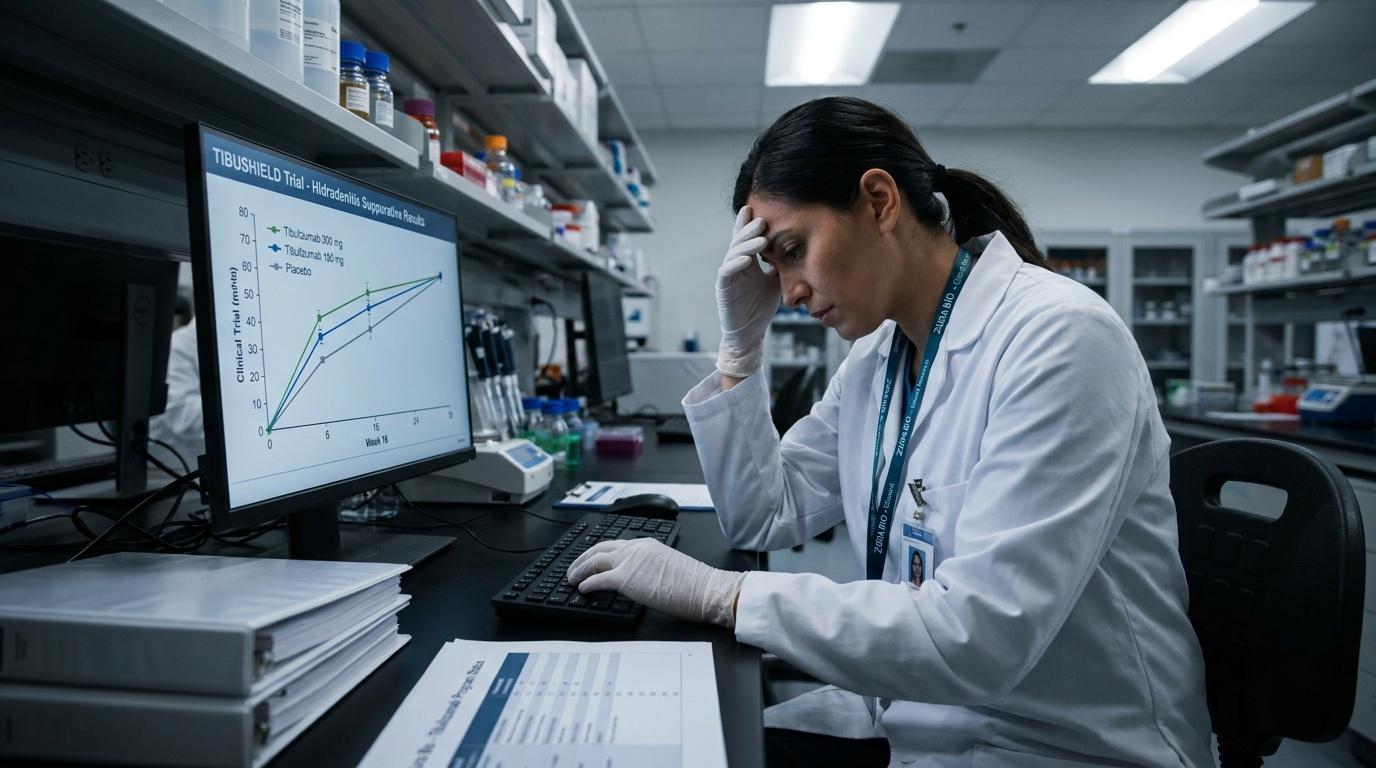
Tibushield enrolled 247 hidradenitis suppurativa patients and compared 300 mg and 150 mg doses of tibulizumab with placebo. At Week 16, changes from baseline in total abscess and inflammatory nodule count were 56% for the 300-mg arm and 58.1% for the 150-mg arm, versus 52.5% for placebo, causing the trial to miss its primary endpoint.
Secondary endpoints showed only small numerical separation from placebo. HiSCR50 rates at Week 16 were 48% for 300 mg and 52.7% for 150 mg, compared with 45.5% for placebo. HiSCR75 rates were 35.3%, 34% and 28.1%, respectively.
Those active-arm response rates were broadly in line with results reported for UCB’s Bimzelx in hidradenitis suppurativa, but the placebo performance in Tibushield was much higher than the placebo rates reported in UCB’s phase 3 studies. That distinction matters because the miss appears tied less to a complete absence of activity than to an inability to separate convincingly from control in this trial setting.
Zura said it is still analyzing pharmacokinetics, pharmacodynamics, exposure-response relationships and the impact of hidradenitis suppurativa-specific factors.
What Survives From Here
Management’s argument for continuing rests on biology rather than momentum. CEO Sandeep Kulkarni, M.D., said the remaining indications have “distinct and uncorrelated pathobiologies and clinical presentations from those of HS,” giving the company a basis to keep testing tibulizumab outside hidradenitis suppurativa.
Safety did not appear to force the retreat. Treatment-emergent adverse events occurred in 52.4% of patients on study drug versus 46.3% on placebo. There was one treatment-related serious adverse event on tibulizumab. Up to 3.7% of patients on tibulizumab had treatment-emergent adverse events leading to discontinuation, compared with 2.4% on placebo. One patient in the tibulizumab arms died of cardiac arrest, which the site investigator determined was unrelated to the study drug.
Zura ended September with $187.7 million in cash and equivalents and said that runway should fund operations through at least the end of 2028. That extends beyond the expected readouts for the two remaining tibulizumab studies, meaning the hidradenitis suppurativa failure hurts the thesis but does not immediately force a financing decision.