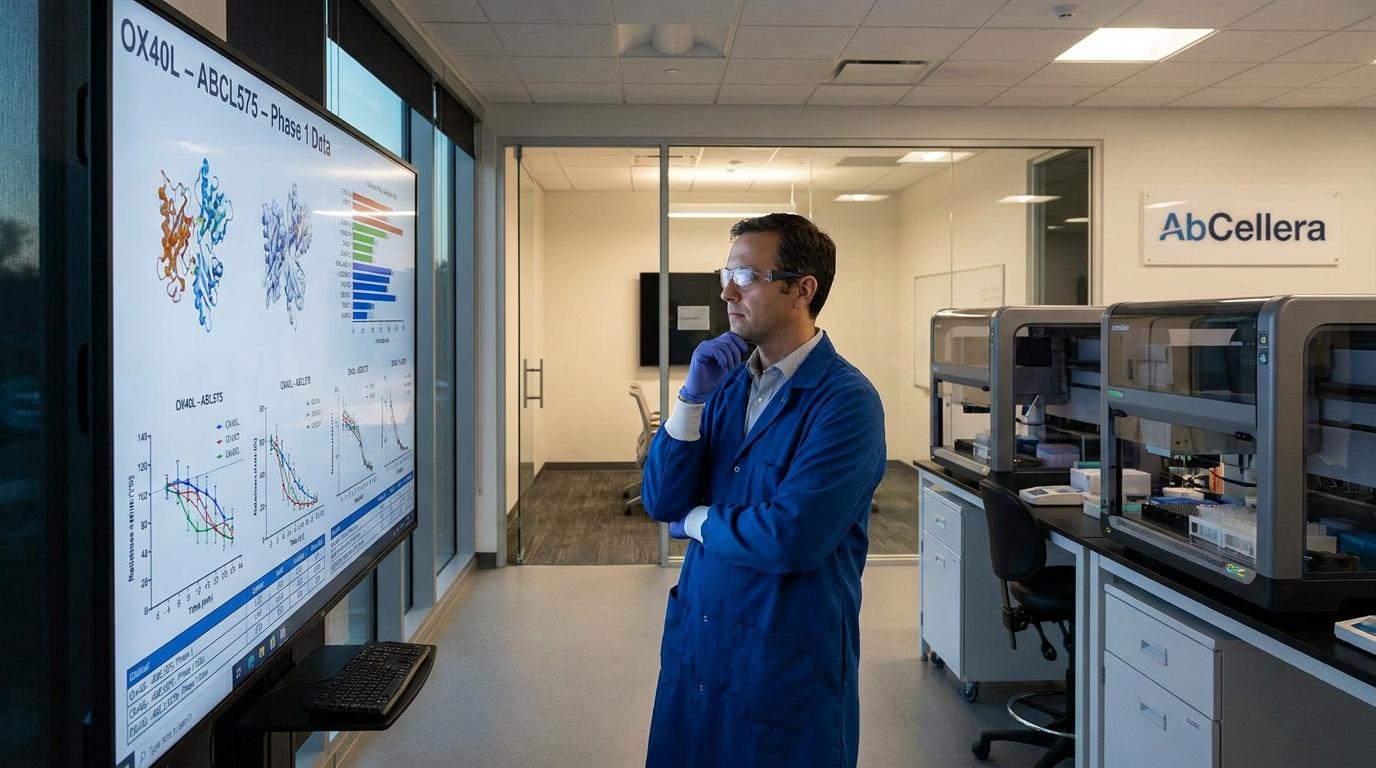
AbCellera has decided not to advance ABCL575 beyond Phase 1, even though the company said the study hit all its endpoints. The candidate is an antibody drug targeting OX40 ligand for atopic dermatitis and other autoimmune conditions.
In its third-quarter earnings results, AbCellera said the Phase 1 trial demonstrated a favorable tolerability profile and a pharmacokinetic profile that supports an extended dosing interval. But the company also said it currently does not plan to develop ABCL575 past Phase 1, attributing the decision to external developments in the OX40/OX40L class.
That makes the program less a case of molecule-specific failure than a signal that class-level risk is now outweighing early technical success. For smaller developers, that kind of readthrough can be decisive: a clean Phase 1 package loses value if the surrounding competitive and safety context makes later differentiation or approval less credible.
The class backdrop
The OX40 and OX40L field has had a difficult 2026. In March, Kyowa Kirin shut all clinical studies of its Amgen-partnered anti-OX40 monoclonal rocatinlimab for inflammatory diseases because of emerging concerns of malignancies with possible viral or immune-related links.
Four months later, Sanofi said it had canceled plans to submit the anti-OX40 ligand antibody amlitelimab to regulators for atopic dermatitis after concluding the drug would not represent a meaningful improvement over existing treatments. That reversal carried added weight because Sanofi acquired amlitelimab through its $1.1 billion purchase of Kymab and had previously positioned the therapy as a potential blockbuster.
Against that backdrop, AbCellera’s retreat suggests that in crowded immunology markets, a program may need more than acceptable safety and dosing convenience to justify additional capital. If the class has unresolved safety questions on one side and limited commercial differentiation on the other, progressing into larger studies becomes harder to defend.
What still stands out
The sector-wide picture is not uniformly negative. In September, Inhibrx Biosciences reported Phase 2 data for its hexavalent OX40 agonist INBRX-106 in combination with Keytruda showing a 48.3% confirmed objective response rate in treatment-naive, PD-L1 positive metastatic or unresectable recurrent head and neck squamous cell carcinoma. Inhibrx CEO Mark Lappe said at the time that the results strengthened the company’s conviction in OX40-mediated T-cell co-stimulation.
That split matters. AbCellera’s exit does not close the book on OX40 biology altogether, but it does narrow enthusiasm for autoimmune applications where regulators, investors and potential partners may now demand a much clearer edge before funding the next step.
AbCellera still has other pipeline programs, led by ABCL635, a neurokinin 3 receptor-targeting antibody that the company recently said had a Phase 2 win in hot flashes caused by menopause.