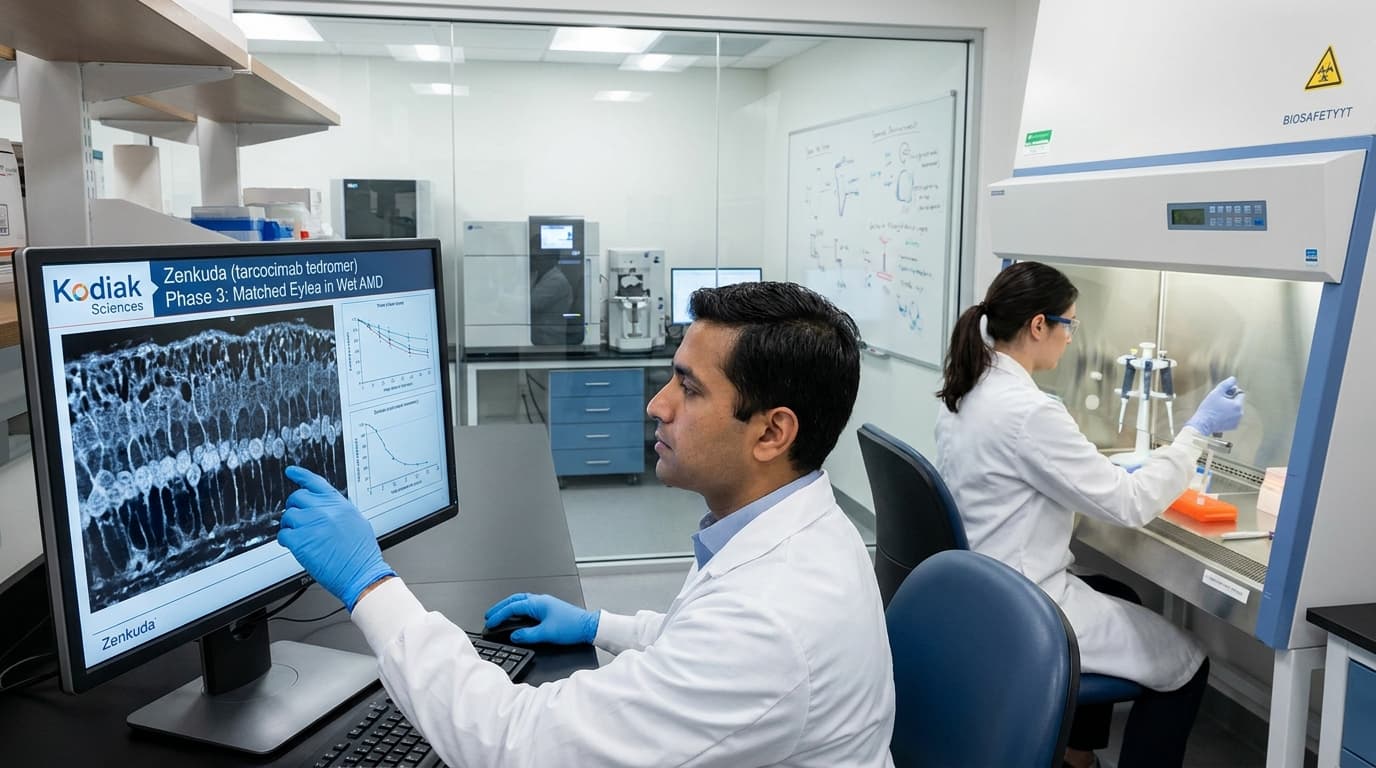
Kodiak Sciences reported that two eye disease candidates matched Regeneron’s Eylea at one year in a phase 3 trial in wet age-related macular degeneration, a result that quickly reshaped investor sentiment around a program many had written off after a 2023 safety setback. The company said it now plans to file zenkuda, also known as tarcocimab tedromer, for FDA approval in the fourth quarter using data from five phase 3 studies across wet age-related macular degeneration, diabetic retinopathy and retinal vein occlusion.
The market reaction was immediate but not identically described across sources. Fierce Biotech said Kodiak’s stock rose 128% to $72.99 at the open from a Friday close of $32.35, while BioSpace reported the stock had soared 166% since market open to $86.53 about one hour into trading. The differing snapshots reflect timing rather than a disagreement over direction: investors treated the readout as a major rehabilitation of Kodiak’s late-stage retina strategy.
The Data
The DAYBREAK study compared tarcocimab tedromer and tabirafusp alfa tedromer against aflibercept, the VEGF inhibitor sold by Regeneron as Eylea, in wet age-related macular degeneration. At one year, both Kodiak candidates matched aflibercept on the primary endpoint assessing vision gains.
Kodiak’s press materials, as described in the source reports, focused more heavily on zenkuda than on tabirafusp. For zenkuda, the company said the drug showed strong immediacy of clinical effect, matching and/or exceeding aflibercept through the loading phase, and both sources said the candidate had a favorable safety profile. Fierce Biotech added one specific comparator detail: Kodiak reported a numerically lower cataract rate than aflibercept.
Durability is the part of the profile Kodiak appears to be using to differentiate zenkuda commercially. BioSpace reported that, using as-needed treatment after an initial loading period, 54% of zenkuda patients were dosed once every six months. Fierce Biotech similarly said more than half of patients were maintained on 24-week dosing through year one using an AI-guided retreatment algorithm. In the control arm, patients on aflibercept received treatment every eight weeks after loading.
That matters because retina markets do not reward efficacy alone. Physicians already have anti-VEGF options that work; a new entrant has to show it can reduce treatment burden without giving up vision outcomes. Based on the topline data, zenkuda’s main pitch is not superior efficacy to Eylea, but matched efficacy with meaningfully longer dosing intervals for many patients.
The Road Here
The readout is notable because tarcocimab’s development was temporarily ended in 2023 after an unexpected increase in cataracts, according to Fierce Biotech. Kodiak later restarted development that year after non-proliferative diabetic retinopathy data supported moving forward, and the company rebuilt a late-phase plan from there.
That history changes the significance of the current result. This is not just another noninferiority study in a crowded ophthalmology market; it is a proof point that a previously troubled asset can still return to a registrational path if a company can redefine where the benefit-risk case is strongest and generate cleaner late-stage data.
The Commercial Picture
Kodiak intends to submit zenkuda later this year across multiple indications, not as a single-asset wet AMD filing. BioSpace said the package will also include one additional wet AMD study, two diabetic retinopathy studies and one study in macular edema after retinal vein occlusion. That broader filing plan matters because the economics of retina drug launches depend on spanning several high-volume retinal diseases rather than winning one niche use.
The harder question is what a win against aflibercept means in today’s market. Fierce Biotech noted that aflibercept patents have expired, exposing Kodiak to biosimilar competition including Biocon’s Yesafili, while branded rivals such as Regeneron’s Eylea HD and Roche’s Vabysmo are also in the field. That makes durability and physician workflow central to zenkuda’s case. Matching Eylea is enough to reopen the regulatory door; whether it is enough to take share depends on whether longer intervals translate into prescribing behavior in a market that now includes lower-cost and higher-dose alternatives.
Tabirafusp remains in the story, but as a more exploratory commercial proposition. Like zenkuda, it matched aflibercept on the primary endpoint in DAYBREAK. Kodiak said it will run post-hoc analyses to identify which treatment-naive wet AMD subgroups may benefit from IL-6 inhibition, and both sources said the asset remains in an ongoing phase 3 superiority program in diabetic macular edema. For now, the near-term value driver is zenkuda’s filing, while tabirafusp looks more like an effort to carve out biology-defined use rather than compete as a broad anti-VEGF substitute.