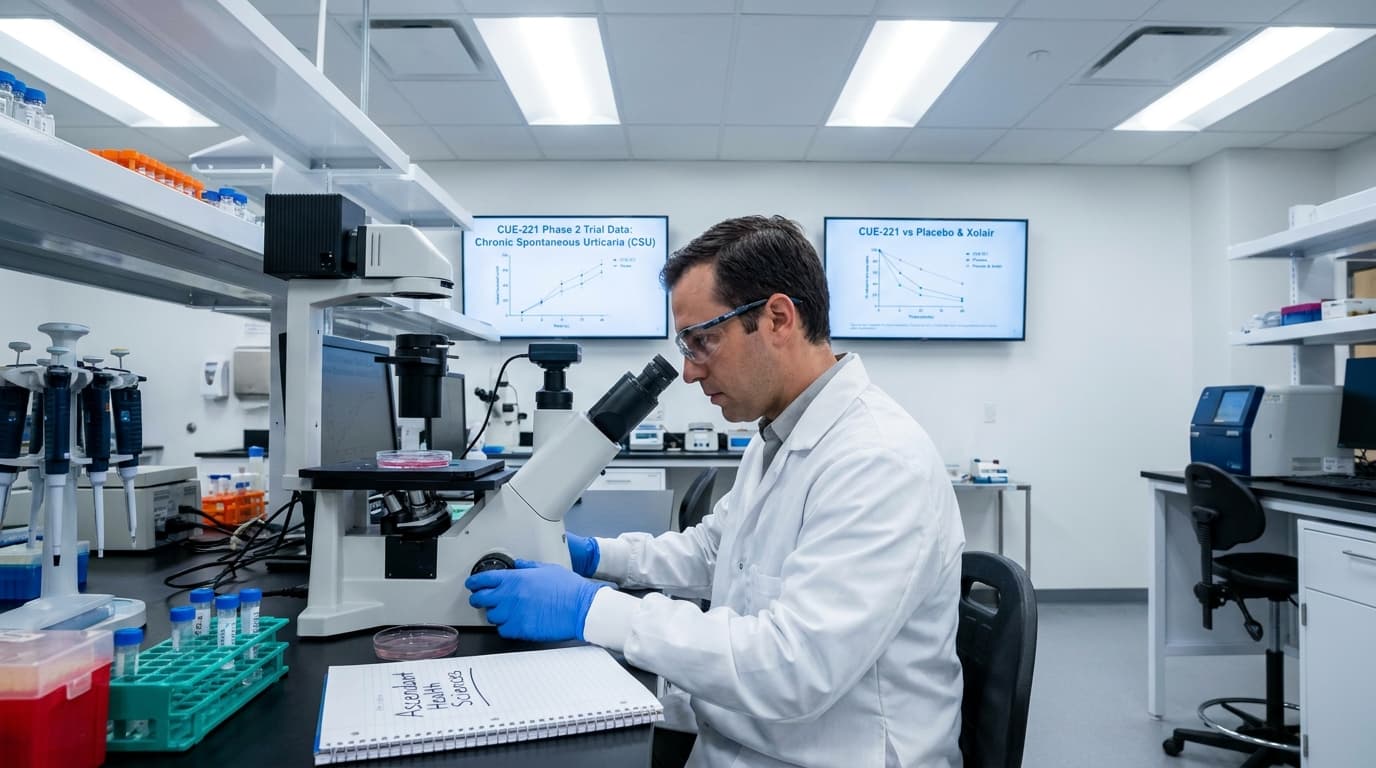
Cue Biopharma said its midstage study of CUE-221 in chronic spontaneous urticaria hit the primary endpoint, clearing the way for a phase 2b/3 trial in a market currently defined by Xolair. The drug was added to Cue’s pipeline in April, when the biotech paid Ascendant Health Sciences $15 million for ex-China rights.
The readout matters because Genesis Life Sciences, part of Ascendant, built the trial with both placebo control and an Xolair cohort, giving Cue an early look at comparative efficacy even though the study was not designed for statistical testing against the marketed drug. That does not establish superiority, but it does provide a directional benchmark as Cue prepares for later-stage development.
The data
The phase 2 study enrolled 145 subjects in China with chronic spontaneous urticaria, or CSU. Patients received one of three doses of CUE-221 or placebo subcutaneously every four weeks. A cohort also received Xolair.
At Week 12, hives were completely resolved in 43% to 54% of patients in the CUE-221 groups on the HSS7 scale, compared with 11% on placebo. Cue said all of the CUE-221 resolution rates were statistically significant versus placebo, meeting the primary endpoint. The Xolair arm reported a 41% resolution rate, but Genesis used that cohort for comparative efficacy without planned statistical testing.
A secondary endpoint on the UAS7 scale showed a similar pattern. Complete response rates were 38% to 46% for CUE-221, versus 11% for placebo and 29% for Xolair.
The longer follow-up may be the most commercially relevant part of the dataset. After a final dose at Week 16, patients were tracked through Week 28. Cue said CUE-221’s effect peaked at Week 22, when the HSS7 resolution rate reached up to 69% on the study drug and 41% on Xolair. By Week 28, the high dose of CUE-221 showed a 60% response rate versus 24% on Xolair, while the two lower doses posted 31% and 24%.
Why Cue sees a differentiation path
Cue framed the Week 28 separation as evidence that CUE-221 may affect disease biology differently from Xolair. Both drugs are designed to neutralize free IgE, but Cue said CUE-221 is engineered to go further by downregulating IgE production to support deeper, more durable disease control.
That claim still needs testing in a later-stage study, but it gives Cue a clearer regulatory and commercial thesis than a simple attempt to match Xolair on Week 12 symptom control. If durability holds up, the company could argue for differentiation in a disease where sustained control matters as much as initial response.
Cue said it will work toward a phase 2b/3 study in CSU while also continuing preparations for a phase 2 food allergy study. The company raised $50 million in July and said in August that it had enough cash for at least the next 12 months. For a biotech that licensed the asset only months ago, this readout shifts CUE-221 from an opportunistic in-licensing deal to a program likely to define the company’s near-term strategy.