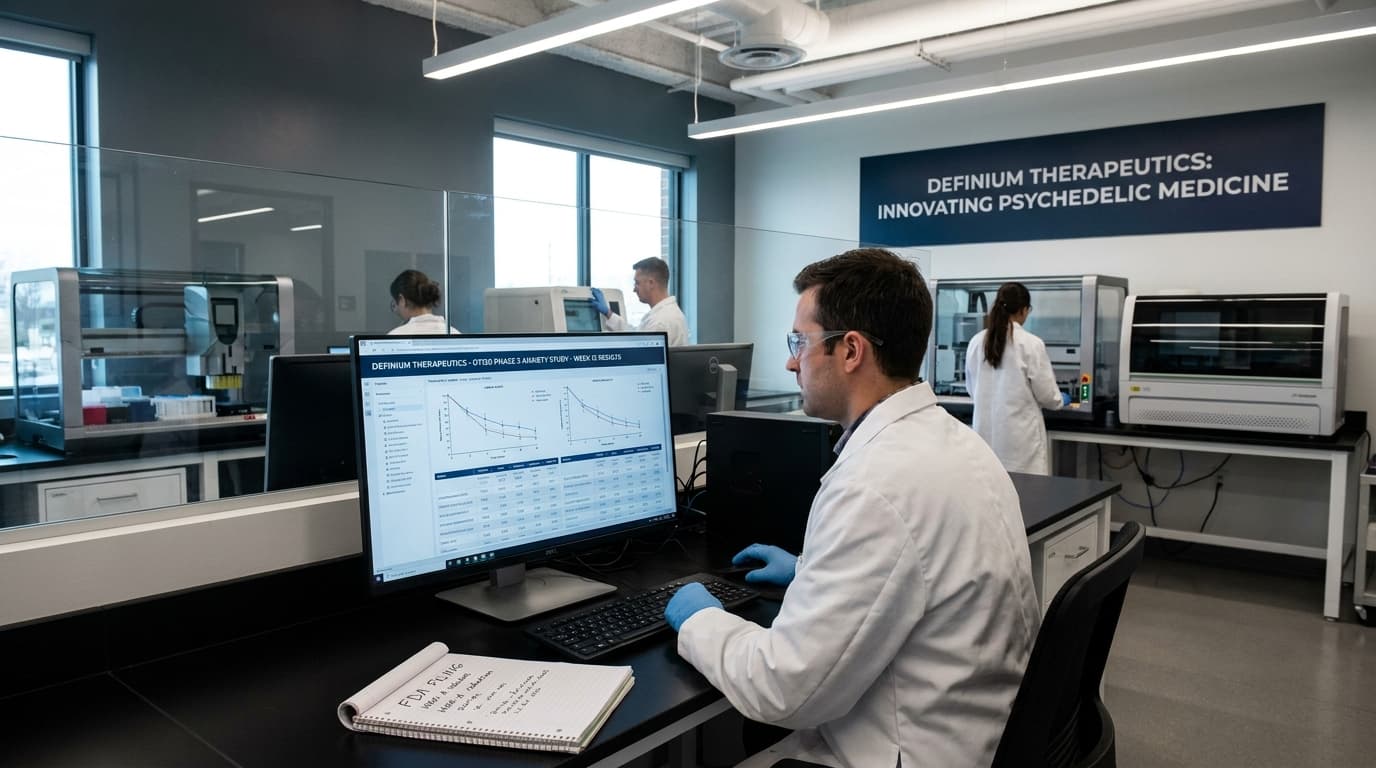

Definium Therapeutics said its oral LSD therapy DT120 met the primary endpoint in Panorama, a 245-patient phase 3 trial in generalized anxiety disorder, adding a second late-stage anxiety success to the company’s recent depression win. The company now has a meeting set with the FDA in the fourth quarter to discuss a new drug application later this year, according to CEO Robert Barrow.
The latest result matters beyond a single readout because Definium is trying to establish that psychedelic efficacy can hold up in larger, controlled studies at a time when the FDA has publicly focused on trial design issues in the field. STAT reported that the company is positioning to seek the first approval of a psychedelic drug for anxiety.
The data
In Panorama, patients receiving 100 micrograms of DT120 saw a 9.8-point reduction on the Hamilton Anxiety Rating Scale at week 12 after treatment, compared with a 4.7-point reduction for placebo. That produced a 5.1-point placebo-adjusted difference. STAT said the magnitude was similar to Definium’s first late-stage anxiety study and larger than what has been observed with many other anxiety therapies, while also noting that cross-study comparisons are difficult.
Panorama also included a 50 microgram dose designed to remain psychoactive without delivering therapeutic benefit. That arm posted a 3.6-point placebo-adjusted change, but the 52-patient group was not powered for statistical analysis. Barrow said the arm was intended to answer concerns about functional unblinding in psychedelic trials, and argued the company achieved that goal because the 50 microgram findings were similar to results from Definium’s earlier phase 2 dose-response work while still separating from the 100 microgram dose.
According to Definium, the study hit all key secondary endpoints and showed no new safety concerns. STAT added that the company said patients experienced changes as early as the second day after dosing. The treatment is delivered in a single eight-hour session with a monitored chaperone-guided experience, a format Definium and investigators are using to differentiate DT120 from daily anxiety medicines.
The road here
Panorama follows the Voyage phase 3 anxiety study reported a month ago, where 100 micrograms of DT120 produced a 5.4-point placebo-adjusted reduction in HAM-A score. Definium also reported a phase 3 win in major depressive disorder in June, giving the company three straight late-stage successes in a 12-week period.
Barrow told Fierce that Definium feels confident in the reliability of the results across both anxiety and depression despite differences in study design. That confidence matters because the FDA recently published a framework in The New England Journal of Medicine highlighting issues such as blinding and trial rigor in psychedelic programs. Definium’s decision to include a psychoactive lower-dose comparator in Panorama looks tailored to that regulatory discussion rather than to a conventional placebo-controlled template alone.
What to watch
The next decision point is regulatory strategy. Barrow said the question of which indication to file first will be discussed with the FDA, but he expressed confidence that Definium can ultimately compete in both major depressive disorder and generalized anxiety disorder.
The company is not stopping with these readouts. Another phase 3 depression study remains ongoing, and Definium plans to start a late-stage PTSD trial next year. Beyond DT120, its pipeline includes DT402, an MDMA formulation in phase 2 testing for autism spectrum disorder, plus additional preclinical candidates. For investors and regulators, the immediate signal is narrower: Definium now has multiple late-stage studies suggesting its program may have reproducibility, which is one of the hardest thresholds for psychedelic developers to clear.