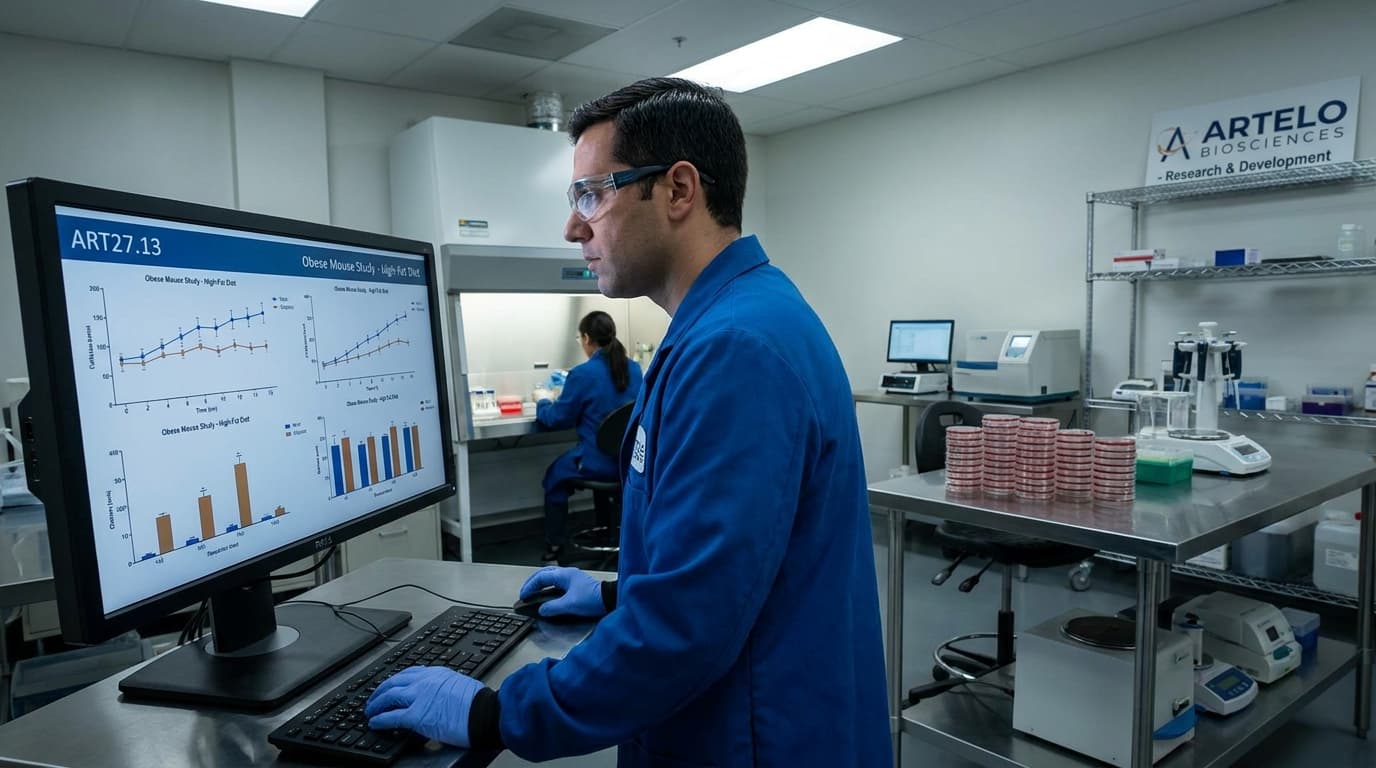
Artelo Biosciences said its oral cannabinoid receptor agonist ART27.13 delivered weight loss in obese mice that was similar to semaglutide over four weeks, adding another early non-incretin data point to an obesity field still dominated by GLP-1 drugs. In the same study set, the company reported that combining ART27.13 with semaglutide led to about twice the weight loss seen with semaglutide alone.
The more commercially relevant detail may be the selectivity signal Artelo highlighted: lean mice dosed with ART27.13 alone did not show changes in body weight, fat mass or lean mass. That does not establish how the drug would behave in humans, but it gives Artelo a cleaner narrative for a mechanism tied to metabolic state rather than generalized wasting, which matters because the asset is already in development for cancer anorexia-cachexia syndrome.
The data
The mouse work covered ART27.13 alone and in combination with semaglutide in obese mice fed a high-fat diet, plus ART27.13 alone in lean mice. In obese mice fed a high-fat diet, ART27.13 alone reduced body weight from baseline by approximately 20% over four weeks, which Artelo said was similar to the weight loss seen with semaglutide.
In the combination arm, obese mice treated with ART27.13 and semaglutide lost approximately 40% of baseline body weight. Artelo also said about 80% of the total weight lost with ART27.13 monotherapy or the combination was fat, compared with about 70% for semaglutide alone.
ART27.13 targets cannabinoid receptors 1 and 2, or CB1 and CB2. According to Artelo, the drug is designed to selectively target peripheral CB1 and CB2 receptors to minimize central nervous system-mediated effects.
The road here
ART27.13 was originally developed by AstraZeneca under the name AZD1940 for pain. After AstraZeneca discontinued development, rights moved to Montreal-based Neomed Institute. Artelo entered an agreement with Neomed in 2017 that gave it an option to exclusively license the drug, with Neomed eligible for milestone payments of up to $202 million and royalties on future sales.
Artelo has been advancing the asset in cancer anorexia-cachexia syndrome and is evaluating it in the phase 2 portion of the CAReS trial across five countries. In September 2025, the company announced positive interim phase 2 data showing that patients who reached the highest evaluated dose gained an average of about 6% of their body weight over 12 weeks, while patients receiving placebo lost about 5%.
That history is what makes the obesity angle notable. Rather than starting from a new discovery platform, Artelo is trying to extend an asset that already has human weight-gain data in a wasting disorder into a weight-management setting, while arguing the preclinical obesity effect is distinct and potentially complementary to GLP-1s.
The commercial picture
Artelo’s chief scientific officer Andy Yates said the company is actively engaging in partnership discussions to advance ART27.13 for both cancer anorexia-cachexia syndrome and obesity. He also pointed to a manufacturing angle, describing ART27.13 as a chemically synthesized compound that can be given at very low doses.
For a small biotech, that combination case may be the most practical entry point. Matching semaglutide in mice is an eye-catching result, but the obesity market is already crowded with incretin-based programs. A non-incretin oral candidate that appears additive in preclinical work gives Artelo a clearer differentiation story than a direct attempt to displace established GLP-1 drugs.