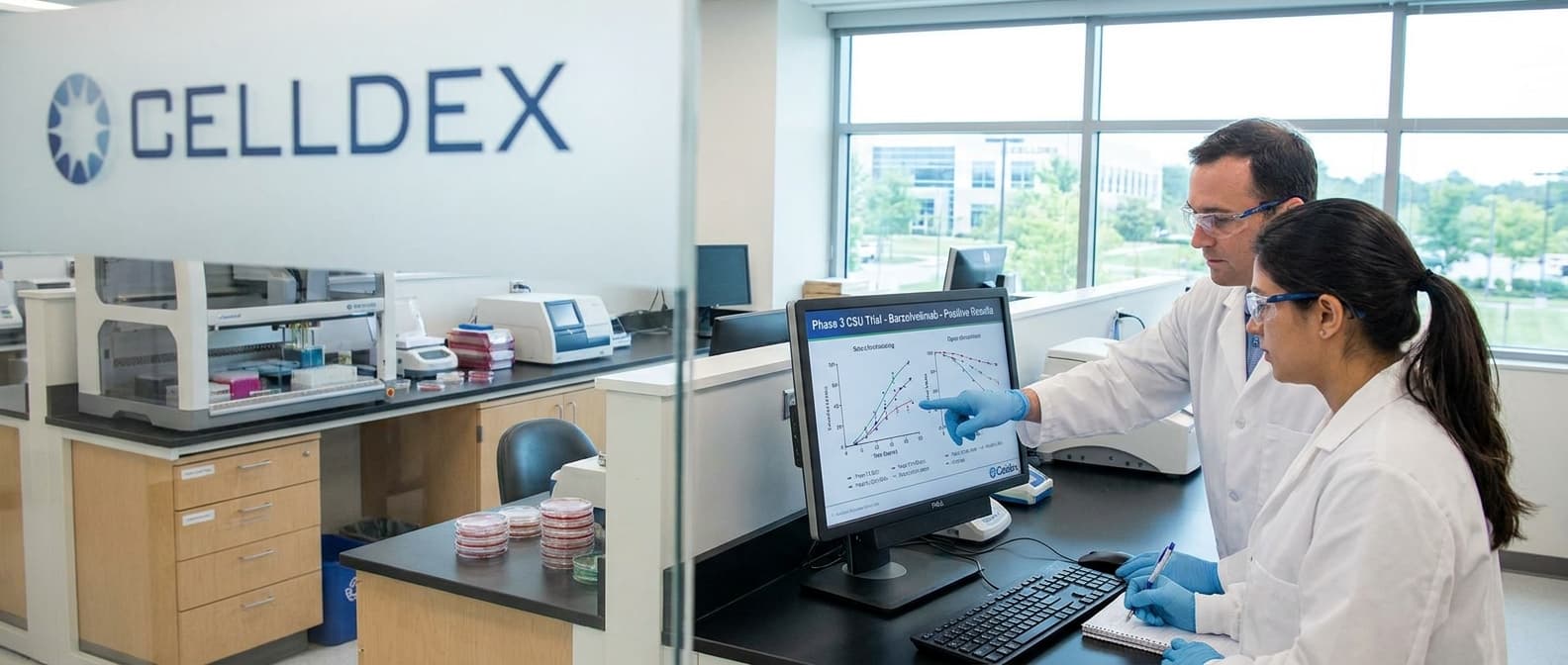
Celldex reported a pair of phase 3 wins for barzolvolimab in treatment-refractory chronic spontaneous urticaria, giving the monoclonal antibody a potential route to FDA filing in 2027 after a recent miss in another dermatology indication.
Barzolvolimab binds to the receptor tyrosine kinase KIT and inhibits its activity. Celldex is targeting mast cells, which the company describes as the primary drivers of the inflammatory response in chronic spontaneous urticaria, where abnormal activation can lead to itchy hives and swelling.
The data
The Embarq CSU1 and CSU2 trials enrolled a combined 1,939 patients in randomized, double-blind, placebo-controlled global studies. Patients received 150 mg of subcutaneous barzolvolimab every four weeks following a 300-mg loading dose, 300 mg every eight weeks following a 450-mg loading dose for 52 weeks, or placebo for 24 weeks.
Celldex said patients on either dose showed significant improvement in daily itch and hive scores, measured by the weekly urticaria activity score, or UAS7, at week 12. The company also said significantly more patients achieved a complete response with either the 150-mg or 300-mg dose at both 12 and 24 weeks compared with placebo.
The studies included patients whose CSU was resistant to treatment with Genentech and Novartis’ Xolair. In that subpopulation, 55.3% and 41.7% of patients treated with the 150-mg dose achieved a complete response, versus 9.3% and 15.1% in the placebo groups at week 12. For the 300-mg dose, 44.3% and 46.4% achieved a complete response by week 12.
Celldex said only two patients experienced anaphylaxis after administration. On the company’s Sept. 22 conference call, it said the overall discontinuation rate was 16%, mainly due to patients withdrawing consent.
The signal
The readout matters because it restores momentum to barzolvolimab after the drug failed a phase 2 prurigo nodularis trial in July 2026, missing its primary itch endpoint at week 12 and failing to move secondary endpoints despite what Celldex then described as profound systemic mast cell depletion.
That contrast suggests the company’s mast cell strategy may be translating more clearly in CSU than in other inflammatory skin diseases. It also puts Celldex back into an increasingly active CSU field one day after Cue Biopharma said its phase 2 candidate CUE-221 hit its primary endpoint and supported a move into a phase 2b/3 trial.
The phase 3 trials will continue for 52 weeks, but Celldex has already framed the current dataset as sufficient to support an FDA submission next year.