Acadia Pharmaceuticals is moving remlifanserin forward in Alzheimer’s disease psychosis even after the phase 2 portion of its ongoing phase 2/3 RADIANT trial missed its primary endpoint. The company called the outcome a narrow miss and argued the overall package is still phase 3-enabling, a view that found at least partial support from BMO Capital analysts, though Stifel said it still lacks a path to conviction.
The asset, also called ACP-204, is a 5HT2A receptor inverse agonist being tested for hallucinations and delusions associated with Alzheimer’s disease psychosis. It hits the same target as Acadia’s Nuplazid but is designed to be less prone to causing QT prolongation, a cardiac adverse event that has mattered in how investors compare the two programs.
The data
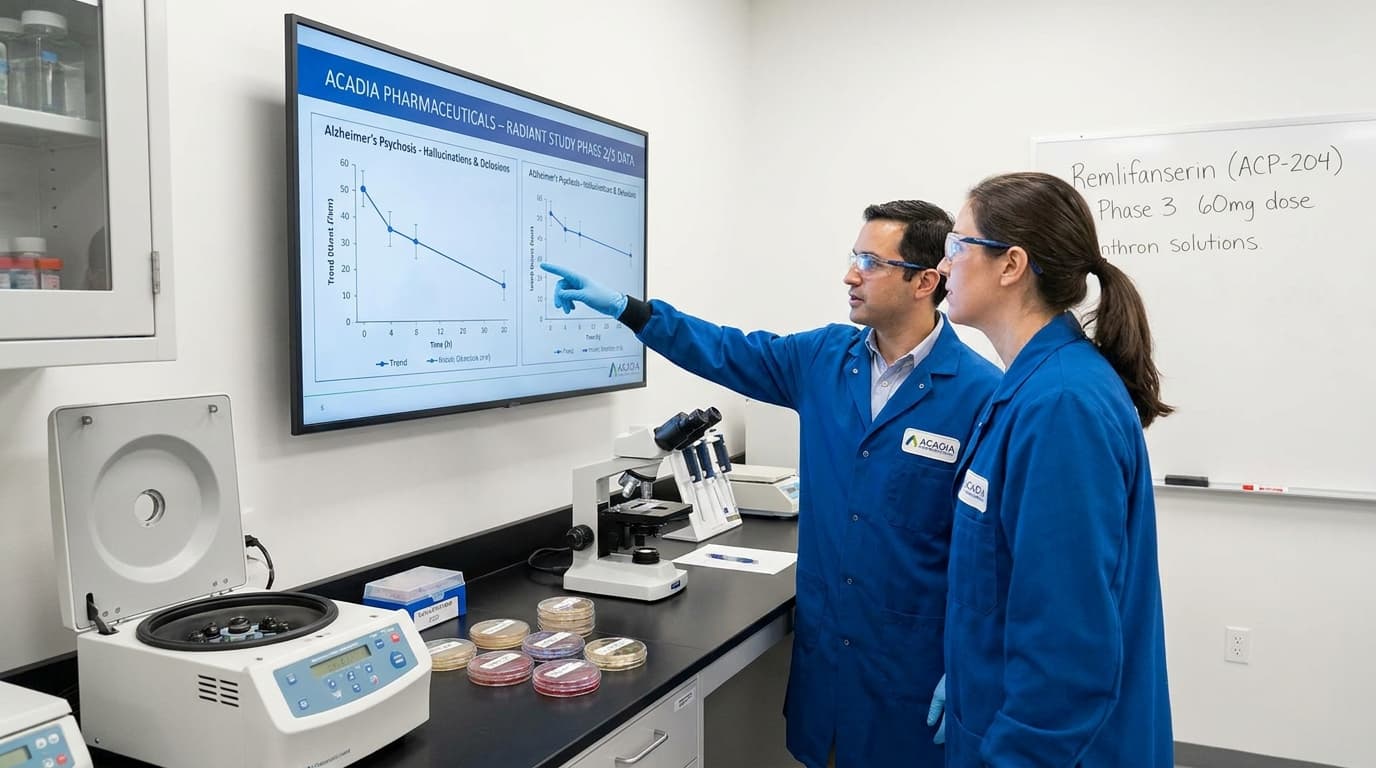
In the phase 2 part of RADIANT, the 60-mg dose of remlifanserin produced a 12.6-point drop on an assessment of hallucinations and delusions at Week 6, versus a 10.4-point decline on placebo. That left the study with a 0.26 effect size and a p-value of 0.0603, just above the 0.05 threshold for statistical significance.
That outcome missed not only the formal primary endpoint but also outside expectations. TD Cowen had named an effect size of 0.35 to 0.4 as the most likely outcome in a Sept. 15 note to investors. BMO instead described the readout as a “near miss,” pointing to how close the p-value came to significance.
Acadia’s case for continuing rests on what came after the primary analysis. On a key secondary endpoint measuring symptom severity, the 60-mg cohort showed a 1.3-point reduction, compared with a 0.9-point reduction on placebo, which the company said was statistically significant. By contrast, the 30-mg dose showed minimal activity or minimal improvement across endpoints compared with placebo, depending on the source’s phrasing.
Management now plans to remove that 30-mg arm from the ongoing phase 3 portion of RADIANT. When asked whether Acadia would also change the primary endpoint in phase 3, CEO Catherine Owen Adams said, “at this point, we’re not proposing that.”
The safety picture
Safety is a major part of why Acadia is still investing. The company said rates of adverse events were similar in the treatment and placebo groups, with similar rates of serious adverse events and discontinuations due to side effects. There were no deaths on remlifanserin, no signal of QT prolongation versus placebo and no evidence that the drug negatively affected motor symptoms or cognition.
That matters beyond Alzheimer’s psychosis. BMO said the absence of a QT signal represents an improvement over Nuplazid and may improve confidence in Acadia’s separate phase 2 trial in psychosis associated with Lewy body dementia. The lack of motor impairment also remains important in Alzheimer’s psychosis, where, as BMO noted, off-label dopamine agent use can lead to long-term motor impairment in some patients.
The commercial picture
The immediate market reaction was negative. As of market open, Acadia’s stock slid nearly 10%, resting at $23 per share. Investors appear to be balancing the unmet need in the indication against the fact that the first efficacy test did not clear its main bar.
Acadia is leaning hard on that unmet-need argument. Owen Adams said the efficacy seen so far, together with the safety and tolerability profile, makes the drug “absolutely worth” taking into phase 3. The company has also highlighted that more than 7 million Americans live with Alzheimer’s disease and about 30% of those patients experience psychosis. In July, remlifanserin received Fast Track status from the FDA in this indication.
The signal from this readout is less that Acadia has de-risked the program than that it believes safety and dose optimization may still salvage a difficult indication. Dropping the low-dose arm could increase the study’s power, as Stifel noted, but the company is still asking phase 3 to confirm efficacy after phase 2 failed to do so on the primary endpoint.
What to watch
The next inflection point is the ongoing phase 3 portion of RADIANT, now centered on the 60-mg dose. Separate from Alzheimer’s psychosis, Acadia is also continuing a mid-stage study of remlifanserin in psychosis associated with Lewy body dementia, with a phase 2 readout expected in early 2028, according to ClinicalTrials.gov.