A study published in Nature Biotechnology introduces scSTAMP-seq, short for single-cell spatial transcriptomic and multiomic profiling, as a modular barcoding strategy for adding spatial information to standard single-cell workflows. The authors position the method around a familiar problem in the field: high-content single-cell sequencing is powerful, but spatial context is often lost when cells are dissociated for analysis.
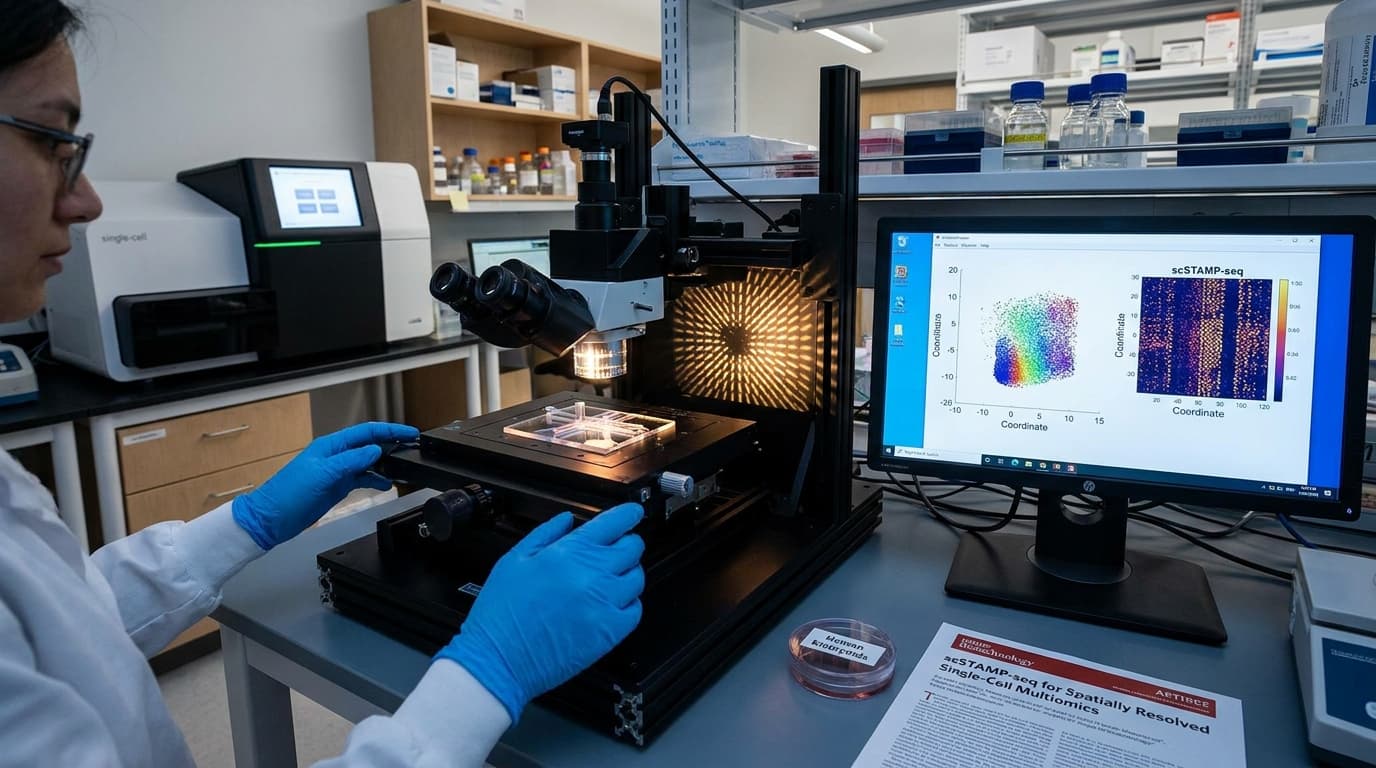
The approach labels live and fixed cells with cholesterol-conjugated, photocleavable hashtag oligonucleotides. Patterned light exposure then photocleaves the tags in a way that stamps spatial coordinates onto individual cells, after which the cells can proceed into single-cell multiome sequencing. In practical terms, the paper is proposing a bridge between in situ spatial encoding and established downstream sequencing platforms, rather than a fully separate spatial readout stack.
The method
The core technical claim is that scSTAMP-seq preserves spatial information while leveraging standard single-cell platforms. That matters because many spatial techniques force users into specialized imaging-heavy or tissue-bound workflows, whereas this design is presented as modular and compatible with existing single-cell infrastructure.
The use of photocleavable oligonucleotides and patterned light is the distinguishing feature. Instead of inferring where a cell came from after dissociation, the method assigns a spatial barcode before sequencing by exposing defined regions to light. The cholesterol-conjugated hashtag oligonucleotides provide the membrane-associated labeling step, and the light pattern creates the topological gradient that encodes location.
Because the paper describes the workflow as applicable to both live and fixed cells, the platform could be relevant across experimental settings that prioritize either functional cell handling or preserved specimens. The study also frames scSTAMP-seq as multiomic, not transcriptomic alone, which is an important distinction for groups trying to connect gene expression states with chromatin-level regulation in the same cells.
What The Study Shows
The authors apply scSTAMP-seq to human embryoids and report that spatial organization and epigenetic states coregulate cellular programs in these heterogeneous systems. That application functions as both a biological use case and a proof point for the platform’s intended value: combining spatial position with transcriptomic and epigenomic information at single-cell resolution.
The paper does not just present a new barcode chemistry; it argues that spatial patterning can be integrated with multiome sequencing to study how cell state emerges from both location and chromatin context. In the embryoid setting, that is a meaningful test bed because heterogeneous developmental systems are exactly where dissociation-based sequencing can erase some of the structure researchers want to understand.
For the broader single-cell field, the signal is that the commercial and scientific opportunity may increasingly sit with techniques that plug into standard platforms rather than replace them. If scSTAMP-seq proves reproducible beyond the initial study, its main advantage may be workflow fit: preserving spatial coordinates without giving up the scale and assay flexibility of mainstream single-cell sequencing.
The authors state that raw and processed sequencing data from the study were deposited in the National Center for Biotechnology Information Gene Expression Omnibus under accession number GSE237524. They also state that custom code and documentation for scSTAMP-seq analysis are available on GitHub at https://github.com/deylabucsb/scSTAMP-seq.