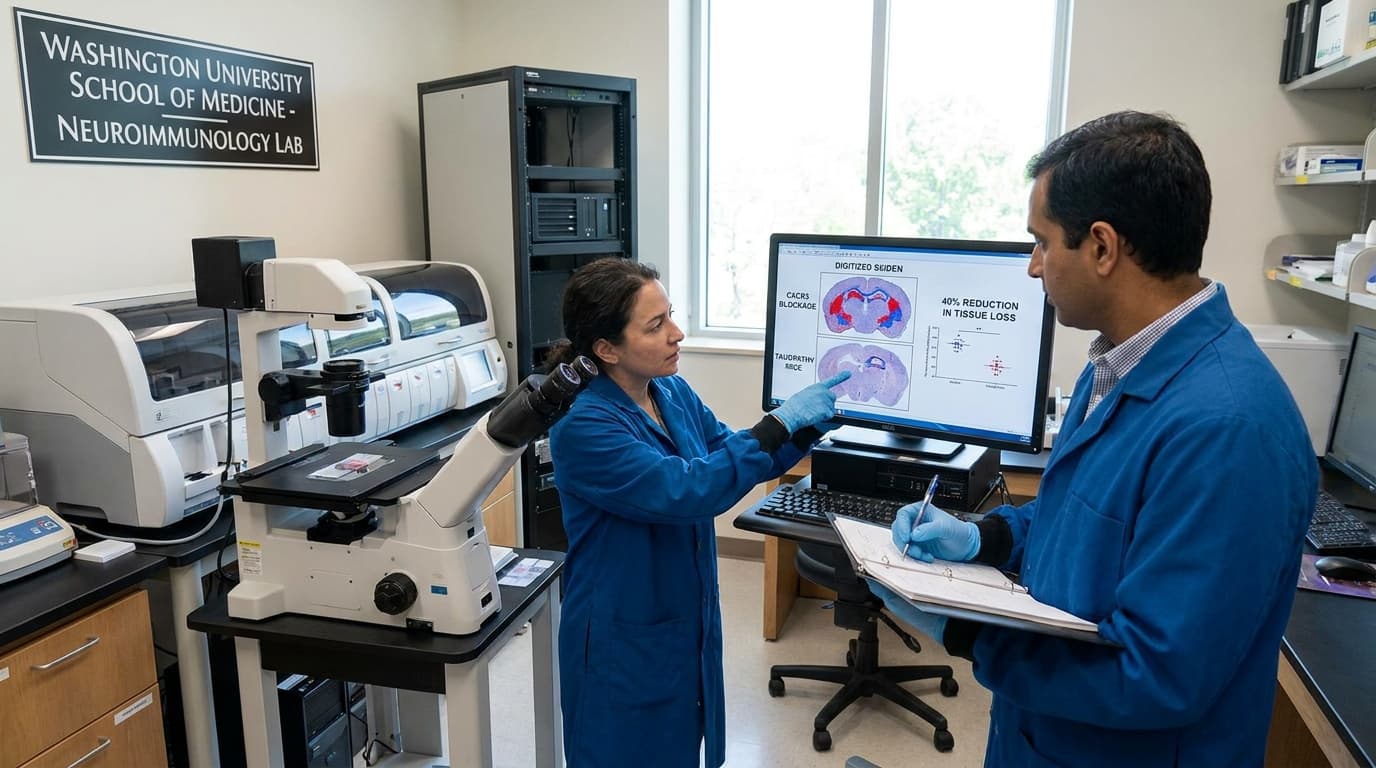
Washington University in St. Louis researchers reported preclinical evidence that limiting T cell entry into the brain may slow neurodegeneration in Alzheimer’s-related disease models. In mice modeling Alzheimer’s disease and other tauopathies, an antibody that blocks CXCR3 kept T cells from accumulating in the brain, reduced tissue loss in memory-related regions, and improved performance on standard memory tests.
The work adds to a growing line of research that shifts attention from protein buildup alone to the immune system’s role in neuronal damage. Its strategic significance is that it suggests a way to slow degeneration without depending on drugs that must reach the brain, a constraint that shapes current Alzheimer’s therapy design.
The data
The researchers studied mice used to model Alzheimer’s disease and other tauopathies, which are marked by buildup of the protein tau. They treated the animals with an antibody that blocks CXCR3, a molecule immune cells use to home in on sites of infection and damage.
Blocking CXCR3 prevented T cells from building up in the mice brains. In treated animals, loss of brain tissue in memory-related brain regions was 40% less than in untreated counterparts. The treated mice also did better on standard memory tests.
One important qualifier in the results is that both treated and untreated groups had similar levels of tau. That means the apparent benefit did not come from reducing the protein burden itself. Instead, the study points to immune-cell trafficking as a distinct lever that may influence how much damage tau-associated disease causes.
Why this matters
Much of Alzheimer’s drug development has focused on protein clumps linked to the disease. This study supports a different framing: downstream immune activity may be part of what turns pathology into tissue loss and functional decline.
That distinction matters commercially and scientifically. If neurodegeneration can be slowed by stopping damaging immune cells from entering the brain, developers may not need every effective therapy to directly clear tau or to cross the blood-brain barrier. A peripheral mechanism could widen the set of drug formats that are feasible to test, while also creating combination possibilities with therapies aimed at protein pathology.
The results also sharpen an emerging signal in neurodegeneration research. Similar tau levels paired with different outcomes in tissue loss and memory suggest that measuring pathology alone may miss clinically relevant biology. For developers, that raises the importance of selecting endpoints that capture function and neuroprotection, not just biomarker movement.
What to watch
The main limitation is translation. The report notes it is unclear whether the findings will hold up in people. That caution is central: the study was done in mice, and immune mechanisms that appear tractable in animal models often prove harder to reproduce in human neurodegenerative disease.
Still, the paper, published in Neuron, gives the field a more specific immunology target than a broad claim that inflammation matters. The next signal will be whether CXCR3-linked T cell exclusion can be reproduced beyond these models and whether the approach can preserve function in ways that remain meaningful when moved out of preclinical systems.