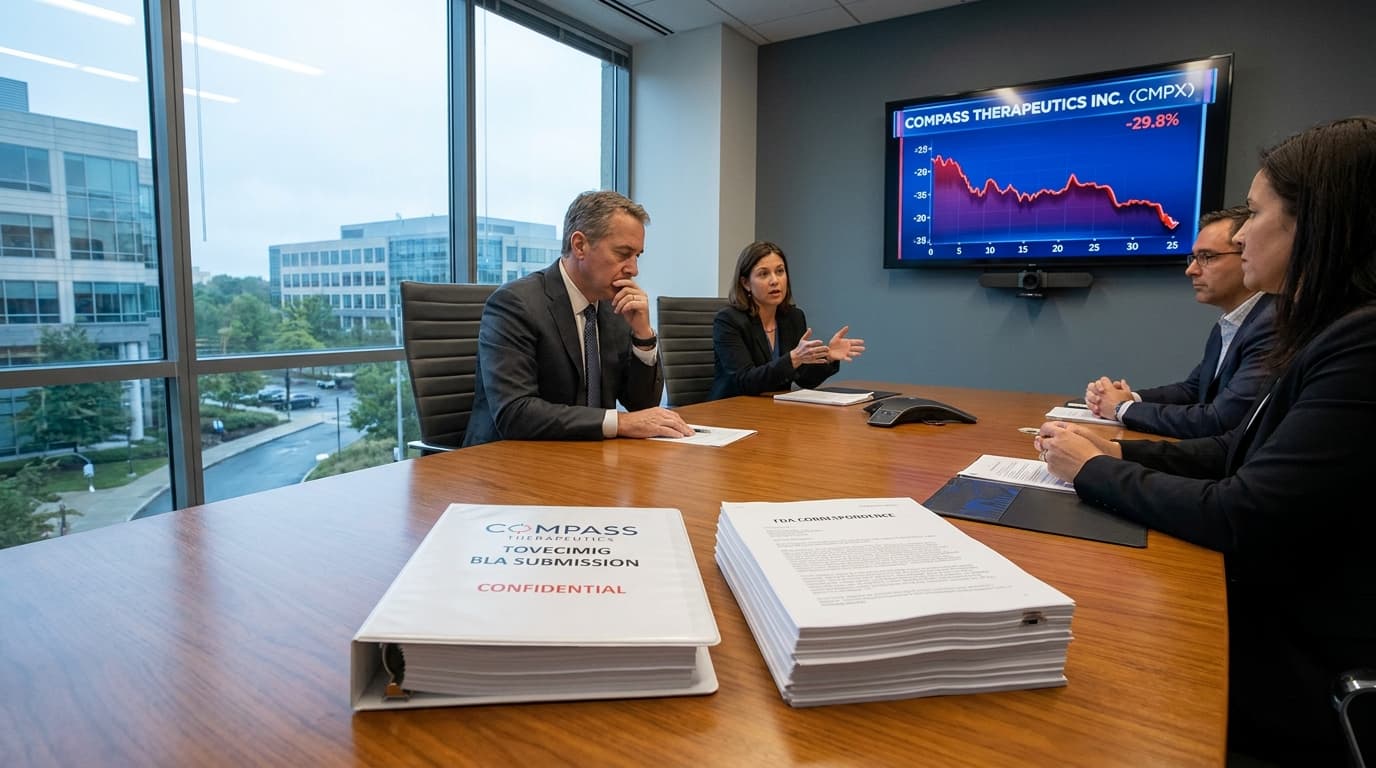
Compass Therapeutics said it will proceed with a biologics license application for tovecimig in advanced biliary tract cancer even after the FDA recommended a new clinical trial to demonstrate an overall survival benefit before submission. The feedback landed after discussions last month and pushed Compass shares down nearly 30% to $1.29 on Tuesday morning.
The company is trying to avoid what Leerink Partners said would likely be a three-year delay if it ran the additional study first. That matters because Compass says the existing Phase 2/3 COMPANION-002 dataset still shows clinically meaningful activity in previously treated, advanced biliary tract cancer despite the survival result not reaching statistical significance.
The data
Compass reported in April that COMPANION-002 met its primary endpoint on progression-free survival. Patients on tovecimig plus chemotherapy had average progression-free survival of 4.7 months versus 2.6 months in the control arm, and the company said the data suggest a 56% reduction in the risk of disease progression.
The trial also showed an objective response rate of 18% for patients who received tovecimig plus chemotherapy compared with 5.3% for patients who received chemotherapy alone. But the secondary endpoint of overall survival was not met.
Compass said the overall survival analysis was confounded by both high crossover and notably prolonged survival in crossover patients who were randomized to the control arm and then treated with tovecimig. CEO Thomas Schuetz said the company remains confident the statistically significant improvements in progression-free survival and objective response rate, together with subset analyses on survival, support the drug’s activity in this setting.
The regulatory picture
The immediate issue is not a safety finding. Leerink noted that the FDA did not ask for a new study to establish safety or clarify potential toxicities, which leaves open the possibility that Compass can still try to navigate a filing based on the current package.
Compass said it will engage with the FDA on a path forward while maintaining its planned BLA submission. Schuetz said the company respects the agency’s feedback even though it was not the response the company expected.
The regulatory signal for the broader sector is that the FDA is still pressing for survival evidence in hard-to-treat oncology settings even when a study hits progression-based endpoints. At the same time, the agency’s recommendation rather than an explicit precondition gives Compass room to attempt an at-risk filing.
The road here
BioSpace noted that analysts had already viewed the April readout as a challenge for an FDA application because the trial’s main efficacy success did not extend to overall survival. Tuesday’s update turned that concern into a direct regulatory obstacle.
Leerink compared Compass’s position with Summit Therapeutics, where the FDA also requested an additional study to demonstrate overall survival before a U.S. approval filing for ivonescimab in EGFR positive non-small cell lung cancer. Summit did not run that new trial, yet the FDA accepted the BLA and set a decision date of November 14.
Leerink said Compass is seeking to re-engage with the FDA and use every available lever, including a citizens’ petition. The firm also pointed to Replimune’s earlier success after an advisory committee meeting for the melanoma drug now approved as Tudriqev, suggesting that forum can sometimes help a company defend a disputed efficacy package.