
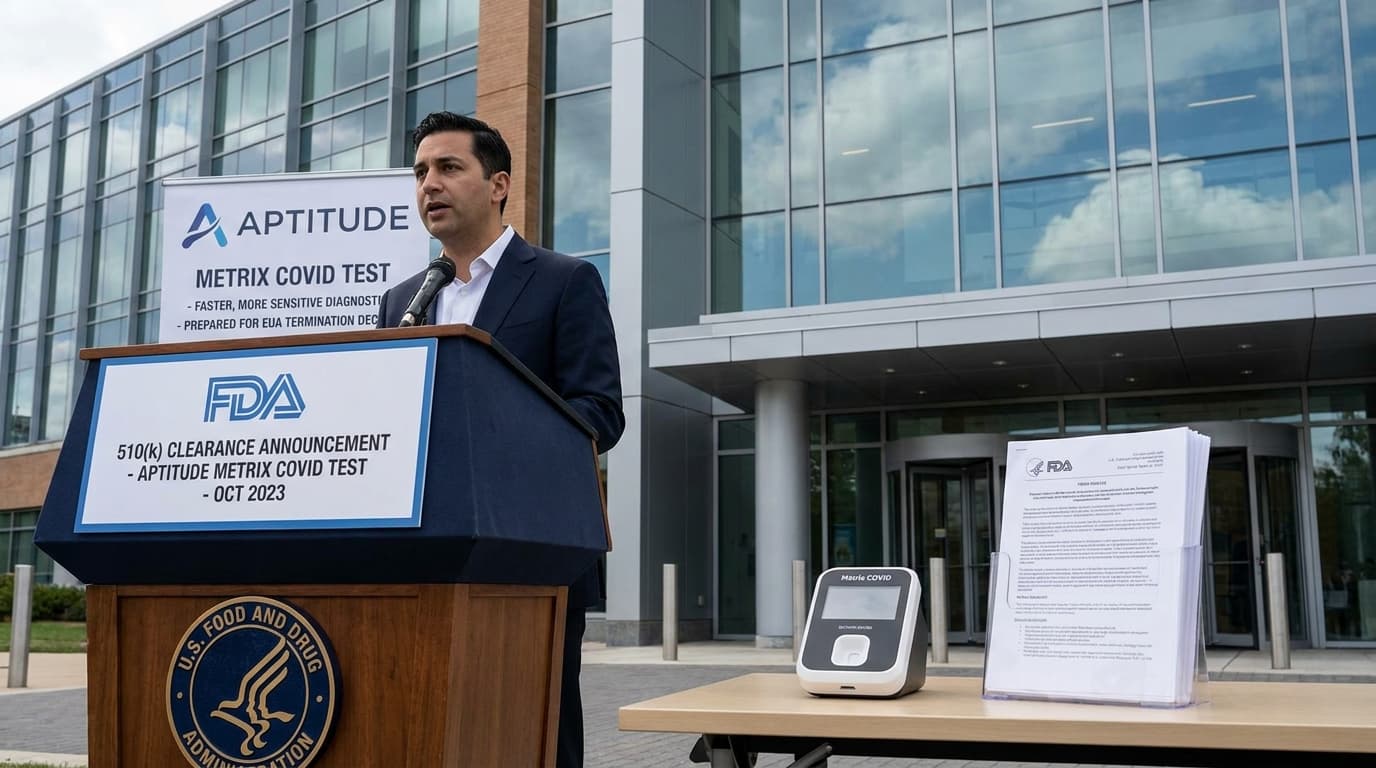
Aptitude said the FDA granted its first 510(k) clearance for the next-generation Metrix COVID diagnostic, giving the company a standard regulatory clearance before the HHS move to terminate COVID-19 Emergency Use Authorization on December 26. The company said the product offers three-times greater sensitivity and 30% faster results than its original emergency use authorized test.
The timing is the main signal. As the EUA period closes, companies that convert COVID products to 510(k)-cleared status are in a stronger position to preserve access and purchasing continuity, while products tied only to emergency pathways face more uncertainty.
What The Clearance Covers
Aptitude said the hand-sized diagnostic is now cleared for over-the-counter use and for professional use in CLIA-waived settings. That expands the addressable market beyond a narrow clinical channel and gives the company a clearer commercial route during the upcoming respiratory season.
The latest Metrix diagnostic was supported by the U.S. Health and Human Services’ Biomedical Advanced Research and Development Authority. JP Wang, Aptitude’s co-CEO, said the company is continuing to develop the Metrix platform with faster tests, better performance, simpler operations and a broader menu.
The Transition Beyond EUA
Aptitude said it does not expect any disruptions to product availability during the upcoming respiratory season. During the transition period ahead of the EUA policy termination, all previously distributed Metrix products can continue to be used based on their expiration dates.
The clearance also sets up the next regulatory step for the platform. Aptitude’s Metrix COVID/Flu test is under FDA review for 510(k) clearance, and the company said it is expanding the platform toward RSV, strep and sexually transmitted infections. Those diagnostics are either in late-stage development or under FDA review.
For Aptitude, that makes this decision more than a single-product update. It is an early proof that the company can move its menu from emergency-era authorization into conventional clearance pathways.


