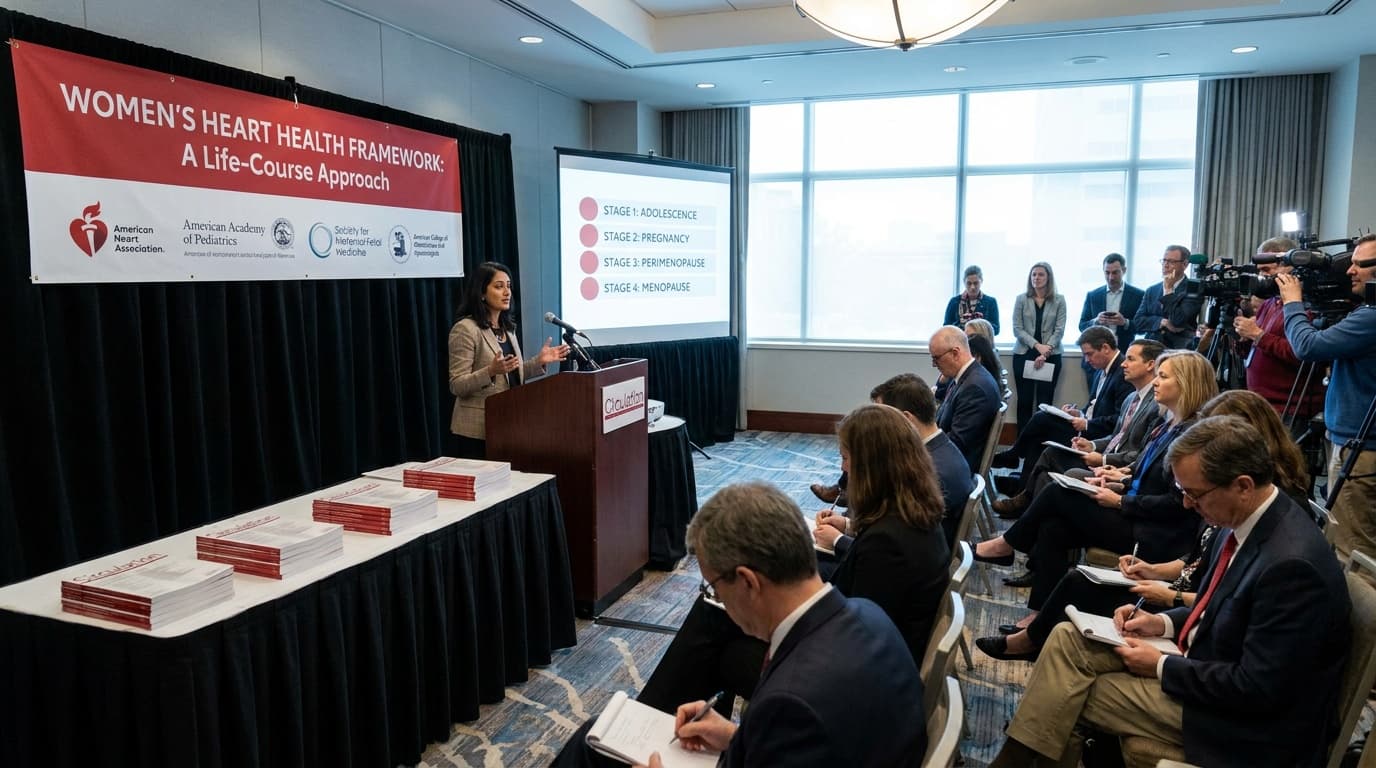
Four medical societies have published a new framework for women’s cardiovascular care built around four life stages, arguing that the way care is typically split across specialties misses how female-specific biology shapes heart health over time. The guidance, published Monday in Circulation, comes from the American Heart Association, American Academy of Pediatrics, Society for Maternal-Fetal Medicine, and the American College of Obstetricians and Gynecologists.
The stated aim is to unite clinicians and patients over a lifetime of care and help dislodge cardiovascular disease as the leading cause of death in women. In comments to STAT, writing group chair Sadiya Khan, a professor of cardiovascular epidemiology at Northwestern University Feinberg School of Medicine, described the core problem as siloed care in a population that often moves among many clinicians.
The framework
The three articles in Circulation present guidance across the course of a woman’s life and argue that care should reflect transitions not found in the male models that have long dominated health care: periods, pregnancy, perimenopause, and menopause. Khan said what happens in adolescence and young adulthood can shape cardiovascular health for years and decades, making early action materially important rather than preparatory.
That framing treats hormonally mediated transitions as cardiovascular events as well as reproductive ones. Khan said the departure from sex-agnostic medicine begins around perimenarche, the time around the first period, and should continue across the life course rather than end with reproductive or hormonal health.
Where the guidance concentrates risk
Pregnancy is one example the group uses to show why disconnected care can miss longer-term implications. Khan pointed to links between blood pressure and diabetes in pregnancy, saying those issues matter not only during pregnancy but across the life course, and that the transition from postpartum care to primary care to preventive care has gained attention for that reason.
The guidance also identifies perimenopause as a cardiovascular inflection point. It defines that transition as variable period cycle length, skipped cycles, and hormone changes occurring from about age 45 to 51. During that period, changes in cholesterol and metabolic health can serve as early signs of cardiovascular risk, and Khan said identifying that risk early and acting on it may reduce later cardiovascular disease.
In adolescence, the framework broadens cardiovascular assessment beyond conventional risk markers. Khan said changes in cycle duration and bleeding matter partly because heavy menstrual bleeding can lead to iron deficiency, which can impair activity or exercise and also impair cardiovascular health. She also said abnormal periods can flag polyendocrine metabolic ovarian syndrome, as it is now called, a condition that usually takes years to diagnose in teens and young adults.
Mental and psychosocial health are also presented as connected to cardiovascular health rather than separate domains. Khan said depression and anxiety in teen girls start to increase and continue through life, with pregnancy and postpartum periods bringing further increases related to hormonal change. She added that eating disorders, disordered eating, poverty, unequal compensation, and single parenthood are part of the cardiovascular picture because structural and societal gender norms influence health.
The signal
The strategic implication of the framework is less about a new intervention than about where responsibility sits. By creating shared language for clinicians and patients about what is normal, what to expect, and what should prompt attention at each stage, the societies are pushing for a model in which cardiovascular prevention begins earlier and follows women through handoffs that are often treated as separate episodes of care.
If that approach gains traction, the operational change for health systems is not simply more screening. It is a stronger expectation that adolescence, pregnancy, postpartum care, perimenopause, and menopause each feed into longitudinal cardiovascular risk management rather than being handled as isolated specialties.