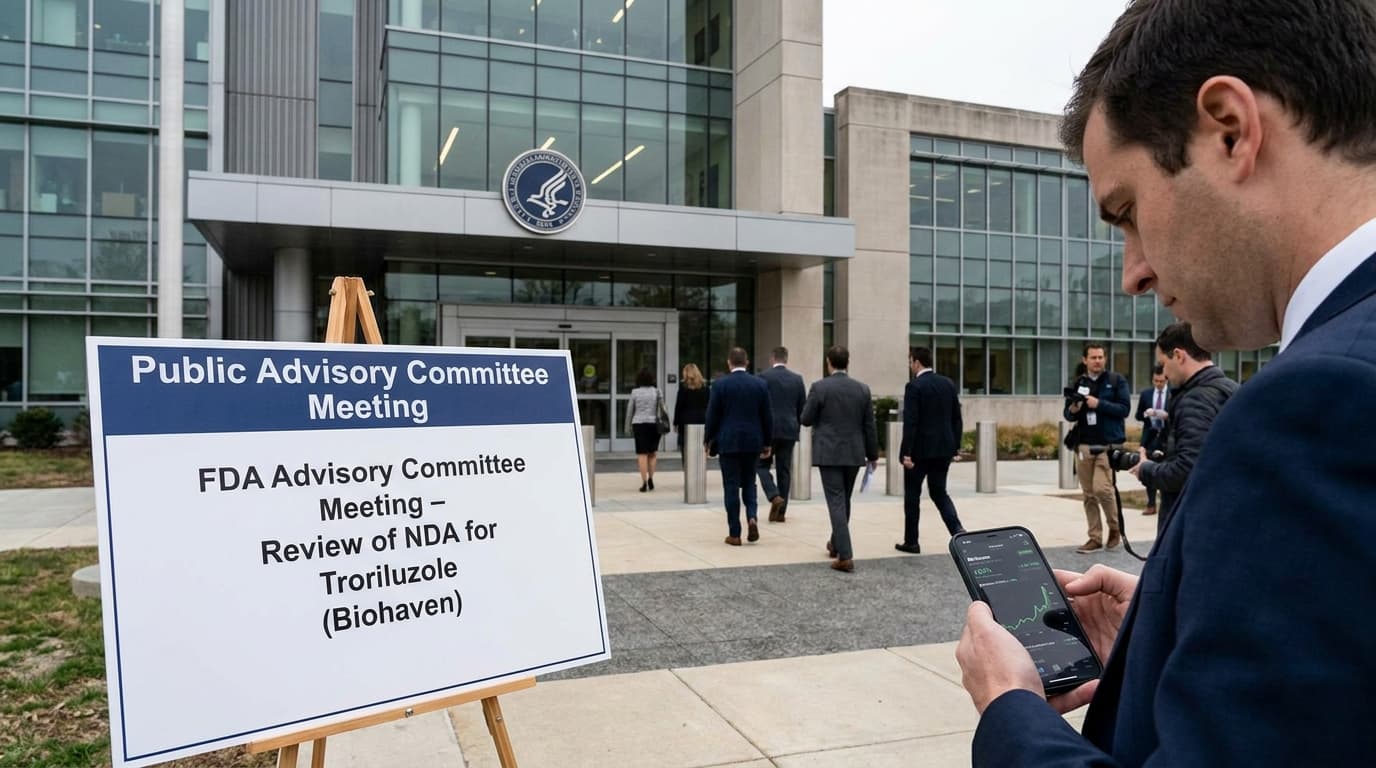
Biohaven shares rose as much as 36% Thursday morning after the company disclosed that the FDA accepted its resubmission for troriluzole in spinocerebellar ataxia, a rare degenerative disorder. In a Thursday SEC filing, Biohaven said the FDA assigned a new action date in the first quarter of next year and intends to hold an advisory committee meeting, with a date to be set “in the near term.”
The filing matters because the agency had issued a complete response letter for the application in November 2025, rejecting the drug for use in spinocerebellar ataxia. By 10:40 a.m. ET on Thursday, Biohaven shares were at $15.41, up 30% from the prior close, after the stock had fallen nearly 45% to $7.60 per share following last year's setback.
The Road Back To Review
The prior rejection centered on the company’s evidentiary approach. According to the source, the FDA cited “issues that can be inherent to real-world evidence and external control studies including potential bias.” Biohaven’s package had relied on a three-year real-world evidence trial, study 206-RWE, which compared troriluzole to a natural history database using a movement scale modified for spinocerebellar ataxia as primary evidence to support effectiveness.
Before finalizing the Phase 3 study design, Biohaven had received FDA feedback that “a large and robust treatment effect would be needed to overcome the biases of an externally controlled trial, in order for it to be used as the primary basis for substantial evidence for effectiveness,” according to a Nov. 4, 2025 Biohaven press release cited in the report. After the complete response letter, the company said it believed the trial met that bar, pointing to statistical significance and clinical meaningfulness on the primary endpoint and eight consecutive secondary endpoints.
What Changes Now
Biohaven said the resubmission includes new positive supportive analyses, and the FDA considers the filing a complete response to the Nov. 4 complete response letter. William Blair wrote Thursday that the advisory committee is likely to be the key inflection point, specifically because of the FDA’s earlier reluctance to accept the company’s three-year real-world evidence trial.
The remaining investment debate is whether the updated analyses and committee discussion can convert a contested data package into an approvable rare-disease case. William Blair said it continues to view the risk-benefit profile as favorable in spinocerebellar ataxia, where there is no currently approved FDA therapy.
Spinocerebellar ataxia is a group of rare diseases that lead to progressive loss of control over movement, and many forms are genetic with no cure. Even though the Phase 3 study missed its primary endpoint of f-SARA, William Blair noted that comparisons to natural history controls showed a 50% to 70% slower rate of decline for patients taking a 200 mg dose, representing a delay of 1.5 to 2.2 years in disease progression over three years.