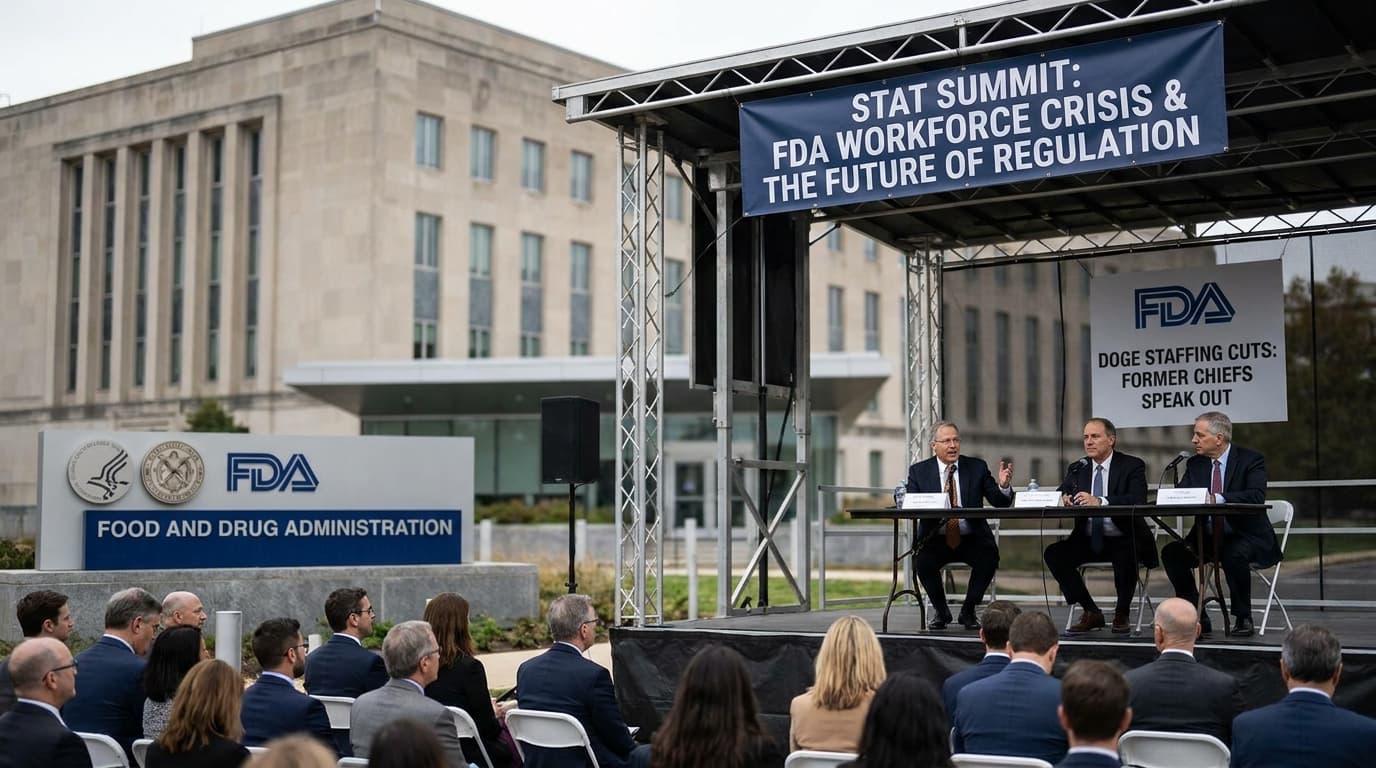
Three former Food and Drug Administration chiefs used a public forum this week to describe the FDA’s recent staffing losses as a structural blow to the agency, not a temporary disruption. Speaking at the STAT Summit in Boston, former commissioner Robert Califf called DOGE “one of the biggest disasters in American history,” arguing that mass layoffs and subsequent departures stripped out institutional knowledge that cannot be replaced quickly.
The criticism went beyond the initial cuts. According to the former officials, the loss of 3,500 workers under the Elon Musk-led initiative was followed by a larger staff exodus during the tenure of former FDA Commissioner Marty Makary, who resigned in May. White House official Heidi Overton has since been nominated to replace Makary, though she has not yet faced a Senate confirmation vote.
Why the workforce issue matters
Califf’s remarks were echoed by Scott Gottlieb, who led the agency for part of the first Trump administration, and Ned Sharpless, who served as acting commissioner toward the end of that administration. Sharpless said the cuts were “arbitrary” and described a practical consequence already showing up in industry interactions: companies he works with through Jupiter BioVentures are often meeting with more junior and less experienced drug and medical device reviewers.
That matters because the FDA’s value to the biopharmaceutical market depends partly on review consistency, accumulated expertise, and internal confidence in statutory decision-making. A thinner bench can slow judgment even when formal timelines do not change, especially if experienced staff are replaced by reviewers still learning how the agency handles difficult tradeoffs.
The former commissioners’ advice to Overton, if she is confirmed, was direct: “Recruit, support, and defend the workforce,” as Gottlieb put it. In their telling, the challenge is not simply to refill vacancies. It is to persuade staff that they will be protected from political meddling and future rounds of firing. That is a more difficult management problem because it goes to the credibility of the institution, not just headcount.
Signs of stabilization, with limits
Despite the criticism, the panel did not present the FDA as locked in decline. Califf said “the sowers of chaos came and went,” referring to departures of unnamed high-profile officials that the article says include Makary and former top drug and device regulators Vinay Prasad and Tracy Beth Høeg.
Gottlieb was notably more positive about the current setup, praising Kyle Diamantas, the agency’s top food regulator who is now acting commissioner, and policy lead Grace Graham. He said they are helping the FDA get “back to the basics” and restoring confidence that the regulatory agency is making rational decisions.
That combination of severe institutional criticism and guarded optimism is the main policy signal here. For companies, the former commissioners are not arguing that the FDA’s statutory role has changed. They are arguing that execution quality depends on whether current leadership can make the agency feel governable again.
Trust, vaccines, and the limits of the FDA’s mandate
The panel also addressed public trust in federal agencies, especially around vaccines. Sharpless said public communication during the Covid-19 pandemic included “errors,” and cited the politicization of vaccines as an early problem. Califf and Gottlieb were more pointed about health secretary Robert F. Kennedy Jr., with Califf saying Kennedy is “actively still eroding public confidence in these issues.”
At the same time, the former officials argued that some politically charged debates are outside the FDA’s core job. Sharpless said the agency’s mandate is not to change drug prices or solve vaccine hesitancy, but to work within statute to prioritize safe and effective medicine. That framing is important for industry because it suggests one route to stabilization: narrow the agency back to its formal remit and reduce the pressure to use it as a vehicle for broader cultural or economic fights.
Califf added that distrust in health agencies also reflects anger over high health care costs, saying frustration persists when biotech executives do not acknowledge that drugs are too expensive. Even so, the panel’s main conclusion was narrower than a general critique of the health system. Their argument was that the FDA can recover, but only if leadership restores professional security first and lets the agency operate in its statutory lane.