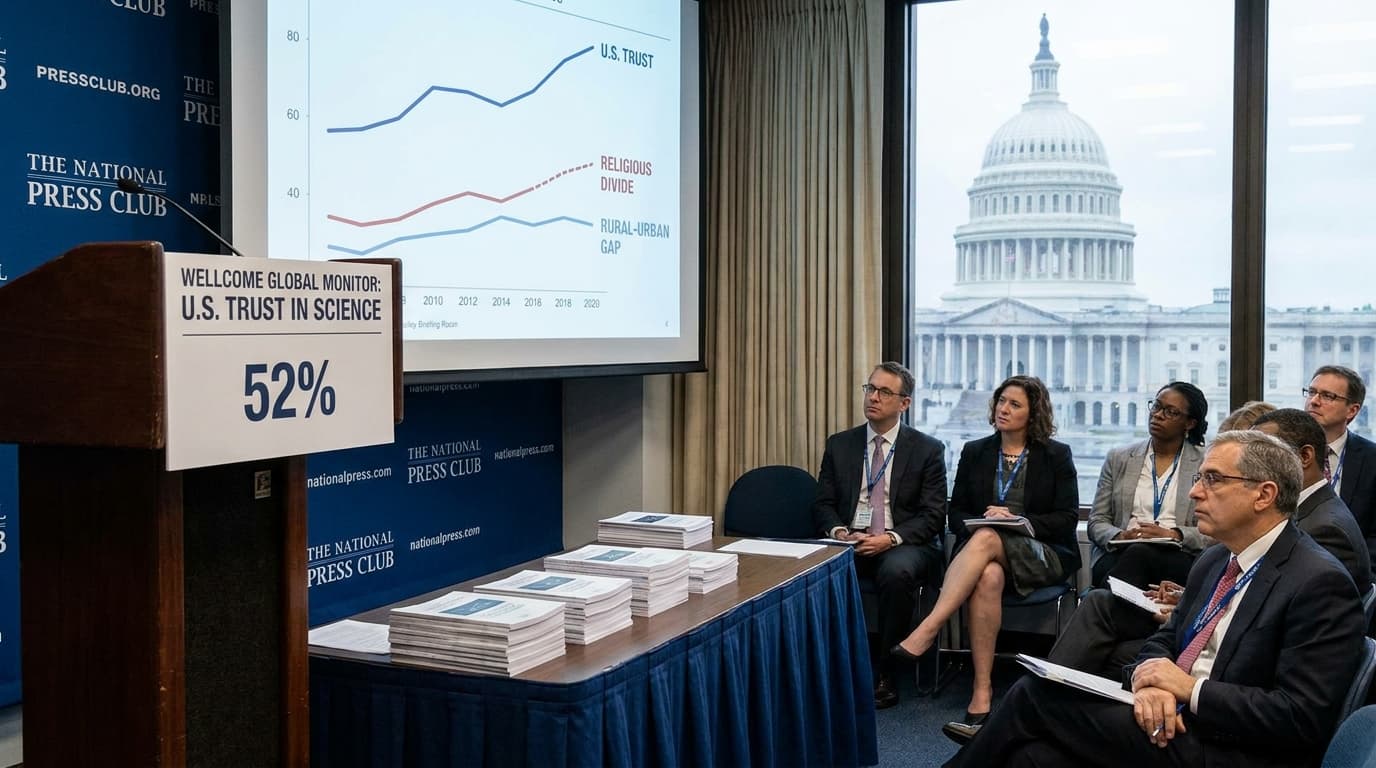
Americans report substantially higher trust in science than respondents around the world, according to the newest edition of the Wellcome Global Monitor, but the same survey points to a more polarized U.S. picture than the topline numbers suggest.
The survey found that 52% of Americans report having “a lot” of trust in science, compared with 26% globally. On vaccines, 45% of Americans said they would want to get shots recommended by a nurse or doctor “right away,” versus 28% in Germany. The share of Americans who agree that science benefits most people in their society also rose from 48% in 2018 to 57% in 2025, even as the global share fell from 42% to 37% over the same period.
For healthcare and policy leaders, that combination matters. The U.S. does not read as a simple anti-science market in this dataset. Instead, it looks like a market where trust remains relatively high overall, but access, identity, and lived experience shape whether people feel science is delivering tangible benefits.
The Divides
STAT’s analysis of the Wellcome data found the U.S. gap between religious and non-religious respondents on whether science benefits most people in the country was 24 percentage points. Across high-income nations, the average gap was 5 points.
A similar pattern appeared between urban and rural respondents. In the United States, the gap on whether science benefits most people was 19 percentage points, compared with 3 points across other high-income nations.
Education split Americans as well. Among Americans without four-year degrees, 47% said science benefits most people, versus 71% of college graduates.
Those figures suggest that aggregate trust is masking a distribution problem. If confidence in science tracks whether people can see its effects in daily life, then differences in care access, institutional proximity, and communication are likely shaping attitudes at least as much as abstract views about research.
What The Survey Captured
Wellcome, a British foundation focused on scientific research, funded the survey in 2018, 2020 and 2025. The latest edition was administered through the Gallup World Poll using in-person, telephone and online surveys of more than 140,000 adults. The global findings were weighted to reflect the relative populations of countries in the survey.
The survey itself does not explain why the United States appears to be outpacing peer countries on trust. Matthew Motta, an associate professor at Boston University School of Public Health who studies public opinion research, told STAT that Americans are “more extreme responders to public opinion surveys.” That framing helps explain why the U.S. can show both higher enthusiasm and stronger rejection than peers.
Germany is one example. While fewer Germans than Americans said they would get vaccines “right away,” only 8% of Germans said they would “not get vaccines at all,” compared with 13% of Americans. Much of the German response sat in the middle, with people saying they would prefer to think about it for some time.
The Policy Signal
The data also suggest the widening U.S. divide is not being driven mainly by traditionally less-trusting groups becoming markedly more negative. Americans who identify as religious and say science benefits most people increased from 46% in 2018 to 50% in 2025. Among Americans without four-year degrees, that measure rose by 3 percentage points over seven years.
Instead, the larger shift came from groups moving further in the other direction. College graduates showed a 13 percentage point increase in appreciation of science’s benefits, and secular Americans showed a 15 percentage point increase.
That has practical implications for public health strategy. Brian Castrucci, president and CEO of the de Beaumont Foundation, told STAT that some people feel left behind and do not understand how science benefits them personally. Wellcome also found that trust in science is closely associated with confidence in a nation’s health care systems, and only 40% of Americans reported a lot of confidence in U.S. hospitals and health clinics, the same share reported in Portugal and Uruguay.
Yotam Ophir, an associate professor of communication at the University at Buffalo, told STAT that diverging political views on science became visible during the Tea Party movement of the 2010s and were amplified during Trump’s presidency. The broader signal is that high national trust does not remove the execution problem. In the U.S., support for science appears strong enough to sustain demand for vaccination and research-backed care, but uneven enough that institutions still have to prove relevance community by community.