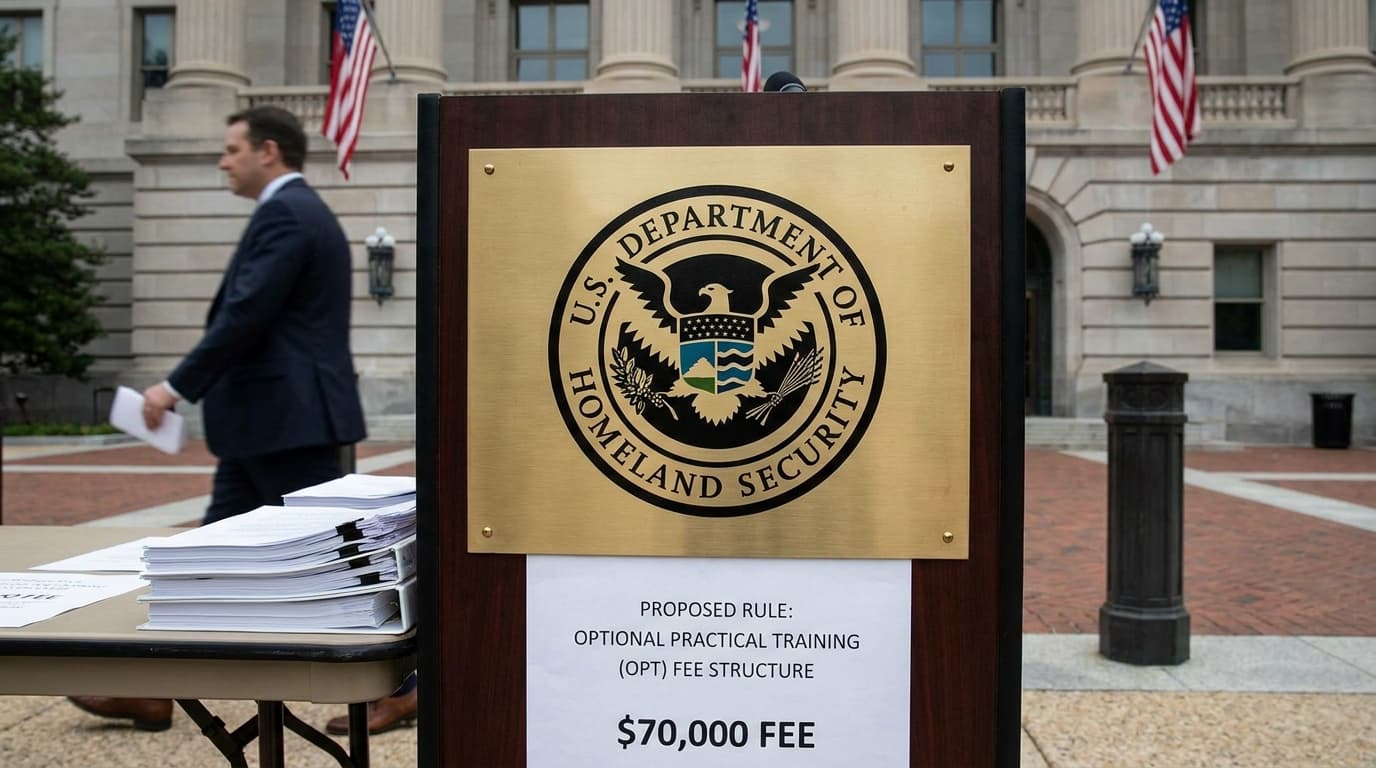
The Trump administration has proposed a new fee structure for Optional Practical Training, the work authorization program that lets international students gain professional experience related to their field of study while remaining on a student visa. The Department of Homeland Security said Wednesday that it wants to charge academic institutions $70,000 for each student they recommend for OPT, plus an additional $30,000 for students seeking to remain in the program beyond one year.
DHS said the fee is intended to address alleged fraud and abuse and to reduce competition facing U.S. citizens in the job market. If finalized, the department estimates the fees would generate $12.4 billion annually. The proposed rule is slated for publication in the Federal Register on Thursday, and DHS said it will accept public comments through November 9.
What the proposal would change
OPT requires a school administrator to recommend a student before the student applies for authorization from U.S. Citizenship and Immigration Services, a division of DHS. Students then have 90 days to find a job. For many participants, the program functions as a bridge to longer-term U.S. employment.
Under the proposal, the direct fee obligation would fall on academic institutions rather than students. That structure matters because it could force universities to decide whether to absorb the cost, pass it on through other channels, or become more selective in recommending candidates. In practice, the policy would not just make OPT more expensive; it could change which schools are willing to support participation at all.
The impact would be especially relevant in science fields. Experts cited by STAT note that international students and scholars make up about a quarter of life science Ph.D. graduates and 60% of postdoctoral researchers. Many science students also stay in OPT for three years, meaning the added $30,000 charge for participation beyond one year could hit a meaningful share of STEM trainees.
DHS's case and the likely tradeoffs
DHS argues OPT use has expanded sharply and that the growth has been accompanied by abuse. OPT authorizations for STEM graduates rose from nearly 27,500 in 2015 to more than 95,000 in 2024, according to the department. In the unpublished version of the proposed rule, DHS alleges “widespread” use of OPT as an unlimited employment benefit with little to no connection to a student’s area of study.
To support that argument, the department cited a 2020 incident in which federal agents arrested 15 foreign students charged with fraudulently using OPT to stay in the U.S. It also cited a more recent investigation that it said identified more than 10,000 international students working for “highly suspect” employers, in some cases involving empty or non-existent worksites.
At the same time, DHS acknowledged the proposal would carry economic costs. The agency estimates the new policy could lead to $4 billion a year in opportunity costs tied to students losing work experience, employers losing productivity if they cannot replace international workers, and academic institutions losing international student enrollment. DHS nonetheless said the benefits of protecting U.S. workers and preserving the integrity of the OPT program outweigh those costs.
That framing points to the core policy signal: this is not a narrow anti-fraud adjustment. It is a pricing mechanism designed to reduce program usage by making participation expensive enough to deter schools and, indirectly, students and employers.
The broader policy pattern
The proposal fits into a broader Trump administration push to tighten pathways used by international students, graduate researchers and postdocs. Last year, Trump issued an executive order that would impose a $100,000 fee on H-1B visas, though federal courts have blocked that fee for now and DHS has reintroduced it as a proposed rule.
The administration is also seeking to put four-year caps on how long students and postdocs can remain in the U.S., arguing that the longstanding policy allowing them to stay for the length of their training has incentivized fraud. A federal judge has issued a preliminary injunction preventing those time limits from taking effect, and the order states that the plaintiffs opposing the policy are likely to ultimately succeed in the ongoing lawsuit.
NAFSA: Association of International Educators, which is already suing DHS over that separate visa-duration effort, said the OPT fee proposal would deepen uncertainty. CEO Fanta Aw said OPT allows international students to gain the same hands-on experience as domestic peers while helping fill labor shortages in high-demand STEM fields and generating jobs for U.S. workers on U.S. soil.
The program’s strategic importance is reflected in a NAFSA survey conducted last year, which found that 54% of current graduate students and postdocs would not have come to the U.S. if OPT did not exist, though the survey did not ask about the effect of program fees. Because OPT was formally created in 1992 and has become a major draw for foreign students, a cost shock at this scale could affect not only immigration flows but also the research labor pool that universities and life science employers rely on.