Congo’s Ebola outbreak has killed more than 4,000 people, according to Health Ministry figures released Thursday, marking another escalation in what authorities described as the fastest-growing Ebola outbreak in history. Since the outbreak was declared in eastern Congo on May 15, authorities have recorded 8,300 cases and 4,018 deaths.
The numbers alone convey the scale, but the immediate challenge for containment is operational fragility. The response is facing strikes over unpaid wages, the loss of treatment infrastructure, continued insecurity, and resistance in some communities where residents dismiss Ebola as a hoax.
Pressure on the response system
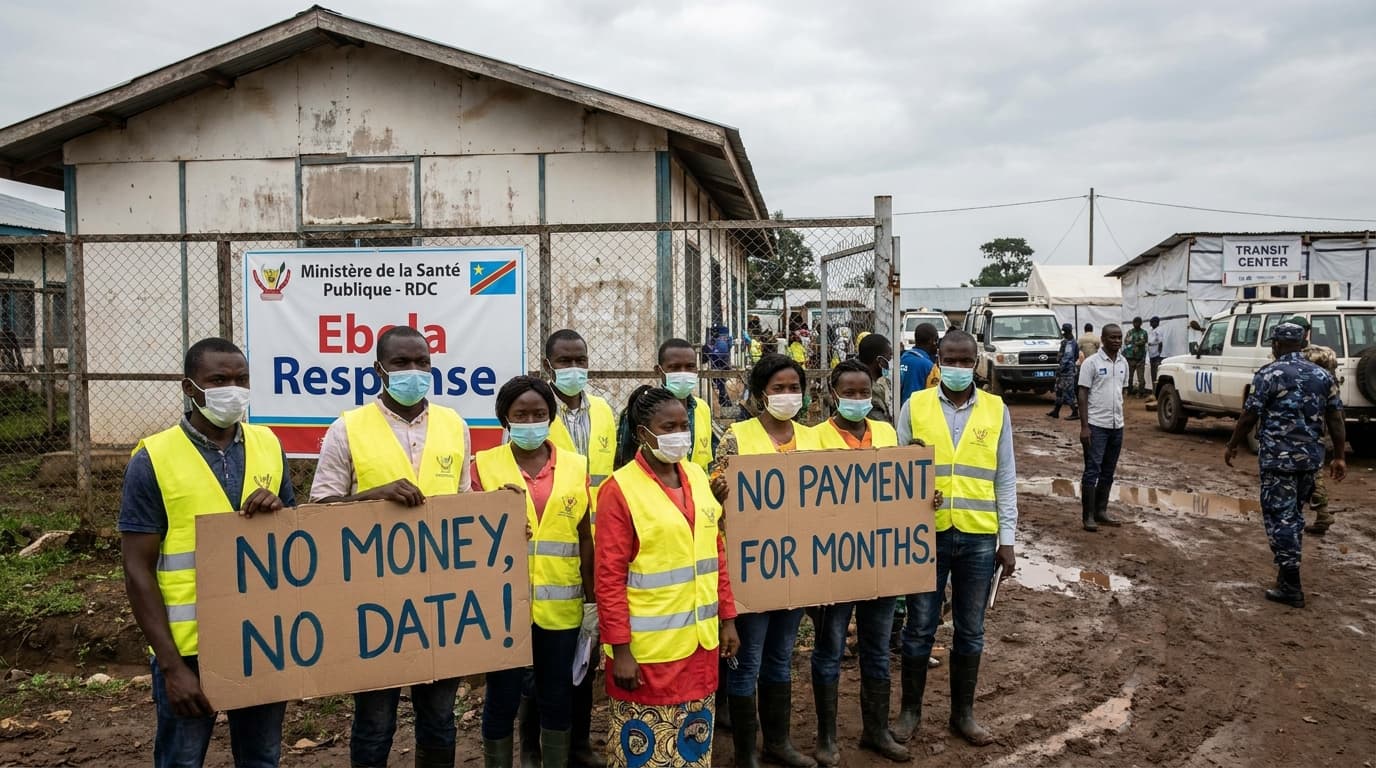
Some health workers gathered in Bunia, the capital of Ituri Province, to demand wages they said were owed for August and September. Protesters included surveillance team members carrying placards reading “No money, no data!” and “No payment for months.” Biongi Beiza, one of the protesters, said there had been no explanation from the administration. Congolese authorities did not immediately address the issue.
Front-line workers have gone on strike several times since the outbreak began, adding another constraint to an already stretched response. In an outbreak where surveillance and rapid case identification are central, payment delays are not just a labor issue; they directly affect the state’s ability to measure spread and interrupt transmission chains.
A separate setback came earlier this week when soldiers burned an Ebola-hit displacement camp that housed a transit center for infected patients in Kigonze, on the outskirts of Bunia, according to Julien Harneis, the U.N. senior Ebola coordinator. The soldiers were looking for weapons, he said, and 19,000 people in the camp fled.
Harneis said the destruction of such a center means losing capacity, losing prior investment, and having to rebuild from scratch. It also means patients lose access to care. In a fast-moving outbreak, treatment and transit sites are not interchangeable assets; each loss immediately reduces practical response capacity.
What is helping, and what is not
One of the tools improving response speed is the use of mobile laboratories. In Butembo, a medical team showed how test turnaround that previously took 72 hours can now be reduced to six hours, according to Lota Kalubi, a doctor at the treatment center there. Michel Ngimba of the National Institute of Biomedical Research in Butembo said the labs can also be moved quickly to emergency locations that are otherwise difficult to reach.
That speed matters because the broader outbreak picture remains mixed. The World Health Organization has raised the alarm about rapid spread into new health zones, which is stretching limited resources. Africa CDC said the number of newly confirmed cases is falling, but cautioned that the decline could reflect insecurity and difficulty securing community cooperation in some hot spots.
Confirmed cases fell from around 850 cases and 470 deaths a week in mid-July to an average of 490 cases and 230 deaths in September. Even so, the outbreak is still on track to exceed the deadliest on record, the West Africa regional outbreak between 2014 and 2016, which killed 11,000 people, according to WHO.
Trust and security remain core constraints
The outbreak is also exacting a toll on responders themselves. Médecins Sans Frontières said one of its aid workers was infected with Ebola while working in Congo and was transferred late Thursday to a high-level isolation unit at Leiden University Medical Center in the Netherlands after arriving on a special medical flight.
Local mistrust continues to complicate efforts to contain the virus. A Congolese politician was beaten to death earlier this week in one of the emerging hot spots after defending government measures, highlighting tensions around the response. Authorities last month launched a village-centered approach that works with local leaders to educate residents, but resistance persists amid broader distrust of the government tied to its handling of past Ebola outbreaks and chronic corruption.
The policy signal is stark: even where diagnostics improve, outbreak control can still fail if security, compensation, and social trust break down at the same time.