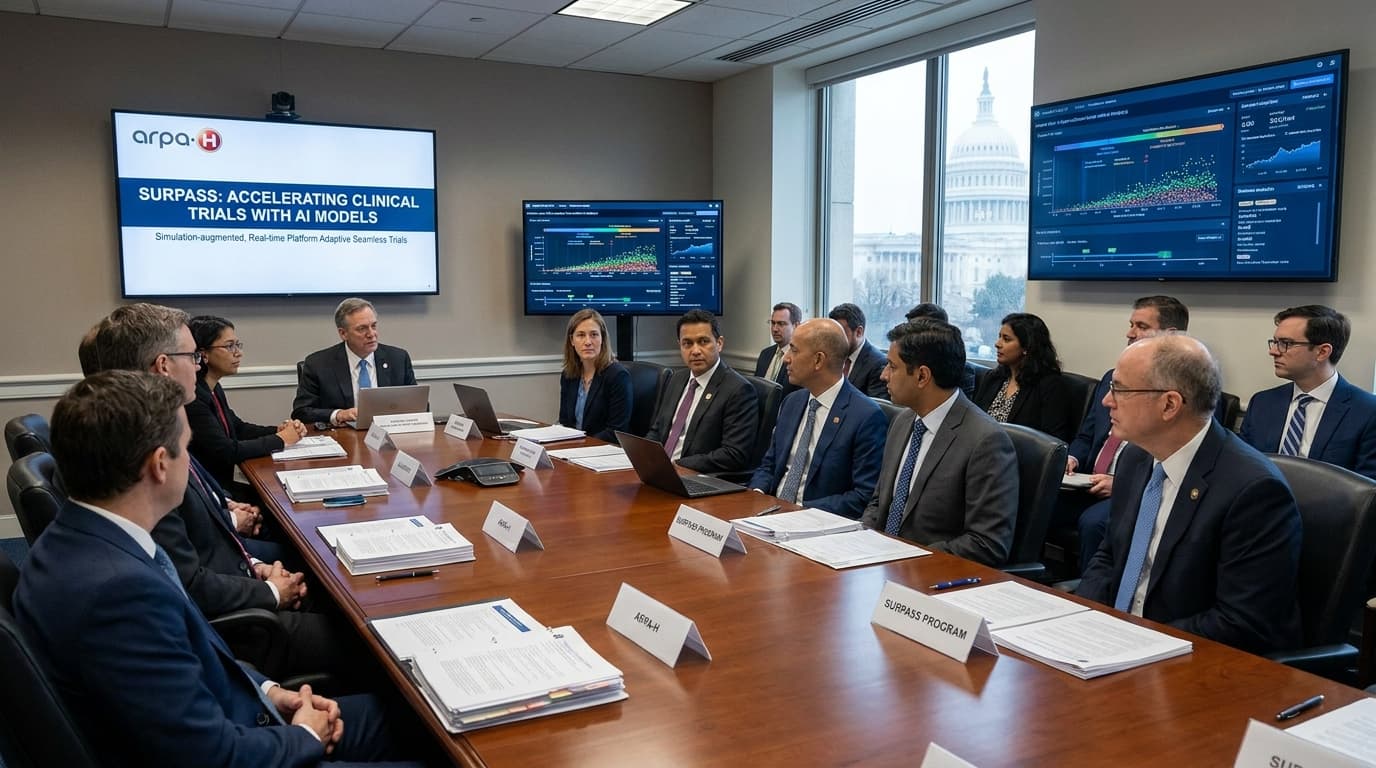
The U.S. government has launched a new ARPA-H initiative aimed at overhauling how clinical trials are designed and run, with the stated goal of evaluating drugs and biologics faster, at lower cost and with fewer participants. Announced by the U.S. Department of Health and Human Services on Wednesday, the program is called Simulation-augmented, Real-time Platform Adaptive Seamless Trials, or SURPASS.
According to the government release, SURPASS will combine advanced computational models, real-time analysis and automation to reduce patient burden and improve trial efficiency. HHS Secretary Robert F. Kennedy Jr. said the department is targeting the delays, duplication and unnecessary costs that slow clinical development, while ARPA-H framed the effort as part of a broader push to secure U.S. leadership in clinical research.
The Program Design
SURPASS is organized around three technical priorities. The first is a “phaseless design engine” intended to use digital twins and other predictive models to simulate outcomes before launch and support faster trials with fewer patients. The second is a “continuous inference engine” designed to analyze data as it accumulates, reducing the need for large conventional control groups while maintaining what the release described as rigorous evidence generation. The third is an “agentic operations layer” meant to automate trial startup and operational tasks, including onboarding for new treatment arms and faster data collection and cleaning.
SURPASS program manager Daria Fedyukina said current trials require too many stops, duplicated infrastructure and too much time before teams know whether a study is on track. In her description, the point is not to replace scientific judgment but to build the technology and biostatistical frameworks that let trial teams learn in real time, adapt when needed and generate evidence faster with less operational burden.
That framing is important because the government is presenting AI and automation here as support tools for trial design and execution. The bet is that simulation and real-time analytics can make clinical development more selective and operationally lighter without abandoning evidentiary rigor.
The Wider Trial Infrastructure Push
ARPA-H also announced three complementary efforts. STACK will use AI to accelerate clinical site activation and convert research-naïve sites into trial sites, with the goal of improving patient access. COMMONS is intended to create a national consent architecture to enable data access across the U.S. clinical-trial ecosystem. CINCH will focus on patient empowerment and care navigation by helping patients contribute their own real-world data.
Taken together, the programs suggest the government sees trial bottlenecks as a systems problem. Design speed, site readiness, consent portability and patient-generated data are being treated as connected constraints rather than separate operational annoyances.
Why The Timing Matters
The rollout comes as HHS argues that the U.S. risks losing clinical-trial leadership and the economic activity tied to it. The BioSpace report notes that China surpassed the U.S. in the number of clinical trials six years ago, and that the U.S. has also fallen behind in R&D funding and translational science since then. In August, Caitlin Frazer of the National Security Commission on Emerging Biotechnology told BioSpace that erosion of the U.S. innovation base could create dependence on a potential adversary for life-sustaining medications.
The latest ARPA-H effort also follows the HHS-wide Operation TrialBlazer Initiative, which included an FDA pilot program intended to reduce the time and burden required to move assets into first-in-human studies. That pilot opened for applications last month and remains open until Oct. 30.
The policy backdrop is more complicated than the launch messaging. ARPA-H was created by the Biden administration in 2022 with an initial $1 billion from Congress. In February 2025, inaugural leader Renee Wegrzyn was let go by the Trump administration, and in October Alicia Jackson was tapped to lead the unit. At the same time, the FDA has been reshaped by staffing cuts and later hiring plans, and last year introduced its own AI tool, Elsa, which drew calls for more detail on how the model works and how its output is evaluated.
The signal for industry is that federal trial policy is shifting from incremental process improvement toward computationally enabled redesign. If these programs gain traction, sponsors may face rising pressure to justify conventional trial architectures when simulation, adaptive analysis and shared infrastructure are available as alternatives.