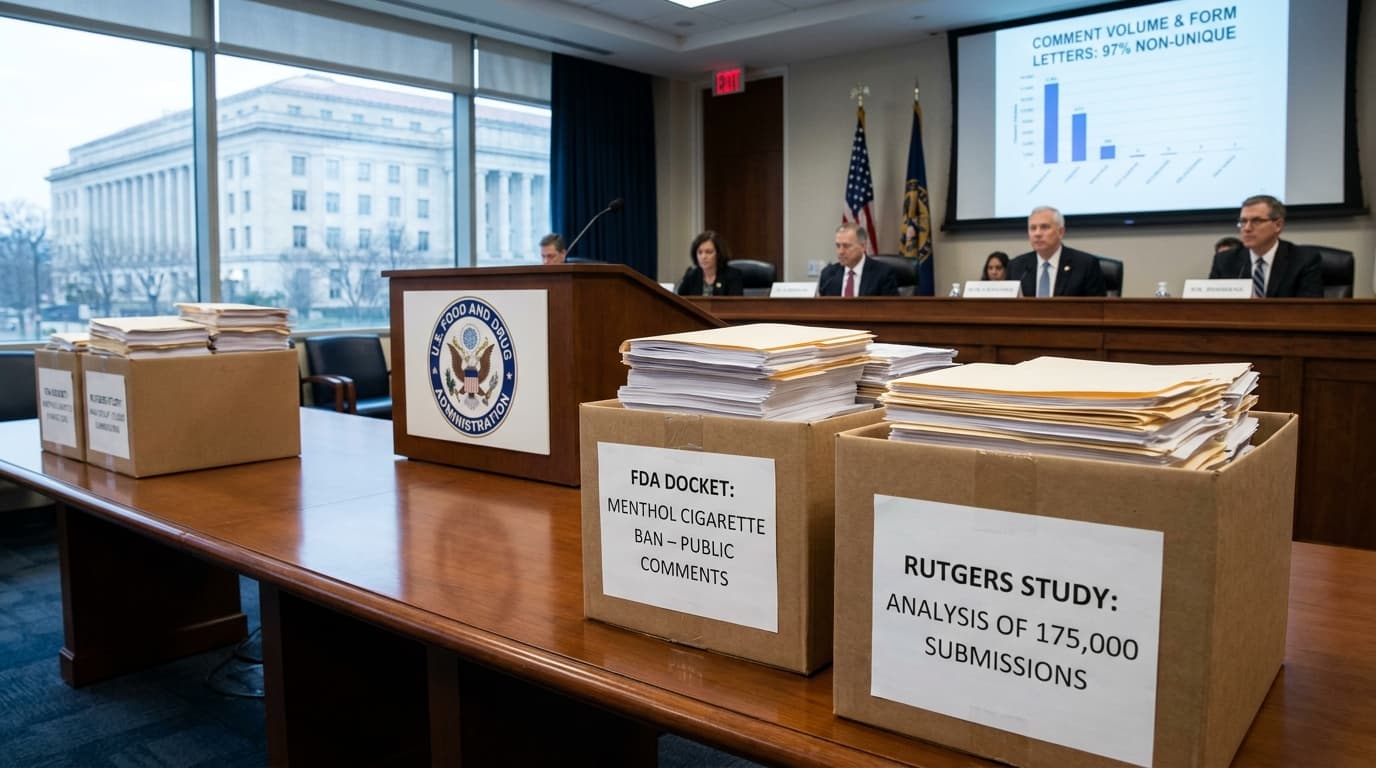
The Biden-era Food and Drug Administration’s proposed ban on menthol cigarettes drew about 175,000 public comments in three months after the agency drafted the rule in 2022. According to a new study by Rutgers University researchers published last month in JAMA Network Open, 97% of those comments were form letters opposing the ban, nearly half used the same language as campaigns run by Altria Group Inc. or Reynolds American, and only 2% were unique.
That alone would normally point to a familiar regulatory tactic rather than a decisive policy outcome. Steven Balla, co-director of the Regulatory Studies Center at George Washington University, told STAT that agencies usually focus on the substance of comments rather than their volume. But in this case, the flood of repetitive submissions appears to have mattered because it became part of the rationale for delay, giving a politically difficult tobacco rule a procedural basis for deferral before it was ultimately abandoned.
Why The Comment Record Mattered
After the public comment period closed in August 2022, the FDA said it would “need ample time to comprehensively review and analyze all of the comments.” The agency missed its following August deadline to issue the rule and set a new deadline of March 2024. That deadline also passed without action.
In April 2024, the Biden administration indefinitely postponed the ban. Xavier Becerra, who was secretary of the Department of Health and Human Services at the time, said the rule had “garnered historic attention” and that the public comment period had yielded “an immense amount of feedback.” The proposed ban was officially scrapped the following year, after President Trump took office.
The signal for policy strategy is that mass comment campaigns do not need to win on regulatory merit to be useful. If they help create delay, they can change the political environment around a rule enough to weaken or kill it later.
What The Study Says About Industry Tactics
The Rutgers researchers found that most of the comments did not engage with the public health case against menthol cigarettes. Instead, they repeated arguments that smoking menthols is “a matter of adult choice” or that a ban would “increase crime, reduce tax revenues, and hurt small businesses.” Tens of thousands of letters were generated by public relations campaigns by Reynolds American, maker of Newport, and Altria, maker of Marlboro Menthol, according to the study.
The tactic itself is not new. STAT reported that the tobacco industry has used similar volume-based comment campaigns since at least the 1980s, and that the broader method has also appeared outside tobacco policy, including during the Federal Communications Commission’s 2017 net neutrality process. What appears unusual here is the apparent effectiveness of the strategy in a major public health rule.
The study also noted a limitation: because most letters did not include identifying information, it is unclear whether the comments reflected authentic grassroots participation, organized astroturfing, or some mix of both. Even with that caveat, the concentration of repeated language tied to tobacco-company campaigns suggests the record was shaped heavily by orchestrated advocacy rather than by distinct substantive objections.
The Stakes Behind The Rule
Menthol cigarettes account for more than a third of all cigarettes sold in the U.S., according to the report. The Biden administration proposed the ban in part because of menthol cigarettes’ disproportionate effect on the health of Black Americans.
The tobacco industry has cultivated menthol’s appeal in the Black community for decades. STAT reported that, starting in the 1960s, Brown & Williamson and rival tobacco companies sponsored jazz festivals, advertised in magazines like Ebony, and distributed free samples to Black residents and even children. Today, about 80% of Black smokers use menthols.
The health burden is not abstract. Though Black smokers tend to start later in life and consume fewer cigarettes each day than white smokers, they fall ill and die at higher rates, according to the Centers for Disease Control and Prevention. Research by the University of Michigan estimated that menthols were responsible for 157,000 smoking-related deaths among Black Americans between 1980 and 2018. The proposed rule targeted the menthol compound because it cools and numbs the throat and airway, making cigarette smoke less harsh. Research cited by STAT says menthols are more likely to addict young smokers and that a ban could avert 650,000 early deaths over four decades.
That combination of public health upside and political sensitivity explains why the rule became vulnerable once it moved beyond technical review. By March 2024, the proposal had collided with re-election politics, as President Biden needed the support of Black Americans while opponents framed the ban around illicit sales and biased policing. STAT reported that researchers have not found those outcomes in Canada or the European Union after menthol bans there, but the existence of those claims was enough to complicate the rule’s path.
For regulators, the episode is a warning that process can become policy. A comment docket packed with repeated industry-aligned submissions may not change the scientific case for a rule, but it can still alter the timetable that determines whether the rule survives at all.