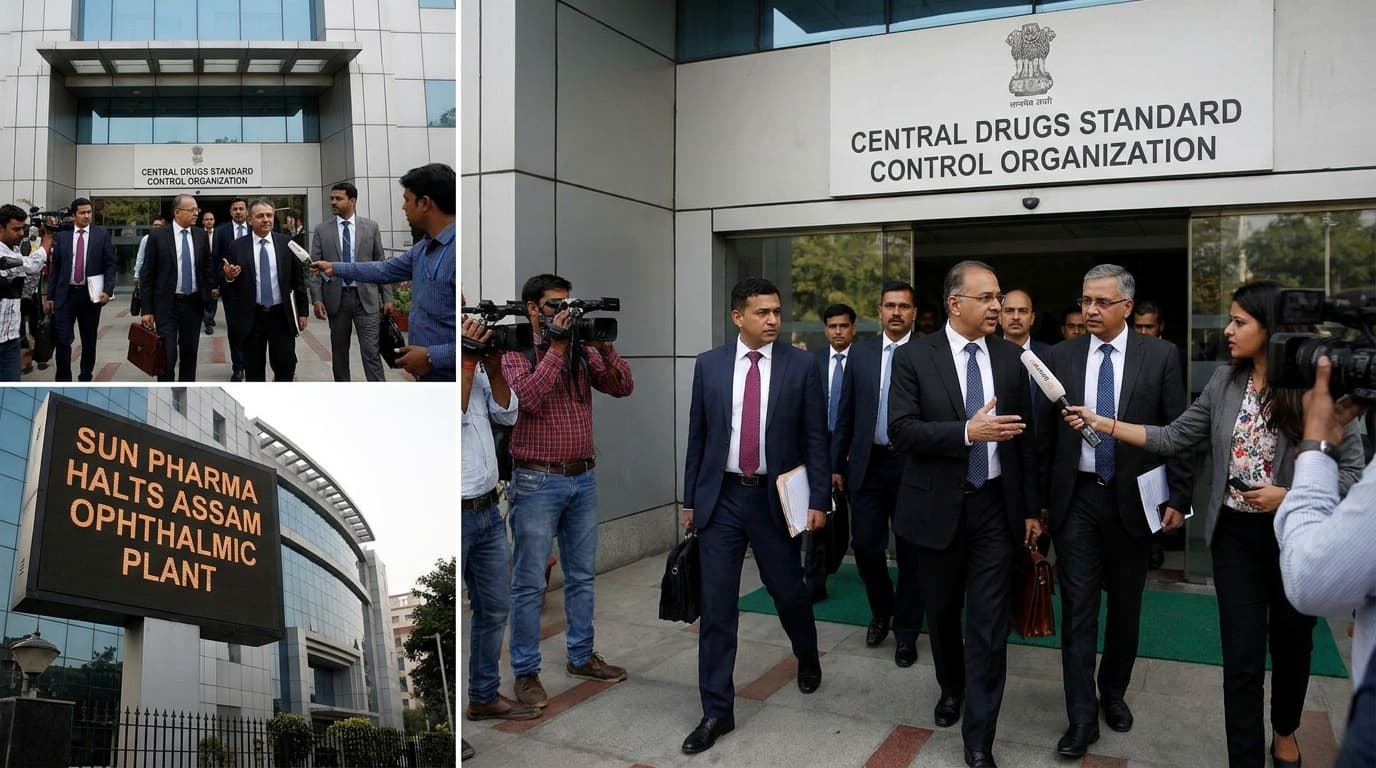
Sun Pharmaceutical Industries has stopped manufacturing eye-care drugs at a plant in India after quality concerns tied to its ophthalmic business. On an earnings call Friday, Managing Director Kirti Ganorkar said the company had “voluntarily recalled” 11 ophthalmology products and “voluntarily initiated a temporary cessation” of manufacturing activities.
That account sits alongside a stricter regulatory version of events. Reuters reported the same day that Indian drug regulators had ordered Sun Pharma to stop manufacturing ophthalmic products at the facility in Assam after a joint federal-state inspection found failures in the company’s quality management system. According to the report, the shutdown order was issued on Aug. 20.
What happened at the plant
Ganorkar said Sun Pharma has “taken a remedial action so that we can put everything in place shortly.” Indian regulators are reportedly reviewing a compliance report the company submitted in response to the production stop.
The company voluntarily recalled 11 ophthalmic products from the Indian market in July, but its notice did not explain why. More detail emerged later when the All India Ophthalmological Society alerted members in June about bacterial contamination in batches of Sun Pharma’s Predmet eye drops. Multiple ophthalmic institutions found contamination consistent with the presence of Pseudomonas.
That pathogen carries broader significance because it was responsible for a U.S. eye infection outbreak in 2022 and 2023. In that outbreak, 14 patients who used artificial tears sold by EzriCare and Delsam Pharma suffered vision loss. BioSpace noted that Indian drugmaker Global Pharma manufactured those artificial tears.
Why the response matters
Sun Pharma had not published a statement about the shutdown at the time of the report, leaving its public comments limited to Reuters and the earnings call. The Bombay Stock Exchange asked the company to provide clarification after seeing the Reuters report.
The episode is a reminder that ophthalmic manufacturing problems can move quickly from product-specific issues to site-level regulatory consequences, especially when contamination questions touch sterility and quality-system controls. For Sun Pharma, the immediate issue is not only recalling affected products but satisfying regulators that the Assam facility’s quality processes are adequate to resume production.
The timing is awkward because the manufacturing disruption surfaced the same day Sun Pharma won FDA approval for Ilumya in adults with active psoriatic arthritis. The IL-23 antagonist was approved in plaque psoriasis in 2018, and the expanded label followed Phase 3 trials linking Ilumya to reductions in tender and swollen joints. But company executives also told analysts that Ilumya’s U.S. business slowed in the most recent quarter and did not explain the cause, though North America CEO Richard Ascroft said Sun Pharma has “put key interventions in place already” and expects the product to return to “more typical growth patterns.”