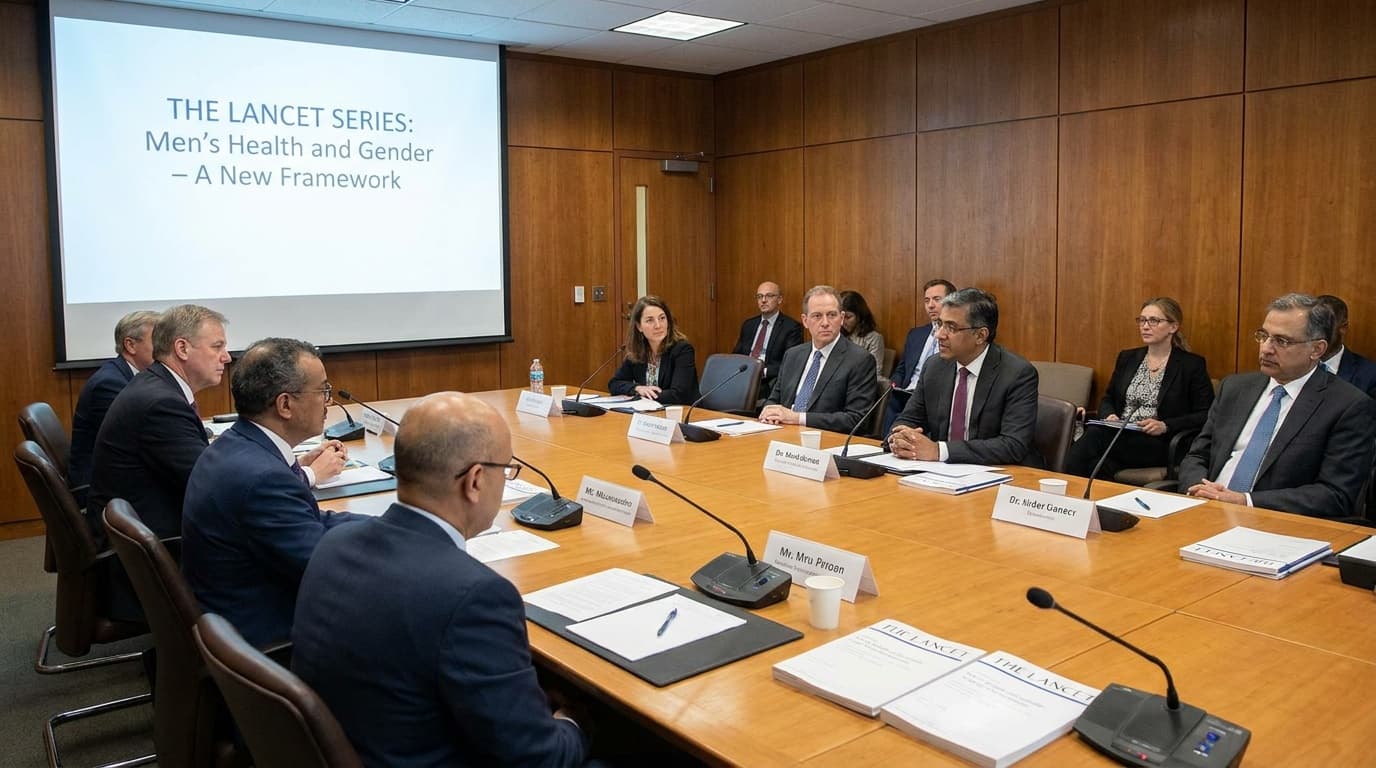
A new series in The Lancet argues that men’s health should be approached less as a biological category and more as a gendered one, in an attempt to explain a persistent paradox: men have worse health outcomes than women even though they hold what the source described as undeniable privilege.
The authors’ central move is to broaden the frame beyond sex. In the introduction, they write that men’s health is defined and shaped by the culturally defined roles, responsibilities, attributes, and entitlements associated with being, or being seen as, a man, along with power relations between and among women and men. That framing shifts attention from individual behavior alone toward structural determinants of health.
The Framework
According to the series as described by STAT, the first paper proposes a framework for analyzing men’s health through an intersectional lens. Rather than treating men as a single group, the approach is meant to examine how gender interacts with other determinants and social structures to produce different health outcomes.
A second paper reviews available data on men’s life expectancy and burden of disability. STAT noted that the effort is constrained by a familiar limitation: many of the underlying studies do not themselves use an intersectional perspective. Even so, the paper tries to identify risk factors and causes within the available evidence.
The third paper turns from description to politics, proposing a strategy that advances men’s health as a contributing factor to the shared public good. That matters because men’s health discussions can quickly be framed as competing with women’s health for attention or resources. The authors reject that framing, writing that a gendered approach to health is not a zero-sum game and can enhance wellbeing for all.
Why The Reframing Matters
The practical signal is less about a single new finding than about what gets counted as a valid explanation. If men’s health is treated mainly as a matter of sex differences or personal choices, the policy response tends to stay narrow. A framework centered on gender and structural determinants opens the door to different kinds of interventions, including those aimed at norms, institutions, and unequal exposures rather than only clinical care.
That also has implications for the evidence base. The source notes that the current literature has limited intersectional depth, which means future research may need to collect and analyze data differently if policymakers want a clearer view of which groups of men face the highest risks and why. In that sense, the series is also a critique of how men’s health has been studied so far.
The political positioning is equally important. By presenting men’s health as part of the shared public good, the authors appear to be trying to avoid a familiar dead end in health policy debates, where attention to one population is interpreted as subtraction from another. The series instead argues that a more gender-aware approach can improve population health more broadly.