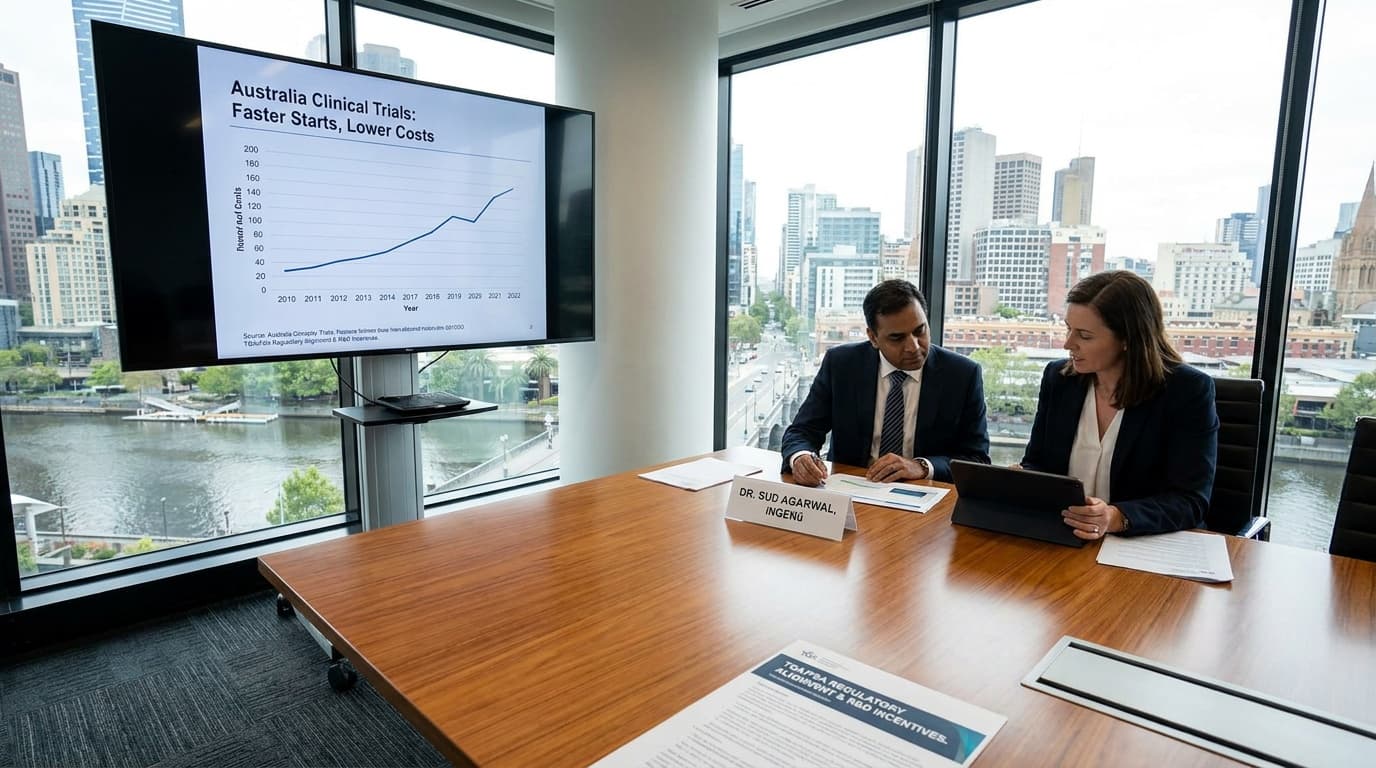
Australian CROs say a mix of pricing pressure and instability in the U.S. regulatory and government funding environment is steering more biotech and pharma companies toward running trials in Australia. According to BioSpace, that interest is especially visible among U.S. sponsors weighing how to stretch limited capital in early development.
Dr. Sud Agarwal, chief medical officer of Melbourne-headquartered CRO iNGENū, said inquiries are up about 25% on last year and that U.S. sponsors account for the vast majority of that increase. Ryan Klein, vice president of business development, US and APAC at Resolian, and Jerome Barley, commercial director at Avion Medical, both described a similar pattern, though Barley said the increase from U.S. companies has ticked up rather than surged overwhelmingly.
The core draw is economic. Agarwal said an early-phase trial in Australia costs much less than in the U.S., which matters for venture-funded companies trying to generate enough data to reach the next financing round. Klein added that prerevenue small biotech companies can recover a significant proportion of R&D spending through Australia’s federal Research and Development Tax Incentive, lowering the net cost of a study.
Why Australia Is Gaining Share
The article points to speed and procedural certainty as the other main reasons sponsors are looking at Australia. Klein said sponsors can often move from submission to first dosing in as little as eight to 10 weeks. He contrasted that with an FDA review process that can take up to six months and in some cases prolong beyond eight months.
Barley said Australia reduces administrative burden and friction without lowering scientific standards. Klein likewise said regulatory expectations around data, safety and trial design are no different than those of other global regulators, while Barley added that filings generated there are accepted internationally.
That combination matters strategically because it changes the risk profile for cash-constrained companies. If a sponsor can start earlier, spend less and still produce globally usable data, Australia becomes more than a backup geography. It becomes a financing tool for early development.
Incentives And Capacity Buildout
The source describes a layered policy push behind that positioning. At the federal level, the longstanding R&D Tax Incentive remains central. At the state level, Klein said Victoria and Queensland have built especially supportive environments for life sciences companies.
Barley said Victoria has a mature ecosystem spanning hospitals, key opinion leader knowledge, universities and biotechs, along with growing globally scaled manufacturing capability. Agarwal said Victoria hosts about 30% of national trial sites and invested A$5 million in industry-sponsored trials in 2025.
Queensland is also investing to move beyond site recruitment alone. Barley highlighted the Translational Research Institute as an Australian-first bench-to-bedside initiative. Agarwal said Queensland has committed A$11.2 million toward a new 40+ bed Phase 1 facility in Brisbane, while the government also announced an expansion of advanced cell and gene therapy capability in July.
The Limits On A Broader Hub Ambition
The same source also makes clear that Australia’s advantage has boundaries. Agarwal said the country still lacks enough GMP capacity for cell therapy, mRNA and biologic programs. He also cited missing trial-data infrastructure across sites and insufficient workforce training for specialized roles.
Population size is another constraint. With 28 million people, Australia is less attractive for large or event-driven studies, according to Agarwal. He said sponsors are less likely to choose the country for large Phase 3 and cardiovascular outcomes trials, rare disease studies that require multicountry recruitment because patient pools are very small, and gene-modified products because gene regulatory licensing adds time.
Klein said Australia has recently focused on building manufacturing capacity for Phase 2 and 3 studies to GMP standards, which is necessary to compete globally. The strategic question is whether that effort can close the gap between being a preferred early-phase destination and becoming a fuller biotech operating base. Agarwal said the next steps should include stronger IP and company retention, more manufacturing and analytical capability in areas such as bioanalysis, radiopharmaceuticals and cell and gene therapy, and simpler national governance.