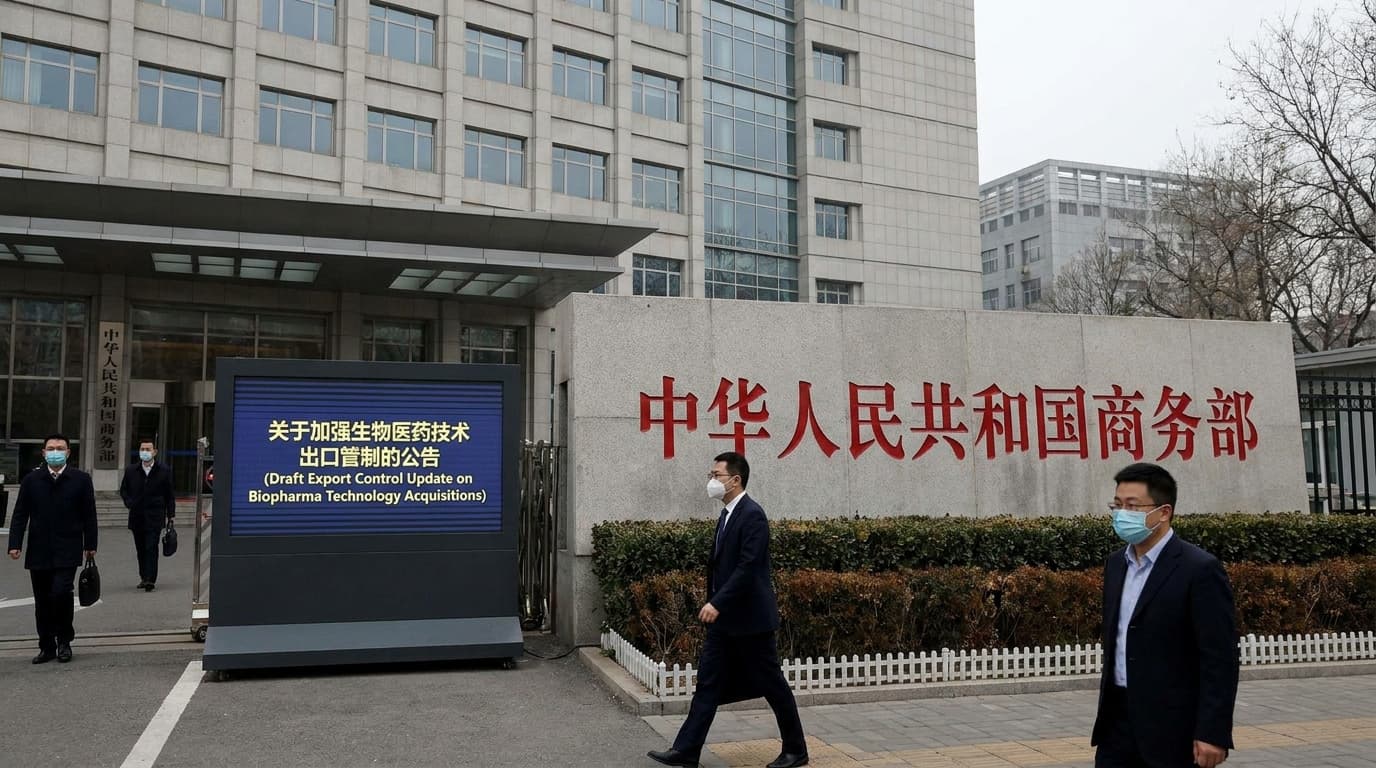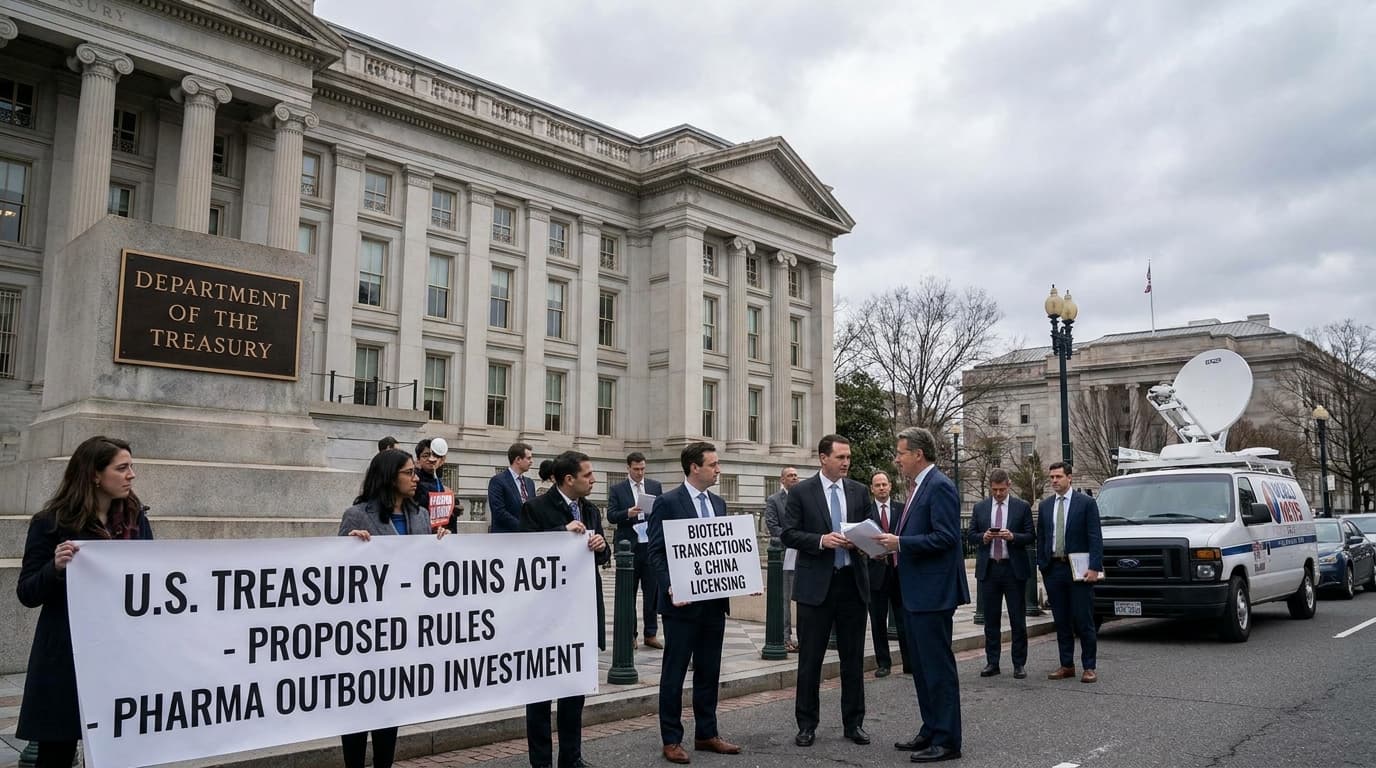
The U.S. Treasury Department has released proposed rules that would pull biotechnology into the Comprehensive Outbound Investment National Security Act by classifying “pharmaceutical compounds” as a prohibited technology for certain outbound transactions involving countries of concern, such as China. The draft reaches across a wide range of modalities, including small molecules, polymers, vaccines, blood products, allergenics, cell and gene therapies, monoclonal antibodies, other recombinant therapeutic proteins and their delivery systems.
For biopharma, the immediate signal is that Washington is trying to extend national security screening deeper into life sciences dealmaking without shutting down the transaction format that has powered many recent U.S.-China partnerships. Under the Treasury’s accompanying Q&A, covered transactions include acquisitions of equity, debt financing that is convertible to equity or carries certain rights, greenfield investments or other corporate expansions, the creation of joint ventures and certain LP investments. Activities outside that definition would not be subject to the program unless they are undertaken to evade or avoid the proposed rule.
What The Rule Would Hit
That structure matters because traditional asset licensing agreements, in which a Western drugmaker pays cash, milestones and sales royalties for ex-China rights, appear to sit outside the proposed regime. FierceBiotech noted that this largely spares the regular in-licensing deals and fee-for-service drug R&D collaborations that have driven many multibillion-dollar arrangements between Western biopharma companies and Chinese companies.
The language also tracks the current text of the COINS Act itself. COINS was enacted as part of the fiscal year 2026 national defense bill and gave Treasury authority to scrutinize or prohibit American investments in sensitive foreign sectors involving countries it views as adversaries. While the law does not name biotech, it allows Treasury to add sectors when writing the implementing rules.
The contrast is sharp between licensing and capital-backed structures. Bristol Myers Squibb’s potential $15.2 billion deal with Hengrui Pharma covering 13 early-stage programs appears, based on public announcements cited by FierceBiotech, to be a pure licensing agreement. By comparison, Pfizer’s deal structure with 3SBio last year included not only the in-licensing of a PD-1xVEGF bispecific antibody but also a $100 million equity investment in the Chinese biotech. Under the proposed Treasury rules, that equity component would be prohibited.
Where Uncertainty Starts
The draft creates more ambiguity around newer cross-border models. FierceBiotech previously cited Laurie Burlingame of Morse, Barnes-Brown & Pendleton saying the law is highly focused on equity investments rather than standard product transactions, which is why a pure sectoral expansion likely would not catch most pharma licensing deals. But Burlingame had also raised concerns about the “NewCo” model, where venture capitalists build a U.S. biotech around assets licensed from China and the Chinese licensor takes an equity stake to preserve long-term upside.
Under existing COINS language, only Chinese ownership of 50% or above would make the NewCo a target. The proposed rules’ anti-evasion clause, however, could pull future China NewCo deals with an equity interest component into added scrutiny even below that threshold.
Joint ventures are another unresolved area. Treasury chose not to define the term beyond its plain English meaning as involving capital and or asset contributions by two parties and the sharing of profits and losses. Treasury also said the term would not require the establishment or formation of a new entity. That leaves room for interpretation around collaboration structures that do not look like classic incorporated joint ventures.
Pfizer’s $10.5 billion, 12-asset collaboration with Innovent Biologics illustrates the problem. The companies agreed to co-develop four programs globally and share development costs along with U.S. and European profits or losses. FierceBiotech noted that it is not immediately clear whether Treasury intends to crack down on that kind of arrangement. If it does, the cut-off matters: only transactions completed before the enactment of the COINS Act on Dec. 18, 2025 are exempt if the rules are implemented.
The broader policy signal is that Treasury is drawing a line against U.S. capital formation inside Chinese biotech more clearly than against U.S. access to Chinese-origin drug assets. That distinction protects much of today’s licensing flow while putting pressure on venture investment, equity-linked partnerships and any collaboration structure that starts to resemble shared ownership rather than a straightforward product rights deal.