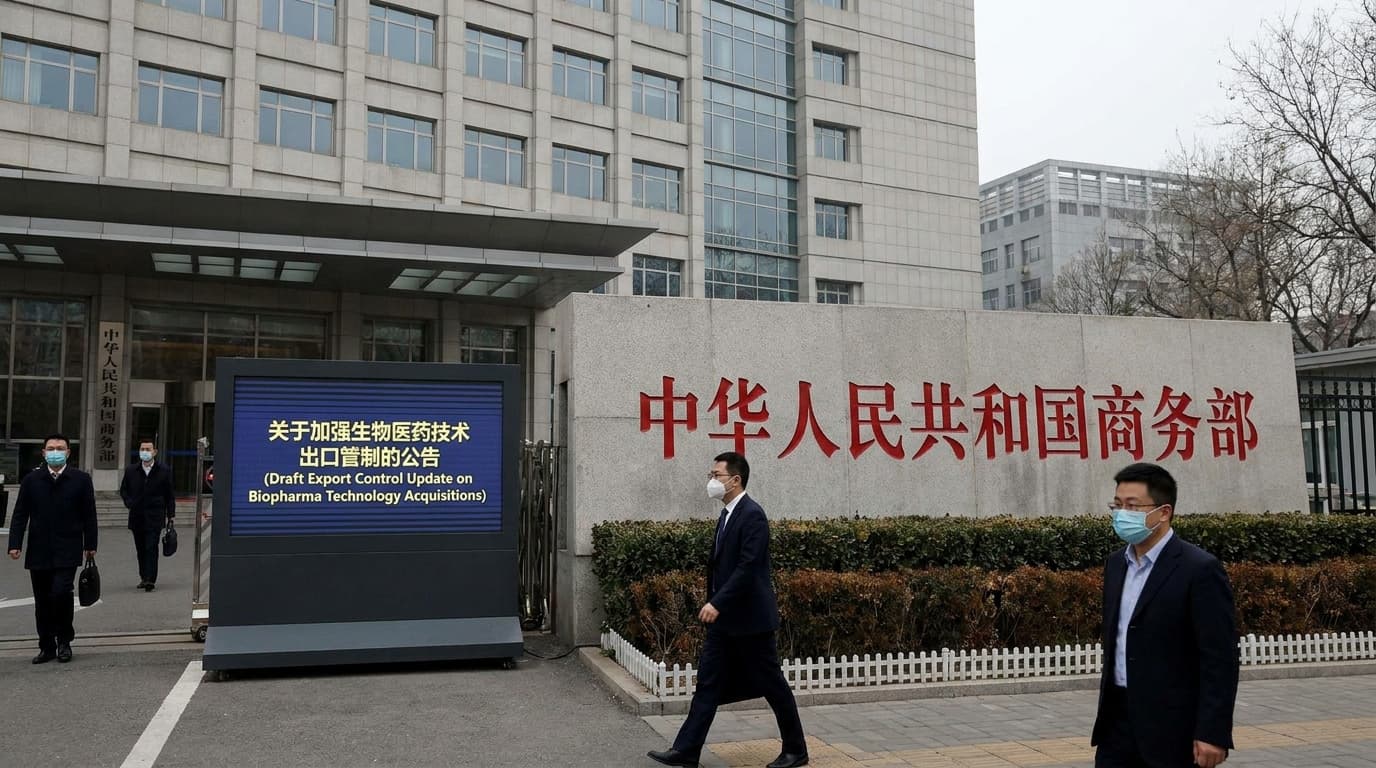
China has published a draft update to its export blacklist that would tighten control over some high-value biopharma technologies, even as it leaves most of the deal structures Western drugmakers have favored largely intact.
Under the proposal published Friday, China would ban foreign acquisitions of proprietary cell and gene therapy, small interfering RNA (siRNA) and pathogen gain-of-function platforms. It would also restrict full transfers of proprietary drug target identification and verification technologies in cell and gene therapy and siRNA to entities overseas, meaning those transactions would require regulatory approval rather than being automatically prohibited.
The move arrives as cross-border interest in Chinese biotech assets remains high. According to China’s drug regulators, foreign transactions of Chinese biotech assets reached $120 billion as of August so far this year, up 36% year over year. But the draft may reshape only a narrow slice of that activity, because most deals have centered on licensing drugs or using platforms to identify molecules rather than buying the underlying technology outright.
What The Draft Would Cover
Biopharma assets are one of 40 key technology areas included in the proposed export-control update, alongside fields such as AI and photovoltaic green energy. In this context, platforms are defined as reusable technologies that can support development of multiple drugs.
Aaron Gu, a partner at Han Kun who specializes in healthcare and life sciences, told Fierce that for biopharma the rule can be summarized as regulating transfers while leaving licensing unconstrained. That distinction is central to the commercial impact. If enacted in its current form, the draft would make outright takeovers of certain core technology engines harder, while preserving room for partnerships that let Chinese groups retain ownership.
A spokesperson for China’s Ministry of Commerce reinforced that reading in a media Q&A, saying out-licensing agreements and the use of know-hows to provide outsourced research and manufacturing services do not fall under the ban. The spokesperson also said out-licensing of drug target identification and verification technologies will generally be approved.
The Deal Impact Looks Uneven
That carveout matters because it aligns with how cross-border biotech business has actually been getting done. Fierce reported that U.S. and European biopharma companies and venture capitalists have almost exclusively focused on buying specific drugs from Chinese counterparts or using a platform to identify new molecules, with ownership of platforms rarely changing hands.
PharmCube data cited by Fierce show that, as of July 1, only five of 121 cross-border Chinese biopharma out-licensing deals this year involved ownership transfer. On that measure, the draft policy looks more like a boundary around strategic control than a broad shutdown of dealmaking.
One example of a transaction that likely would have been blocked under the proposed rule is AstraZeneca’s $1 billion acquisition of Gracell Biotechnologies, whose FasTCAR platform was central to the deal. When it was announced at the end of 2023, Fierce said it was hailed as the first full acquisition of a Chinese biotech by Big Pharma.
The strategic message is that Beijing appears more focused on keeping proprietary R&D engines inside the country than on cutting off foreign capital or partner demand. That supports continued outbound licensing revenue while trying to preserve domestic capability creation.
Why Beijing Is Drawing The Line Here
In the Ministry of Commerce Q&A, the spokesperson framed the proposal as a way to support the “orderly international collaboration around China’s biopharma technologies.” For the pathogen-related provisions, the spokesperson cited national security reasons.
Fierce also tied the draft to concerns that Chinese biotechs have been pushed to out-license or sell early-stage programs because they lack the experience or cash for late-stage trials and global commercialization. A senior Chinese biopharma executive told Fierce in June that authorities do not want companies to use China’s resources to build a strong R&D engine only to sell the whole company overseas. By contrast, the executive described partnerships that preserve ownership while generating royalties, milestones and domestic rights as more aligned with what the government wants.
That helps explain why the final published draft was, in Gu’s words, “significantly better than market expectations.” He said an earlier rumored list had covered many more prominent biopharma modalities and had raised fears of a sweeping blow to Chinese cross-border dealmaking.
The Chinese government is accepting comments on the draft rule until Nov. 15. For now, the clearest signal is not that China is closing the door on biopharma collaboration, but that it is trying to decide which parts of biotech value creation it is willing to export and which parts it wants to keep at home.