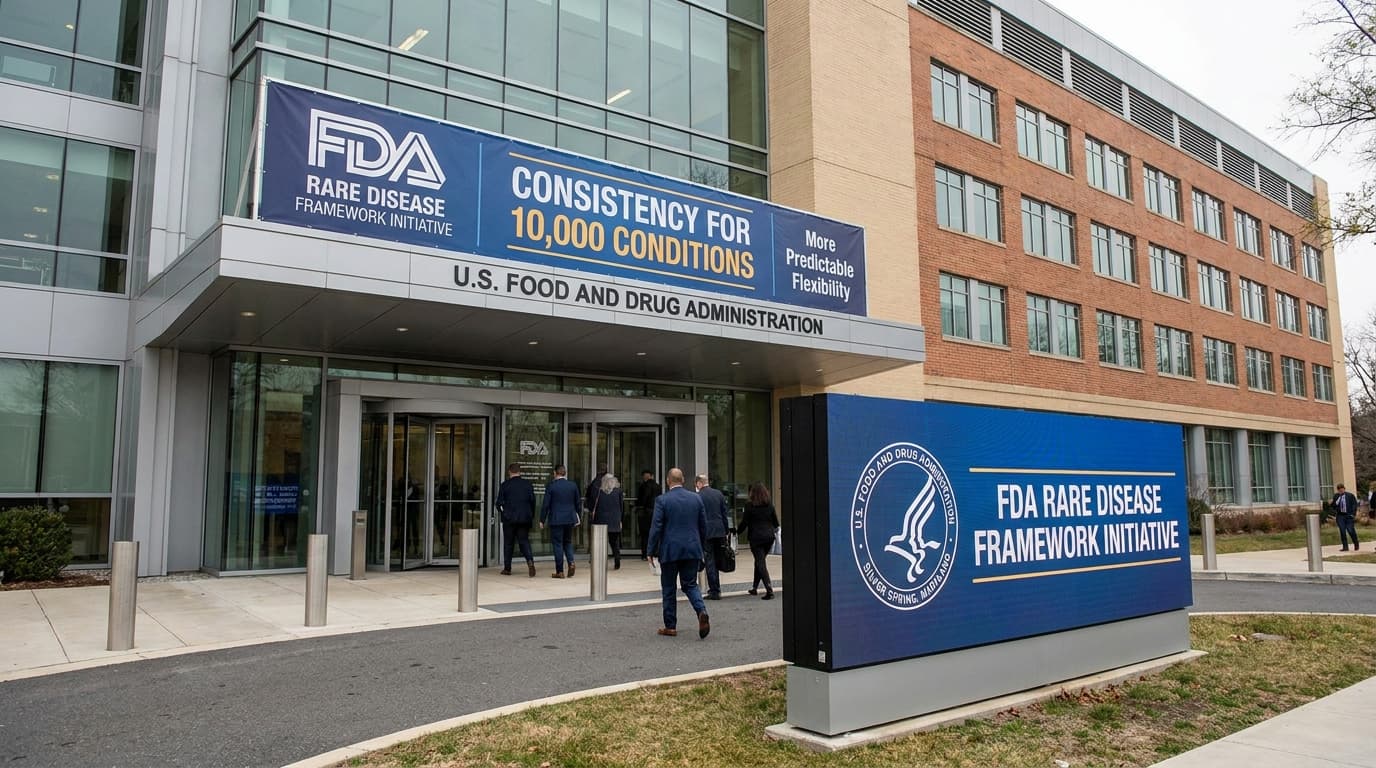
The FDA on Wednesday introduced a Rare Disease Framework Initiative that it said is meant to bring greater consistency to how rare-disease drug development is regulated, while still allowing decisions to reflect the limits of evidence generation in very small patient populations. The agency framed the effort as a way to create a faster and more systematic path across as many as 10,000 rare conditions affecting 30 million Americans.
The central policy tension is explicit: the FDA wants to standardize process without standardizing diseases. In its description of the framework, the agency said development should account for nuance by approaching each disease based on the evidence that can be realistically generated in small populations. That is a meaningful signal for sponsors working in settings where randomized trials may be impractical, because it suggests the agency is trying to make flexibility less ad hoc and more repeatable.
What The Framework Changes
In a white paper accompanying the announcement, the FDA said it wants to build on existing rare-disease efforts and turn them into a consistently used, cross-center approach. The agency pointed to the FDA Rare Disease Innovation Hub, the Center for Drug Evaluation and Research’s Accelerating Rare disease Cures program and the Rare Disease Endpoint Advancement pilot program, which is shared by CDER and the Center for Biologics Evaluation and Research.
The stated goal is to provide greater clarity, consistency and predictability in regulatory decision-making. The framework also emphasizes incorporating the patient voice, using external experts and shared resources, and applying risk-based approaches, especially in chemistry, manufacturing, and controls review and pre-approval inspections.
That combination matters strategically. Rare-disease developers often do not fail only on efficacy debates; they also run into uneven expectations across review teams, endpoint disputes and manufacturing scrutiny that can be hard to predict early. A framework that makes those judgments more consistent could reduce execution risk even if evidentiary standards themselves do not become uniformly easier.
The Road Here
The initiative follows the “plausible mechanism” pathway introduced in November 2025 by former FDA Commissioner Marty Makary. That pathway was intended to expedite treatments for diseases with exceedingly small patient populations, where a randomized trial would not be feasible.
At the same time, the agency’s recent history shows why industry is likely to focus on implementation rather than rhetoric. BioSpace noted that some of the FDA’s highest-profile recent reversals have involved external controls. In November last year, the agency disagreed with previous FDA guidance that had allowed uniQure’s Phase 1/2 study, which used a natural history external control, to support a regulatory application for its Huntington’s disease gene therapy AMT-130. The use of an externally controlled study was also, according to Capricor CEO Linda Marbán during a BioSpace webinar in March, “one of the major issues” raised in the July 2025 complete response letter for deramiocel in Duchenne muscular dystrophy cardiomyopathy.
Those examples expose the practical test for the new initiative. The agency can endorse cutting-edge science, novel methodologies and innovative statistical approaches, but the commercial value of the framework will depend on whether review divisions apply those principles consistently when programs hinge on single-arm data, natural history comparisons or other nontraditional evidence packages.
Early Industry Response
Outside groups reacted positively, but their comments also highlighted where the pressure points remain. The National Organization for Rare Disorders said it particularly welcomed the FDA’s emphasis on consistency and predictability across review divisions, patient perspectives, external expertise and stronger institutional knowledge. The Alliance for Regenerative Medicine similarly backed the attempt to avoid forcing rare diseases into a regulatory model built for common disorders, while adding that success in cell and gene therapy will depend on future guidance and rulemaking around single-arm trials and natural history data.
That is the clearest signal from this launch: the FDA is trying to move from case-by-case accommodations to a more operational framework for rare diseases, but developers will judge it by downstream guidance and review behavior. The agency has scheduled an Oct. 28 meeting to gather feedback from patients, advocates and industry, making that discussion the next marker for how much of this initiative becomes policy in practice.