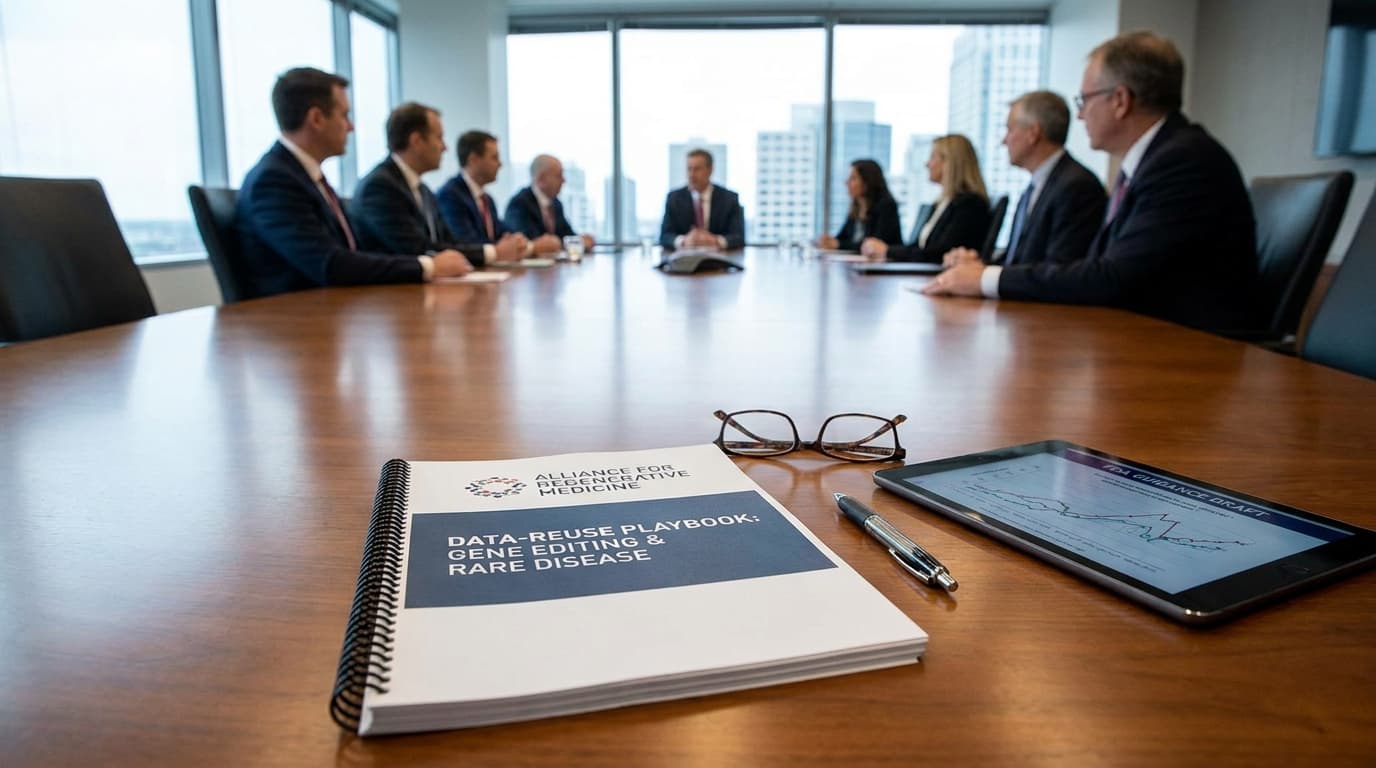
The Alliance for Regenerative Medicine has set out a playbook for how gene-editing developers could reuse data across programs, with the goal of reducing redundant work and lowering the cost of bringing therapies into the clinic. The document, published late last month and described by BioSpace as building on the FDA’s draft guidance from this summer, is aimed squarely at one of the field’s central constraints: the economics of developing products for rare and ultrarare diseases.
ARM’s argument is that platform-style development could make indications with very small patient populations more feasible by shrinking the amount of new work required for each additional program. John Evans, CEO of Beam Therapeutics, which was involved in creating the playbook, told BioSpace that if developers can leverage a platform and make the cost of the incremental effort to treat a mutation very minimal, patients with rare diseases could gain access to therapies that otherwise would not be developed.
The regulatory model ARM is proposing
Josephine Lembong, ARM’s associate director for scientific affairs, said the first step for developers is deciding their main objective. For rare diseases, she said that goal may be rapid clinical proof of concept, full licensure or long-term commercial viability, and that choice should factor in population size, unmet need and the availability of alternative treatments.
Lembong said developers should prepare for a regulatory filing from the outset and design programs for a potential submission. BioSpace reported that this aligns with how Beam operates under Evans, who said the company designs phase 1 trials to be registrational. Beam’s aim, he said, is to move from first-in-human trials to FDA approval in four to five years, compared with eight to 10 years in the traditional clinical pathway.
In parallel, ARM says companies should map programs to existing FDA frameworks and guidance while defining a platform’s scientific boundaries. Lembong said developers need to distinguish fixed components from variable ones. In her description, elements such as the delivery vehicle, route and formulation may be fixed and therefore support data reuse, while guide-specific biology cannot be assumed from the first product and should be evaluated directly.
Where developers see the biggest savings
Evans said acute toxicity studies offer the biggest opportunity for reuse under a platform model. His view is that if a lipid nanoparticle remains the same and only the payload is adapted to a new target mutation, the acute toxicity outcome would be the same, making repeat studies redundant.
He also pointed to chemistry, manufacturing and controls as a major source of overhead in genetic medicine. Under a platform approach, Evans said, Beam can use the same assays every time and know what it is going to get. That matters because cost reduction here is not just a scientific efficiency story; it is a gating issue for whether multiple small-population programs can be advanced at all.
BioSpace reported that Evans sees an additional streamlining opportunity that is somewhat more unique to Beam’s base-editing approach. He said companies could use the plausible mechanism pathway, which the FDA unveiled last year, to avoid generating animal data in each genetic driver of diseases with many variants. He cited phenylketonuria, which Beam is pursuing and which is caused by hundreds of variants.
Even under ARM’s proposed framework, developers would still need to complete product-specific work each time. Evans said Beam would need to show every new editor is potent enough, often in cells, and would continue to run on- and off-target editing studies. He described that remaining work as potentially about 10% of a full package, with everything else cross-referenced to studies already run.
The strategic signal
The most important shift in ARM’s playbook is that it treats the investigational new drug application less as a one-product dossier and more as a platform container. Evans said IND applications are now effectively platform INDs where multiple edits can live together, all trying to deliver the same functional outcome on the gene and on the patient.
ARM also says the platform model by itself may not fully solve cost and access problems. That is why the playbook calls for broader discussion about whether some traditional development expectations should be modified, abbreviated or, in carefully justified cases, removed altogether when risks are low and potential benefits are high. The group described existing accelerated clinical development pathways as untenable for many sponsors in the rare and ultrarare disease space and proposed a bifurcated regulatory framework that would allow higher-risk, streamlined development for severe rare diseases with no standard of care.
That makes this more than a technical guidance exercise. The field is trying to create a regulatory and development structure that can support repetition at scale rather than one-off successes. As Evans put it, the goal is not to look up in five or 10 years and see this done once or twice, but 10, 20 or 100 times.