When a leaked draft opinion signaled in spring 2022 that the U.S. Supreme Court would overturn Roe v. Wade, Betsy Pleasants changed her dissertation. She had been studying the effects of the Covid-19 pandemic on abortion services as a graduate student at the UC Berkeley School of Public Health. After the court finalized its decision that June, ending the nearly 50-year-old constitutional right to abortion and triggering rapid policy change and increased state restrictions, Pleasants and her thesis committee redirected the project toward something more immediate: documenting how people were navigating the new barriers in real time.
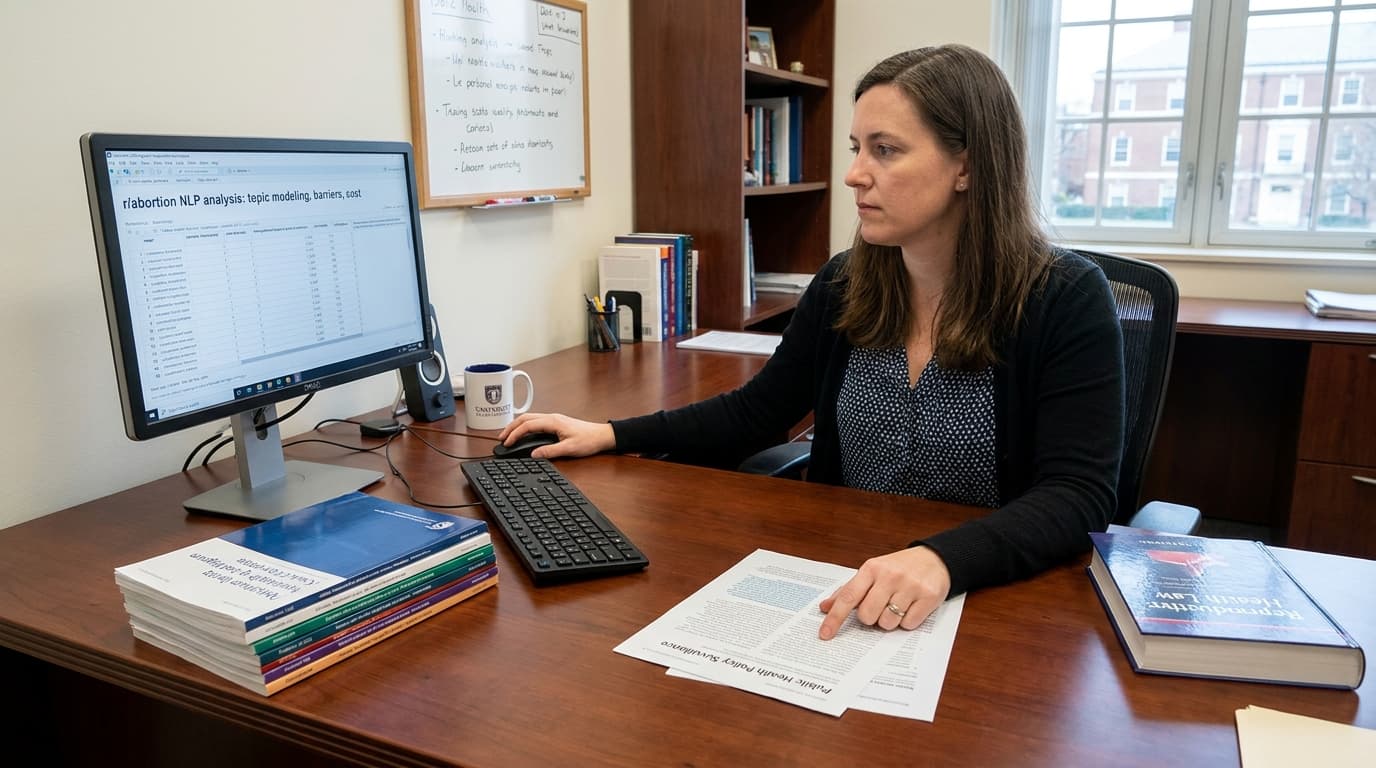
Pleasants, now a postdoctoral research associate at the Center for Women’s Health Research at the University of North Carolina, turned to Reddit. Working with colleagues, she analyzed thousands of posts from the forum r/abortion using natural language processing, or NLP, together with a qualitative close reading of a subset of posts. The result is less a story about artificial intelligence replacing traditional public health research than about using computational tools to widen the field of view without losing context.
The Research Signal
Pleasants’ team used the dual approach to track emerging barriers to abortion access and to examine how online resources connect people with evidence-based information and services. According to the profile, the work was built with safeguards for user privacy and aimed to preserve the complexity behind the data rather than flatten it into trends alone.
The findings reaffirmed established barriers, including high costs and limited appointment availability. They also surfaced less commonly documented problems: delays in receiving abortion medications by mail, low credibility of online ordering platforms, and concerns about the legal risks of seeking abortion or related medical care.
That combination is the core policy value of the work. Conventional studies often confirm what researchers already know, but they can be slower to register new frictions created by sudden legal shifts. By using NLP on a large body of posts and then reviewing a subset closely, Pleasants’ project appears designed to catch both the recurring access problems and the newer ones produced by a changing legal environment.
Why Reddit Matters Here
The platform choice is not incidental. The profile says analyzing r/abortion let Pleasants capture perspectives that are often overlooked by conventional research methods. Reddit’s relative anonymity gave people a venue to discuss stigmatized experiences and urgent decisions in their own words.
Ushma Upadhyay, professor in the Department of Obstetrics, Gynecology, & Reproductive Sciences at the University of California San Francisco, who mentored Pleasants during her doctoral research, said she did not know of other studies at the time using NLP to study online discourse on abortion. Upadhyay contrasted the approach with the more typical practice of taking a random sample small enough to analyze manually, saying Pleasants was able to get a more complete picture.
Danny Valdez, associate professor of public health at the Indiana School of Public Health-Bloomington, framed the method as a way to see communication patterns at scale when people need help. In that sense, the project is also a model for how AI tools can support public health decision-making: not by substituting for domain expertise, but by helping researchers identify where policy is translating into real-world obstacles.
Pleasants described the work as documentation in a complex policy moment, intended to support evidence-based policy change over time and advocate for improved access to reproductive health care. For health policy research, the larger signal is that real-time online discourse may become a more important complement to surveys and administrative datasets when legal changes move faster than traditional study designs. In areas where stigma, privacy concerns, and fragmented access already limit visibility, that could materially change how researchers detect emerging barriers.