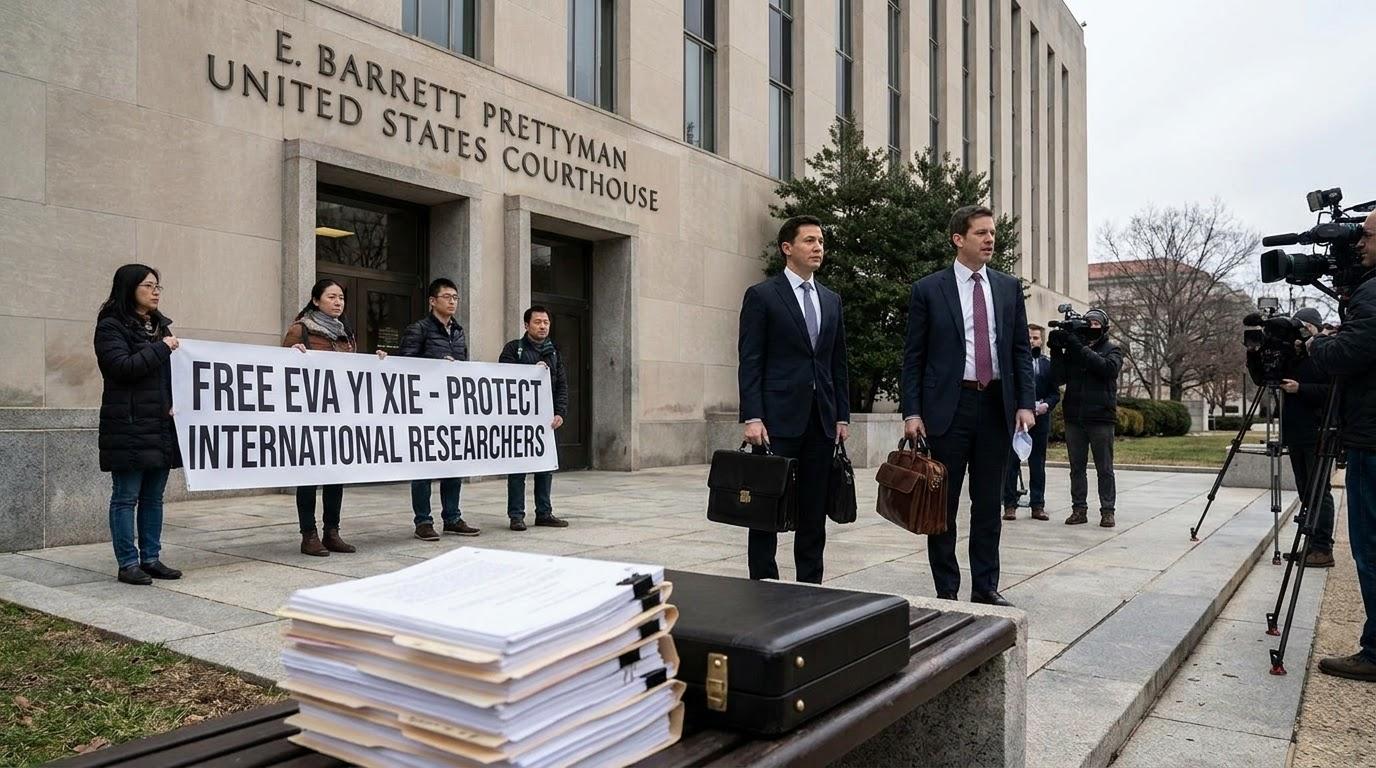
A graduate student and scientific researcher at Princeton University was detained by Immigration and Customs Enforcement earlier this week while traveling home after presenting research at the annual Society for Neuroscience conference in Washington, D.C. The researcher, Eva Yi Xie, was detained Thursday.
Although Xie has lived in the U.S. since 2016 after moving from China, The New York Times reported that her visa had expired. Her lawyers told a reporter she had a pending asylum application and was therefore allowed to remain in the country legally. ICE did not respond to a request for comment about why she was detained.
The immediate effect has been to turn a single detention into a broader warning signal for academia. The news, first posted by one of Xie’s mentors on X, spread quickly through academic circles because it appeared to confirm a fear already circulating among non-U.S. academics and international students: that traveling to conferences to present research and meet collaborators may be too risky during a second Trump administration that has cracked down on immigration.
Why The Case Is Resonating
Caitlin Rivers, a Johns Hopkins academic, said a staff member of hers was detained by ICE earlier this year and described an "open question" about whether it is safe for international students on visas to travel. That concern lands at a moment when some U.S. conferences have reported smaller attendance over the past two years and some have considered hosting in other countries.
The administration has also been explicit about wanting to reduce the number of foreign-born graduate students in the U.S. In its science blueprint released earlier this year, the White House wrote that "America’s over-reliance on foreign students also creates a security challenge." In that context, Xie’s detention is likely to be read by universities less as an isolated incident than as a policy risk that could affect conference attendance, recruiting, and the willingness of international trainees to remain in U.S. programs.
A report released earlier this week found that international graduate student enrollment is down by a third at academic medical centers. Xie is also not the first graduate student detention cited in the story: Tufts researcher Rumeysa Ozturk was detained by ICE last year in Cambridge, Mass., and later decided to leave the country.
The Academic Stakes
Princeton said it has provided Xie with legal representation. Rodney D. Priestley, the dean of Princeton University’s graduate school, said the news of her detention was distressing for him and many members of the university community and added that the university hopes she will soon be able to resume her studies.
Her advisers and peers described her as a rising researcher whose work spans neuroscience and artificial intelligence. Xie uses experiments on mice and large datasets of neural recordings to study how different parts of the brain work together to make decisions. Benjamin Eysenbach, a computer scientist at Princeton and one of her advisers, said that breadth is what makes her unusual: she works across AI and machine learning, computational models of the brain, and hands-on experimental work that includes surgery on mice, data collection, and analysis.
As one example, Eysenbach pointed to a workshop Xie convened at last year’s NeurIPS conference, where she presented her own research and brought together leaders in AI and neuroscience to explore collaboration. The practical loss for U.S. research institutions is not only the disruption of one student’s training. It is the possibility that scientists who connect disciplines and convene networks may decide that the costs of visible participation in U.S. academic life have risen.
Krithik Ramesh, a fellow researcher who has known Xie since high school science fairs, said he reacted with disbelief after learning about the detention. His objection was tied directly to the role conferences play in science: researchers present work publicly precisely to share it. If that routine activity begins to carry detention risk, the policy effect reaches beyond immigration enforcement and into how research communities function.