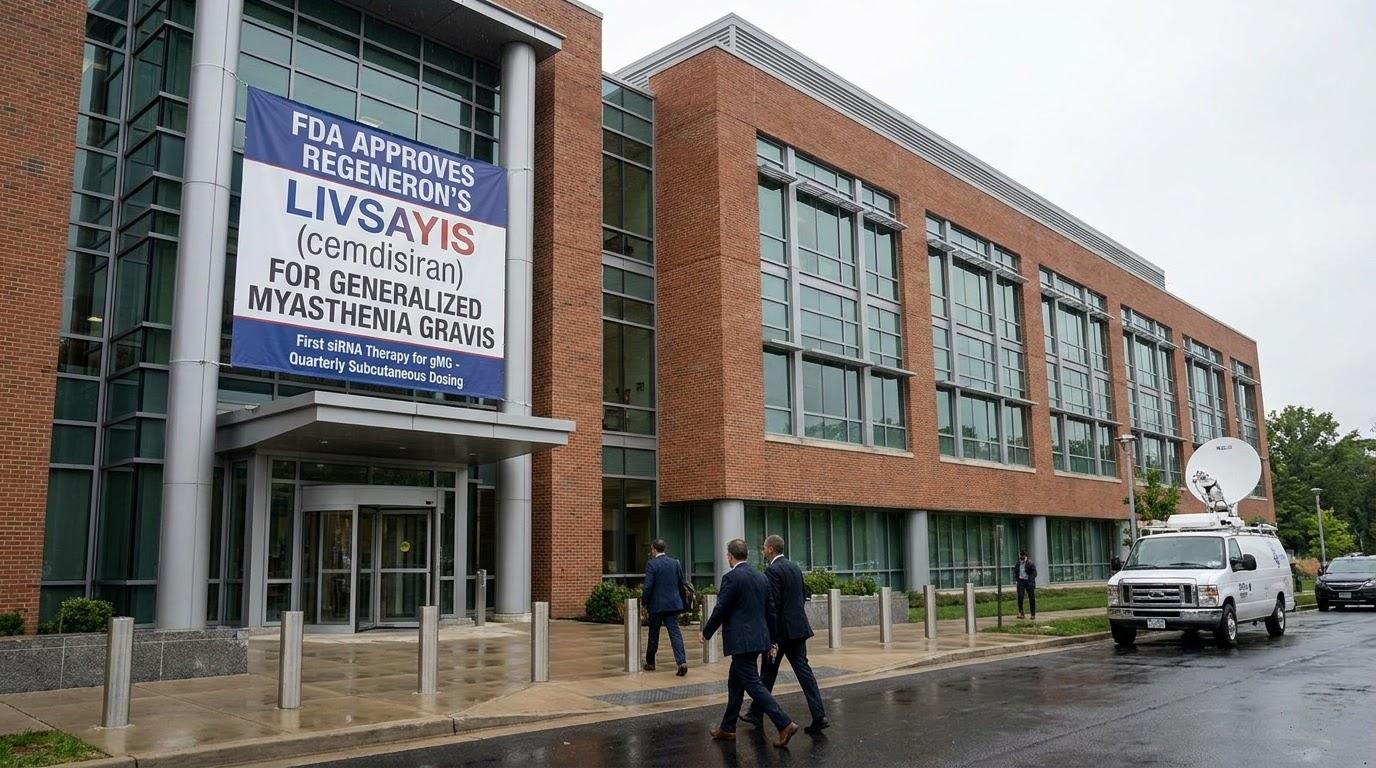
Regeneron added another new modality to its commercial roster late Wednesday when the FDA approved cemdisiran, to be sold as Livsayis, for adults with generalized myasthenia gravis who are positive for anti-acetylcholine receptors. Regeneron said this is the most common type of the autoimmune disease.
The approval is a first on two levels for the company: Livsayis is Regeneron’s first approved siRNA therapy, and the company said it is also the first siRNA drug approved for gMG. Strategically, the decision extends Regeneron’s recent run of firsts beyond gene therapy and rare disease into RNA medicines, giving the company another proof point that pipeline diversification is starting to convert into marketed products.
The data
Livsayis is a complement component factor 5-directed siRNA designed to reduce circulating C5 protein levels and limit terminal complement activation, which Regeneron described as a key driver of the disease. The approval was supported by the Phase 3 NIMBLE trial.
In NIMBLE, Livsayis produced a 4.5-point improvement at 24 weeks on a scale measuring how gMG symptoms affect daily functioning, versus a 2.2-point improvement for placebo, meeting the primary endpoint. The drug also met the key secondary endpoint on a clinician assessment of muscle function, with a 4.2-point improvement compared with 1.5 points for placebo.
Regeneron said Livsayis is the only FDA-approved treatment for gMG administered subcutaneously four times a year. Truist said that dosing schedule provides “a practical point of differentiation,” while BMO Capital Markets wrote that the approval establishes the asset as a first-in-class siRNA therapy for gMG that pairs what it called best-in-class efficacy with quarterly subQ dosing to improve the patient experience.
Safety was broadly in line with the C5 class, based on the company’s framing and analyst reaction. Livsayis carries a boxed warning for serious meningococcal infections and other serious infections, which Regeneron said is consistent with other FDA-approved medicines that reduce C5 activity. The drug is also available only through a Risk Evaluation and Mitigation Strategy program. The most common adverse reactions in around 5% of patients in NIMBLE were injection site reactions, viral infections and urinary tract infections. Truist said the boxed warning had been anticipated.
The road here
The gMG approval follows the FDA’s April nod for Otarmeni, which BioSpace described as Regeneron’s first gene therapy, and the August approval of Pasatru for fibrodysplasia ossificans progressiva. That sequence matters because it shows the company is converting newer platform bets into approvals across multiple categories rather than relying on a single franchise expansion.
BMO wrote that the Livsayis decision validates Regeneron’s siRNA platform and adds a modest growth driver to the portfolio. BioSpace also clarified that Regeneron licensed Livsayis from Alnylam Pharmaceuticals, which was not involved in the drug’s development.