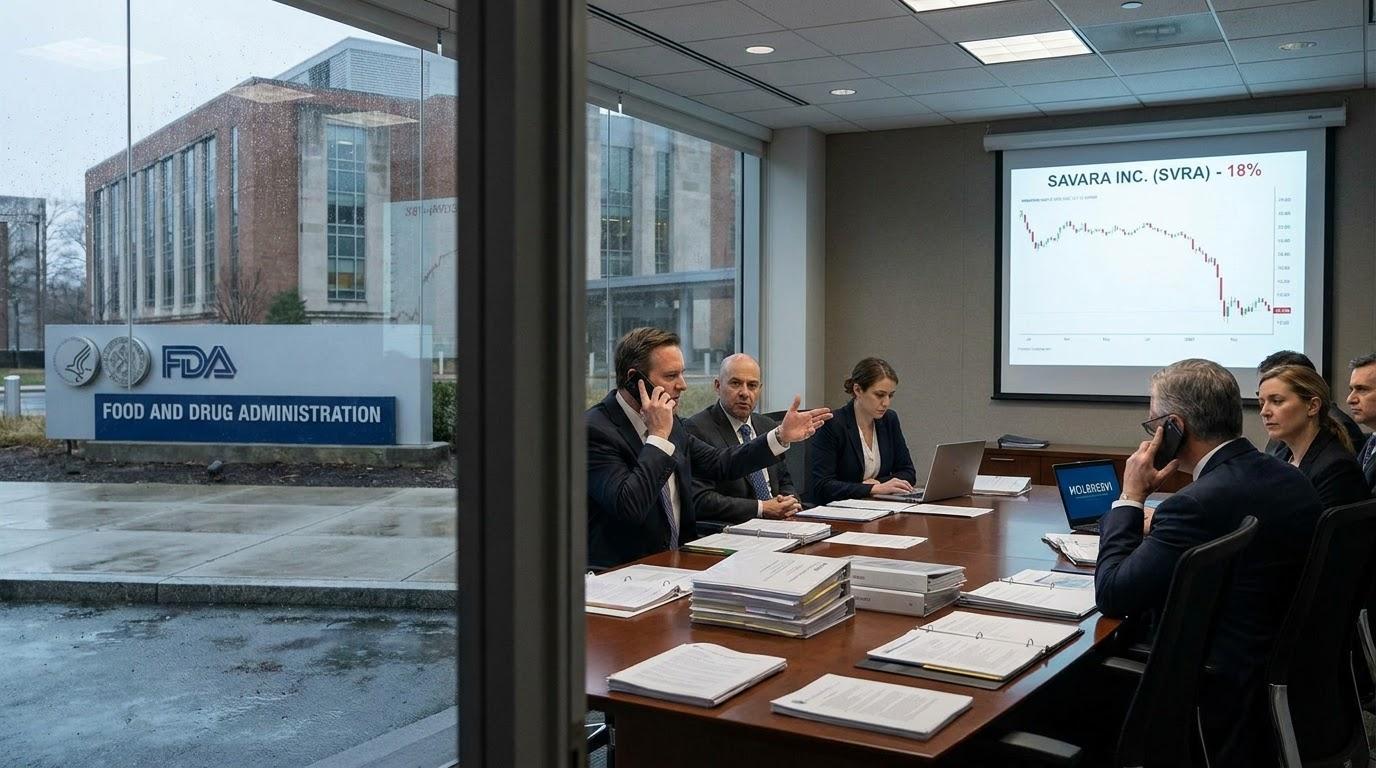
Savara said the FDA has told the company it will not meet the expected Nov. 22 decision date for molgramostim, which the company may market as Molbreevi, in autoimmune pulmonary alveolar proteinosis. The agency did not assign a revised PDUFA date, turning what had already been a delayed review into a more open-ended one.
The lack of a new deadline drove an immediate market reaction. Savara’s stock fell 18% at market open on Friday to $4.26 per share, reflecting not a disclosed rejection but uncertainty over why the FDA needs more time and when the review will conclude.
The Regulatory Delay
This is the second delay in the review. In April, the FDA extended the biologics license application review by three months after treating Savara’s responses to agency information requests as a major amendment. BioSpace reported that Savara said at that time the delay was not related to safety, efficacy or manufacturing issues.
That earlier clarification matters now because it narrows, but does not eliminate, the range of explanations investors may consider. Jefferies wrote Friday that because the FDA postponed its decision rather than issuing a complete response letter, the move may point to potential FDA bandwidth issues and could still bridge to a U.S. launch in early 2027. The firm also noted that missed PDUFAs are rare and that the agency has had 11 months to review Savara’s package.
Jefferies said the absence of a revised PDUFA date leaves room for stock volatility. The firm also raised the possibility of manufacturing issues, citing the fact that the FDA had refused to review a 2025 Molbreevi application because of chemistry, manufacturing and controls concerns. But BioSpace reported that Savara resolved those deficiencies before the current review cycle.
The Clinical And Commercial Stakes
Molgramostim is an inhaled therapy for autoimmune pulmonary alveolar proteinosis, a rare lung disease that can lead to serious complications including lung fibrosis. If approved, it would become the first FDA-approved treatment for the condition.
Jefferies said it still has high confidence in approval, pointing to what it called compelling Phase 3 data and long-term durability in an open-label extension. In the 48-week IMPALA-2 trial, Molbreevi significantly improved a measure of pulmonary function at 24 weeks compared with placebo, meeting the main endpoint.
The program also carries FDA fast track, breakthrough therapy and orphan drug designations. Guggenheim likewise said Friday that it continues to believe the clinical data is sufficient for approval and that the company has taken the proper steps to address remaining manufacturing questions.
For Savara, the regulatory overhang is about timing as much as approvability. Jefferies estimates Molbreevi could become the standard of care in the disease if approved and models conservative peak sales of more than $500 million. With no new FDA deadline, the company is left in a holding pattern where the asset’s commercial opportunity remains intact in analyst models, but the path to launch is less predictable than it appeared even after the April extension.