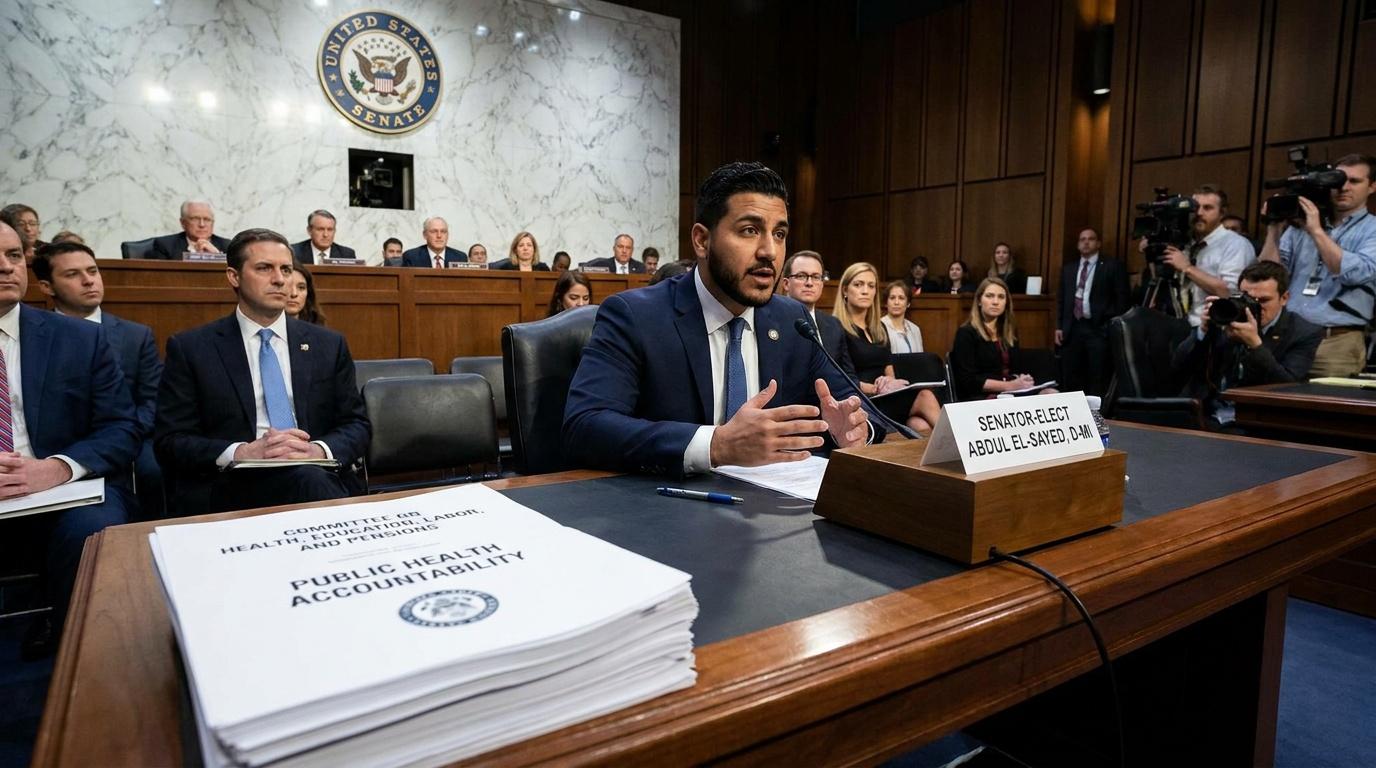
More than 5,000 Americans have been sickened by measles this year, the United States is expected to lose its formal measles elimination status by the end of the month, dengue fever is spreading in Florida, respiratory virus season is underway, and the country recently weathered a foodborne illness outbreak that sickened more than 20,000. Against that backdrop, Senator-elect Abdul El-Sayed told STAT that the erosion of trust in science and public health has had "disastrous consequences," while arguing that the response has to be political, institutional, and economic at the same time.
In the interview, the Michigan Democrat said he remains hopeful that the United States can repair that trust deficit. But he directed frustration at Health and Human Services Secretary Robert F. Kennedy Jr., at drug and insurance companies, and at the field of public health itself, framing the problem not as a messaging issue alone but as a failure to confront power and deliver visible public benefit.
What El-Sayed Says Needs To Change
El-Sayed laid out a three-part view of how trust could be rebuilt from Washington. First, he said policymakers should "start taking on greed," pointing to his support for "Medicare for All" as a way to remove what he described as the greed of the insurance industry, the pharmaceutical industry, and hospital corporations from the path between scientific progress and patients.
Second, he said public officials need to "show the grifters for who they are," arguing that some figures have used scientific language they do not understand to mislead the public while profiting from that distrust. Third, he called for a reinvigorated public-health movement willing to confront large corporations directly, saying the field needs to be prepared to "pick a righteous fight in service of the public health."
That mix of anti-corporate rhetoric and institutional repair is the clearest signal in the interview. El-Sayed is not presenting trust in science as something that can be restored through education campaigns alone. He is tying credibility to whether government can show that it is willing to challenge concentrated economic interests and produce tangible improvements in affordability, safety, and oversight.
His Approach To RFK Jr.
Although El-Sayed said he is eager to investigate Kennedy, he also argued that the mistake would be to center inquiries on the most polarizing subjects. Instead, he said he wants to know why Kennedy "DOGE’d away or he allowed the DOGE’ing away of the CDC and the FDA" in ways that left the country "eating crap lettuce," and why he has not led on pesticides or food additives despite earlier promises to confront corporations.
He also said voters who supported Kennedy should judge him on whether he actually challenged those interests. El-Sayed’s argument was direct: Kennedy said he would stand up to corporations, and "he hasn’t," while El-Sayed said his own record shows he has taken on entrenched interests, including facing unusually heavy spending against him in a primary election.
At the same time, El-Sayed said the broader objective is not punishment for its own sake. He said the priority is to build a CDC, FDA, and NIH that are "worthy of the people that they serve," and that any investigation should be about correcting problems and addressing flaws rather than seeking retribution. If people knowingly broke something, he said, they should be held accountable, but he repeatedly shifted the emphasis away from personality-driven conflict and toward institutional function.
Where He Sees Room To Work
El-Sayed did not rule out working with Kennedy and his team. He said that if Kennedy "actually wants to show up and start doing the things he said he was going to do on pollutants, on additives," then cooperation is possible.
For policy and market participants, that leaves a narrow but important opening. The interview suggests that future pressure from El-Sayed is likely to focus less on symbolic fights and more on whether officials act against corporate practices tied to food safety, environmental exposures, and healthcare affordability. That matters because it points to a style of health-policy oversight aimed at operational failures and economic incentives rather than only ideological positioning.