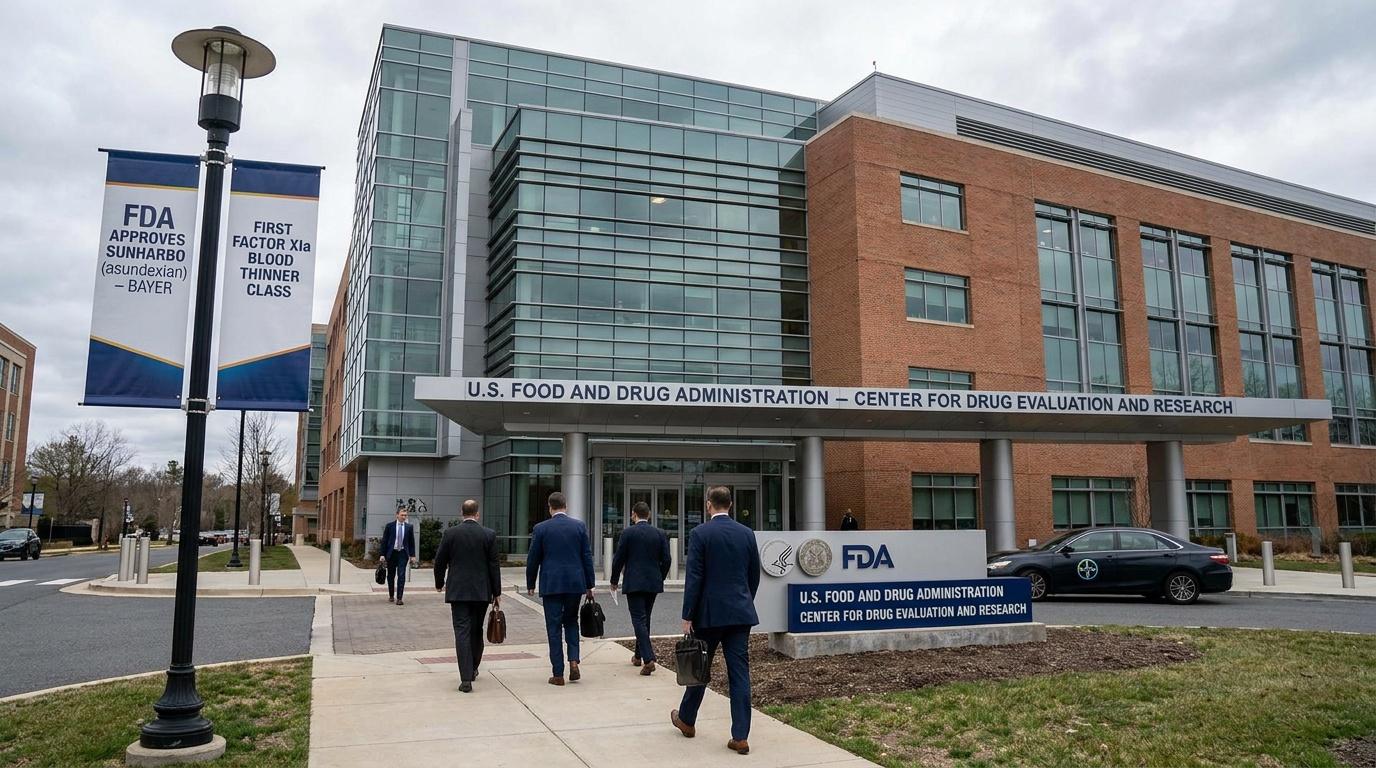
Bayer has won FDA approval for asundexian, which will be sold as Sunharbo, to reduce the risk of stroke in adults after recent non-cardioembolic ischemic stroke or high-risk transient ischemic attack when used with anti-platelet therapy. The oral, once-daily drug is the first factor XIa inhibitor to reach the market.
That makes the decision larger than a single product approval. Sunharbo now becomes the first commercial test of whether blocking factor XIa can deliver antithrombotic benefit while avoiding the bleeding tradeoffs that have shaped use of older blood thinners.
The data
The approval was based on the Phase 3 OCEANIC-STROKE trial. In that study, 50 mg of Sunharbo taken daily reduced the risk of ischemic stroke by 26% versus placebo over a median of 14.2 months.
BioSpace reported that bleeding was elevated in certain scenarios, but Sunharbo was not associated with an increase in overall major bleeding. BMO analysts said the trial offered “the strongest evidence that Factor XIa inhibition can deliver clinically meaningful antithrombotic benefits with a favorable bleeding profile.”
Sunharbo works by blocking factor XIa, a liver-produced protein involved in blood clotting. That distinguishes it from currently approved blood thinners such as Bristol Myers Squibb and Pfizer’s Eliquis and Johnson and Johnson and Bayer’s Xarelto, which inhibit Factor Xa instead.
The commercial picture
A month supply of Sunharbo reportedly costs $748.5, or about $9,100 a year, according to a note from BMO analysts cited by BioSpace. Bayer recently also secured approval in China and said the drug is under regulatory review in several other regions.
The strategic value extends beyond Bayer’s own launch. BMO wrote that Sunharbo’s approval derisks the regulatory path for other factor XIa inhibitors, especially milvexian from Bristol Myers Squibb and Johnson and Johnson. For those companies, the Bayer decision provides clinical and regulatory validation for the target in secondary stroke prevention before milvexian’s late-stage data in the indication are due before the year ends.
The road here
Sunharbo reached approval with FDA fast track status and a priority review granted in May. But Bayer’s broader factor XIa story remains mixed.
In 2023, Bayer stopped its Phase 3 OCEANIC-AF trial of asundexian against Eliquis in patients with atrial fibrillation who were at risk for stroke because of lack of efficacy. BioSpace said BMO remains more cautious about the mechanism’s potential in atrial fibrillation, where milvexian data are expected in 2027.
The result is a more defined commercial and development map for the class: factor XIa inhibition now has a first approved use in secondary stroke prevention, but not yet proof that the mechanism can displace established anticoagulants in atrial fibrillation.