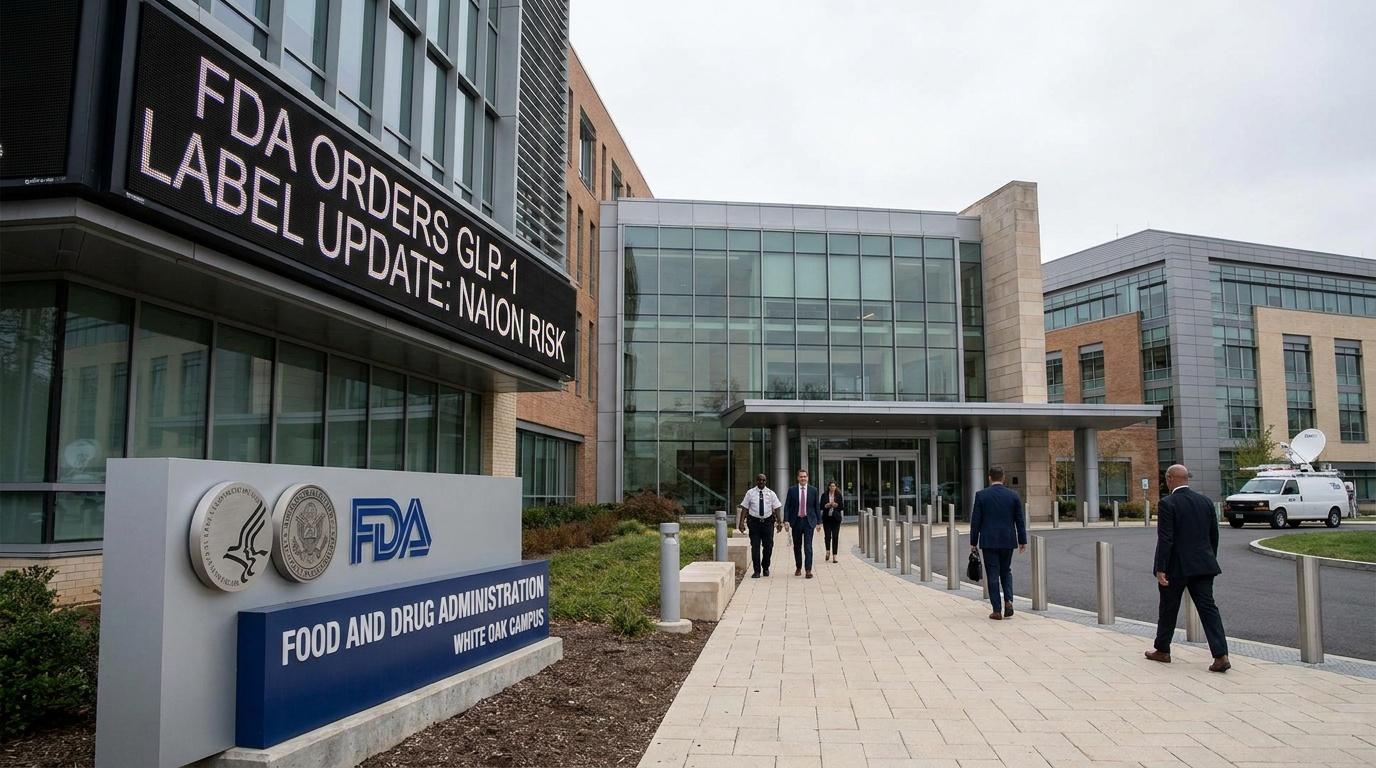
The FDA is requiring all approved GLP-1 receptor agonists to update their labeling to include a potential increased risk of non-arteritic anterior ischemic optic neuropathy, or NAION, a rare eye condition that causes optic nerve swelling and can lead to blindness, often in one eye. The agency said cases of NAION have been reported for all currently marketed GLP-1s and concluded that the class is associated with a potentially higher risk of developing the condition.
The order applies to 12 approved drugs. BioSpace specifically named Novo’s semaglutide products Wegovy and Ozempic, along with Eli Lilly’s tirzepatide products Zepbound and Mounjaro and the oral GLP-1 Foundayo. The regulatory significance is that the FDA chose a class-wide warnings update rather than product-specific action, signaling concern broad enough to standardize disclosure across the category.
The Evidence Behind The Update
The FDA said the decision followed an assessment launched after a 2024 study in JAMA Ophthalmology found an association between semaglutide and higher risk of NAION. In its own meta-analysis of 126 clinical trials across development programs, the agency reviewed 78,217 patients who received a GLP-1 receptor agonist.
That analysis identified 15 probable NAION events: 10 in patients treated with GLP-1 receptor agonists, five in patients receiving placebo and none in patients who received other non-GLP-1 receptor agonist glucose-lowering medication. The FDA said this translated to a NAION incidence rate of 6.4 events per 100,000 patient-years for patients treated with GLP-1s, compared with 3.8 events per 100,000 patient-years for comparators.
The agency also ran a retrospective study through its real-world evidence data network in adults with type 2 diabetes taking medication. That study found no higher risk for NAION associated with GLP-1s versus SGLT-2 inhibitors such as Jardiance, but it did find increased risk when GLP-1s were compared with DPP-4 inhibitors such as Januvia. The FDA additionally reviewed adverse event reports, while cautioning that those reports were difficult to interpret because NAION risk factors often overlap with conditions common in patients treated with GLP-1s. An FDA animal-data review did not identify a mechanism for how GLP-1s could raise the potential risk.
What The Action Means For The Market
BMO analysts wrote that they see limited risk to obesity coverage, specifically for Novo and Lilly, given the rarity of incidence. They also said the FDA’s move formalizes a previously recognized NAION safety signal, with low absolute event rates and a Warnings and Precautions update rather than a restriction on approved indications.
That distinction matters because GLP-1s have become some of the industry’s top-selling medicines. BioSpace reported that Lilly’s Mounjaro and Zepbound generated a combined $36.51 billion in 2025, while Novo’s semaglutide franchise of Ozempic, Wegovy and Rybelsus brought in $36.19 billion in the same year. For companies in the class, the immediate burden is likely to be label harmonization and physician communication, not a change in the commercial addressable market.