Kratom and supplements made from it have drawn increasing attention from public health leaders over the last few years, but public familiarity remains low even as newer, stronger products spread across smoke shop and gas station shelves.
STAT reported that new survey data from the Annenberg Public Policy Center show about two-thirds, or 66%, of Americans have never heard of kratom. Among people with at least some familiarity, few understood the difference between traditional leaf-based products and newer semi-synthetic derivatives. That gap matters because the market is moving toward more concentrated compounds at the same time policymakers are debating how to limit them.
The products and the risks
Kratom comes from an evergreen tree indigenous to Southeast Asian countries including Thailand, Malaysia, and Indonesia. For centuries, people there have chewed the leaf or brewed it into tea for stimulant-like effects. The source says kratom contains dozens of alkaloids, with mitragynine the most abundant and best understood. It acts as a partial agonist that binds to mu-opioid receptors in the nervous system, producing less of a response than full agonists such as fentanyl or oxycodone.
The first U.S. products were made by drying and grinding the leaves into a powder used as tea or taken in capsules. In low quantities, the source says, kratom can act as a mild stimulant similar to coffee. In higher doses, some people have used it for chronic pain or to ease opioid withdrawal, though STAT noted there are no evidence-based dose recommendations and substantial variation in potency and personal preference.
Research remains limited. STAT reported that up to around 38% of kratom users may develop use disorders. In studies, withdrawal has appeared mild on a scale that measures clinical opioid withdrawal, with symptoms including anxiety, fatigue, gastrointestinal issues, and restlessness.
Why 7-OH is changing the policy debate
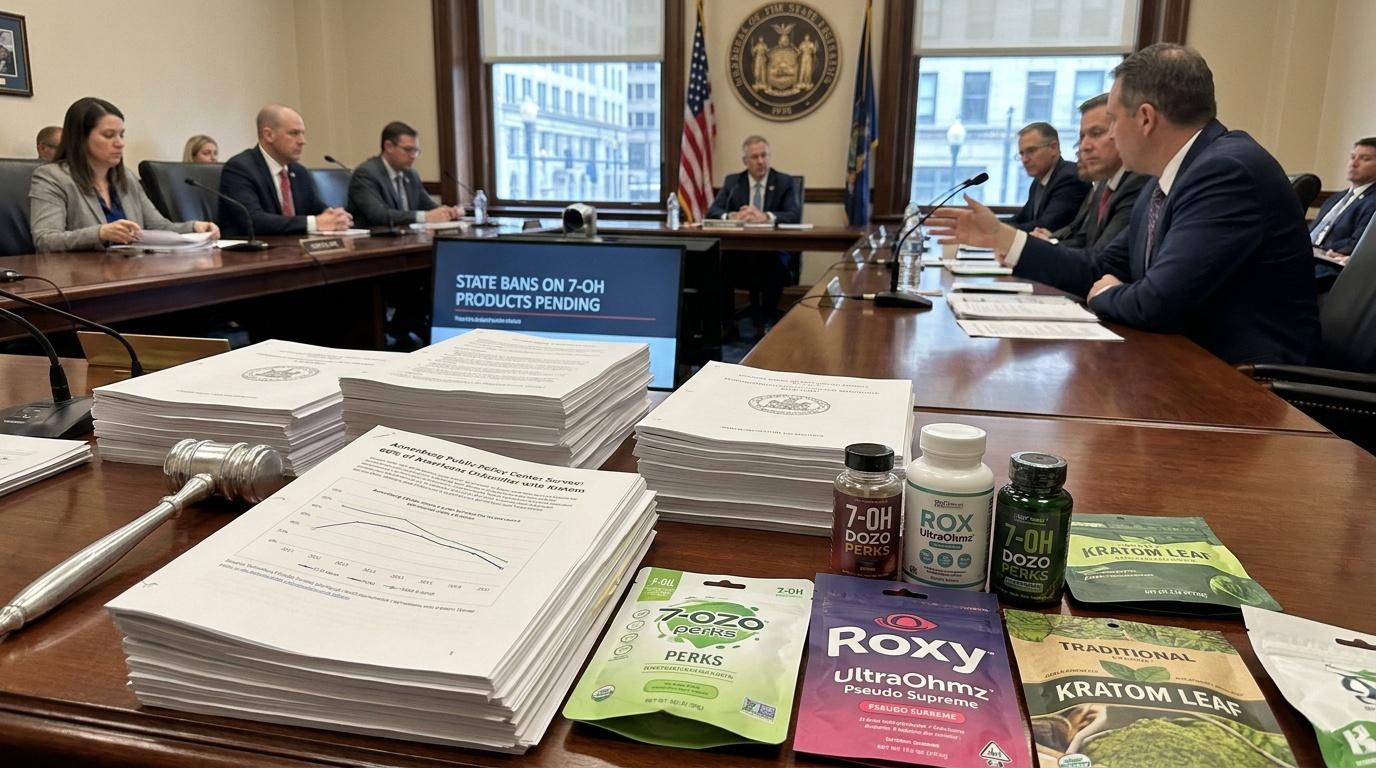
The current policy focus is increasingly on 7-hydroxymitragynine, or 7-OH, and related products such as mitragynine pseudoindoxyl, or MGPI, and dihydro-7-hydroxy mitragynine, or MGM-15. These products may be sold under names such as Dozo Perks, Roxy, and UltraOhmz Pseudo Supreme.
According to Katherine Hill, an epidemiologist at the Yale School of Public Health who has studied kratom, 7-OH does not appear in the fresh kratom leaf chewed in Southeast Asia. It appears in dried leaf powder in small amounts and is also a metabolite formed when the body absorbs mitragynine. The products made with 7-OH are semi-synthetic and contain artificially concentrated amounts of the compound.
STAT reported that when these products first appeared, they were often sold in tablets containing 12-14 milligrams. Users said those doses can offer sedative effects and pain relief. The source also says newer tablets contain 25, 50, and even 100 milligrams, illustrating a potency shift that helps explain the more urgent public health response.
Health officials have warned that concentrated compounds like 7-OH are an emerging public health threat, and federal policies to limit their availability are pending. In the meantime, multiple states and smaller localities have issued emergency bans on 7-OH and, in some cases, on all kratom products. STAT also reported that there are currently no federal proposals aimed at regulating concentrated mitragynine products.
The signal
The central signal is that policy is no longer dealing with a single plant product. It is dealing with a fast-segmenting retail category in which traditional leaf powder, concentrated mitragynine extracts, and semi-synthetic 7-OH products carry different risk profiles but can be sold into the same consumer channels.
That makes regulation harder and consumer confusion more consequential. In the Annenberg survey of nearly 2,000 people, 66% were unsure whether kratom products posed a serious public safety hazard. As long as consumer awareness trails product innovation, the market is likely to keep outpacing any clean regulatory framework.